


China Hits U.S., Europe With New Rare Earths Export Controls
Meanwhile, the U.S. just experienced a 5-week funding surge to support the nation’s critical mineral supply chain.
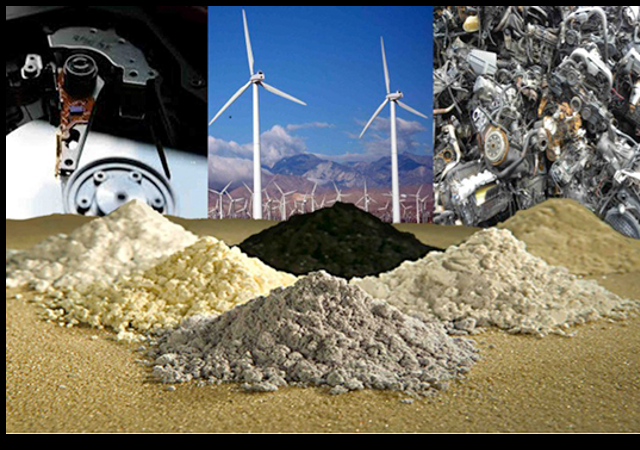
Early this year, the Trump administration unveiled a new minerals stockpile initiative called “Project Vault,” which prioritizes the development of mines and processing operations for more than 50 minerals deemed critical.
This move comes on top of Trump’s pursuit of new alliances to challenge China’s control over these essential resources. Additionally, the administration has been expediting mine openings, supporting new smelting operations, and exploring deep-sea options for these resources.
These developments are likely not making Chinese officials happy. Subsequently, it should not come as a surprise that China has now imposed new export controls on rare earths bound for this country.
China added MP Materials (MP.N) and USA Rare Earth (USAR.O) as well as eight other U.S. entities it said are linked to the U.S. military to its export control list in retaliation for Washington placing several Chinese companies under restrictions this month.
Aveox, a motor manufacturer for mission-critical applications, was also among those placed on the list, which halts Chinese dual-use exports to the companies.
Pentagon-backed MP Materials, which operates the only active rare earth mine in the U.S., and USA Rare Earth are both involved in the mine-to-magnet supply chain.
USA Rare Earth said it did not have any comment on the matter. MP Materials and Aveox were not available for comment outside of business hours.
At this point, U.S. AI policy toward China has become a motivational speaker with sanctions.
Every ban says:
build it yourself.Every blacklist says:
replace us faster.Every export control says:
never trust our supply chain again.Now DeepSeek is developing its own AI chip.… pic.twitter.com/mU52DhRt2u
— 𝘊𝘰𝘳𝘳𝘪𝘯𝘦 (@OopsGuess) July 7, 2026
Europe was also hit with export controls.
China’s Ministry of Commerce announced that it had banned any further shipment to 14 companies in the European Union of “dual-use” materials or products — items that China describes as potentially having both military and civilian applications. As a result, the companies may struggle to buy many of the critical minerals they need to make products like rare-earth magnets and semiconductors, which are essential for cars, offshore wind turbines, robots, drones and other advanced manufacturing applications.
Over the past 16 months, China has used its dominance over the mining and processing of rare earths as leverage in economic disputes with trading partners.
In a statement on Friday, the Commerce Ministry noted that it had acted one day after the European Union imposed sanctions on 14 companies in mainland China and Hong Kong in connection with Russia’s war effort in Ukraine. The European Union said these companies, along with 24 Russian companies and 10 firms elsewhere, were “entities that are part of or support Russia’s military-industrial complex or enable the circumvention of E.U. sanctions.”
Many of the European companies targeted by China play a crucial role in turning rare-earth metals and other critical minerals, like antimony and tungsten, into alloys and specialty chemicals that manufacturers need.
🚨 🇨🇳🇪🇺 CHINA HITS 14 EU ENTITIES WITH AN IMMEDIATE DUAL-USE EXPORT BAN
Reuters reports Beijing added 14 European entities, including Rheinmetall and Vigo Photonics, to its export-control list after the EU sanctioned Chinese firms over support for Russia. Chinese dual-use goods… pic.twitter.com/t4d2AzIXn5
— Naeem Aslam (@NaeemAslam23) July 24, 2026
Meanwhile, from June 2 to June 26, 2026, the U.S. government committed about $2.9 billion in direct funding to build a rare earth metals and permanent magnet supply chain outside China, with the largest portion coming from the Commerce Department’s CHIPS Act rather than the Pentagon.
Over the same five weeks, companies receiving that support layered on a further $1.4 billion of their own capital into the same buildout, the Department of Defense opened its own military installations to critical minerals processors for the first time, and Washington expanded an international alliance aimed at securing supply chains for the technologies that depend on these materials.
The pace and concentration of the announcements, all disclosed within a single month, point to a deliberate acceleration rather than a series of unconnected decisions. What follows maps that funding wave deal by deal, the infrastructure moves that accompanied it and the international dimension that widened it beyond the US alone.
The largest single commitment came on June 2, when USA Rare Earth announced a $1.2 billion investment in a new magnet manufacturing and refined metals facility in Cherokee County, South Carolina. The facility is intended to produce 6,400 tonnes per year of neodymium-iron-boron (NdFeB) magnets and 5,000 tonnes per year of strip-cast metal and alloy, which the company said would form “the magnet manufacturing centerpiece” of its mine-to-magnet value chain. The same announcement included up to €175 million ($204 million) in additional investment pledged to the company’s French subsidiary, Less Common Metals, and its stake in French recycler Carester.
The following day, USA Rare Earth signed a separate agreement with the US Department of Commerce worth up to $1.6 billion in CHIPS Act funding, comprising $277 million in direct federal funding and $1.3 billion in senior secured loan capacity. The funding is earmarked for the company’s integrated heavy rare earth mining, metal and magnet value chain, including production at its Round Top, Texas deposit, targeted for 2028.
In a nutshell, the strategic decoupling from China continues as the administration works to shorten and strengthen the supply chain for these important minerals.
China’s export controls only underscore how urgent it is to rebuild industrial capacity at home and with reliable allies.
Hopefully, the latest spate of export controls from China won’t have the impact the Chinese officials are hoping for.
Donations tax deductible
to the full extent allowed by law.






Comments
They didn’t need to prove Trump right. He was right.
How many US politicians bonus checks from the PRC are threatened?
‘America First’ includes becoming as independent of foreign regimes as possible, not just energy extraction and rare earth mining but basic manufacturing like steel/aluminum, shipbuilding, pharmaceutical production, medical supplies, everything involved in ‘keeping the lights on’ for a first world economy/Nation. I really don’t understand why anyone would oppose this …unless they want the USA to be vulnerable to foreign shenanigans. The more we get back to embracing Washington’s dictum to ‘avoid foreign entanglements’ the more secure the USA becomes b/c we’re no longer/far less dependent upon other Nations.
Without the west as a customer, who else fo the Chicomm’s sell to besides themselves? I dont see an upside for them with this action so long as we develop other supply chains.
In the short term this is try and prevent us from rebuilding our missile defense stockpiles. As well as cruise missiles and smart bombs.
Yep. The problem is short to intermediate in supply disruption. That’s why its critical to get our own resources of most of the rare earth deposits out of the ground. There’s some we don’t have. Unfortunately the supply of those and others is in the control of unsavory folks and gaining access is gonna require real politic not sophistry about ‘morality, good v evil’ b/c the alternative to access is lack of supply which means the USA will not have the tools necessary to ‘do good’ no matter how committed to that we may be. Nations don’t have permanent allies they have permanent interests and IMO Russia is a better bet to acquire this stuff than China. Distasteful? Maybe but beggars can’t be choosers and since we don’t have some of these we are in a sense beggars.
So when they saw the threat they carefully kept hung over our head was about to become useless, they employed it. Hopefully too weak and too late.
These minerals aren’t rare. What they are is messy to extract hence why these industries have been moved to China because they aren’t actually that bothered by the extraction processes or worried about the impact on the environment.
Same thing for petrol and diesel processing. We are in the situation we are in today because our Governments have exported our energy security to parts of the world that aren’t known for their stability because we are more focused on the impact fossil fuel extraction as in our environment instead of producing our own cheap and secure energy sources that actually work (ie dinosaur juice).
Tear down all those useless wind turbines and reprocess all the rare earths and magnets used to build them. Should be enough to keep us going until all the mines/processing facilities are on line.