


Arizona’s Hermosa Mine Clears Final Federal Hurdle Under FAST-41
Region is home to one of the world’s largest undeveloped zinc resources.
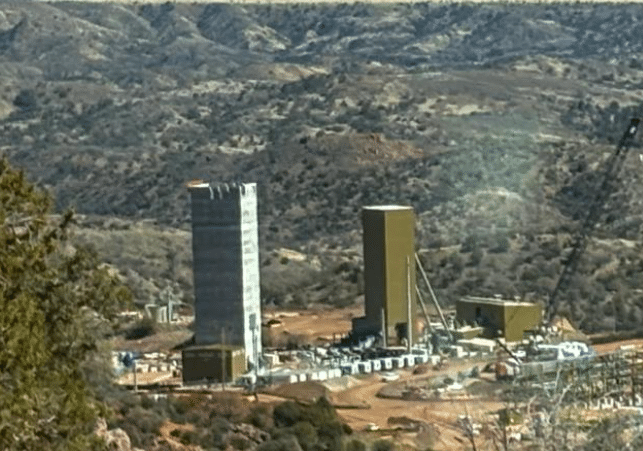
President Donald Trump’s drive to restore American energy dominance and economic strength is increasingly turning on one crucial ingredient: secure, domestic supplies of critical minerals.
The Hermosa Critical Minerals Project in Arizona’s Patagonia Mountains stands at the center of that effort, promising U.S.-based production of zinc and manganese essential for grid reliability, advanced manufacturing, and next‑generation technologies. The U.S. Forest Service approved a final record of decision on Tuesday for the South32 Hermosa project, removing one of the few remaining hurdles for the planned critical-minerals mine.
The Forest Service issued the final record of decision for the Hermosa project on Tuesday, concluding the environmental review process required for infrastructure development on public land.
“The Hermosa Critical Minerals Project shows how increasing domestic production can reduce our dependence on vulnerable foreign sources, and power modern industries, advanced technologies, and essential infrastructure,” U.S. Agriculture Secretary Brooke Rollins said.
While the project is primarily located on private land, planned infrastructure–including an access road, a mine-waste facility and a portion of a power line–crosses into the Coronado National Forest.
President Trump has launched an all-of-government mandate to strengthen and secure America’s critical mineral supply chains — and @USDA is doing just that.@ForestService just issued the final Record of Decision for the Hermosa Critical Minerals Project in Arizona. This will…
— Secretary Brooke Rollins (@SecRollins) July 8, 2026
The approval was expedited by the Trump administration‘s use of FAST-41, which originated as a permitting improvement program created by Congress in 2015 under Title 41 of the Fixing America’s Surface Transportation (FAST) Act. The rules streamline federal environmental reviews and authorizations for complex infrastructure projects.
Once all elements are in place, the project is expected to create thousands of jobs in the region.
The decision, completed in record time as a FAST 41project, supports President Trump’s goal of increasing mineral independence and bolstering the nation’s energy and economic resilience.
South32 Hermosa Inc., an Australia-based mining and metals company, is proposing a $2.16 billion mining and processing operation in a historic mining district in Santa Cruz County, Arizona, near the U.S.–Mexico border. The project is expected to create up to 900 direct jobs and thousands more through indirect economic activity, with a goal of hiring 80 percent of its workforce locally.
…The Hermosa project represents a major economic and strategic opportunity for the United States. As home to one of the world’s largest undeveloped zinc resources—and minerals essential for steel production and large‑capacity batteries—it is a critical investment in the nation’s energy and manufacturing future.
At a time when the United States remains heavily dependent on mineral imports that are vulnerable to long‑term disruptions, the Hermosa Project strengthens national security, supports economic stability, and improves supply chain resilience.
The Hermosa Project was the first to be assisted by the FAST-41 process and impacts the potential route for the development of over 50 other mines.
The final record of decision also represents an important milestone in the broader national conversation around domestic critical mineral development and permitting reform.
Hermosa’s advancement under FAST-41 did not reduce the robustness of environmental review or limit public input. Rather, the process helped improve interagency coordination, transparency and accountability across federal agencies while ensuring the project moved through permitting in a timely and disciplined manner, Risner states.
…Hermosa marked the first project covered by FAST-41 and helped lay the groundwork for the 57 additional mining projects that have followed during the Trump administration.
South32 ultimately committed to more than 135 conservation, mitigation and monitoring measures, which were developed together with federal agencies, Tribes and other local stakeholders.
Investment to get this mine going will be robust, and other key minerals for industry (e.g., silver and lead) will also be extracted.
Australian company South32 acquired the Hermosa project in 2013 when it bought Arizona Minerals, and has pushed to develop what company officials call a “modern, state-of-the-art” mine that will extract high-grade zinc-lead-silver and “battery-grade” manganese, central to building high-capacity batteries for electric cars. South32 said it would invest billions to develop the mine, including funding to build key infrastructure projects, including water management systems, power, site facilities, underground shaft sinking, and other work.
In late April, the company said costs to develop the mine surged more than 50 percent from a $2.2 billion estimate in 2024 to $3.3 billion, and production was pushed to the second half of the fiscal 2028, Mining reported.
The Hermosa Mine will also extract silver and lead “essential for harnessing renewable energy,” the company said. Unlike the pit mines expected for copper mining like the long-controversial Rosemont or Copper World projects, the mine will sink two shafts and use remote-controlled vehicles to extract the minerals.
The mine will occupy around 750 acres, and South32 has said the mine will use advanced technology to minimize air pollution and use 90 percent less water than other mines.
The Hermosa Project seems to be the first real-world test of whether Washington can finally balance national security priorities with some form of sensible environmental policy, all without the usual bureaucratic paralysis.
If this model holds, it not only unlocks Arizona’s mineral wealth but signals that the U.S. is serious about breaking its dangerous dependence on foreign supply chains. And that development is pure gold.
Donations tax deductible
to the full extent allowed by law.





Comments
I know we need the metals, but at what cost to the environment and the last open wild spaces
And a foreign mining company at that
What children and the leftists refuse to accept is that there will always be trade-offs in life. Adults make risk/reward calculations and base subsequent actions on that.
And when the very bureaucracy supposedly in charge of “protecting” the environment pulls stupid shit like the Animas River debacle, perhaps it’s time to re-examine all our assumptions about resource extraction and who is in charge of making those decisions.
Not much at all. It’s mostly private land close to the border. Not scenic national park land. 750 acres or just over one square mile (out of the 520,000 square miles in the below five states)
I voted for this – mining in America, not sending checks to China for key metals and minerals, and stop letting the Democrats tie up our land and resources in red tape and sabotaging our economy.
Hust for the record, here is how much land the federal government owns in these western states:
Arizona: about 38–42% of land
New Mexico: about 32–35%
Utah: about 64%
Nevada: about 80%
Wyoming: about 48%
(Yeah it’s a foreign mining company because Democrats have destroyed the mining industry domestically unlike Australia but better than buying minerals from China. The jobs are local at least and can’t be outsourced to China.)
“ the last open wild spaces”
How big do you think the country is?
If we are ever militarily defeated, or even just taken over, by a foreign country such as China or Russia, “the cost to the environment and the last open wild spaces” will be among the least of our concerns.
.
For the future of our security, keep Democrats out of power.