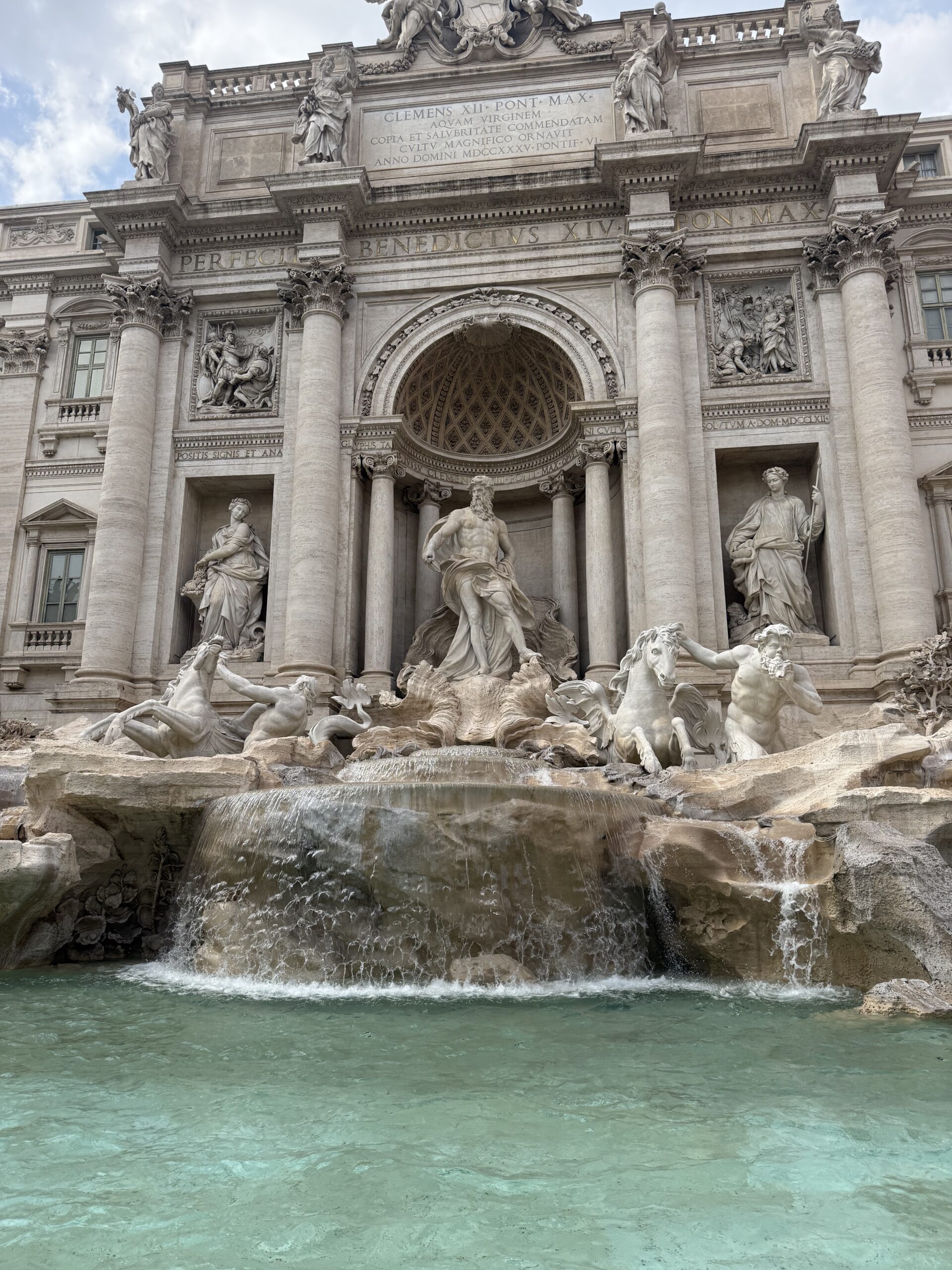
On Tuesday, we ventured out to the touristy part of Rome to check out the Trevi Fountain.
(I chose an Airbnb off to the side of the Vatican … it’s quiet and a real Italian neighborhood!)
The Trevi Fountain is magnificent in person. You just stand there in silence, ignoring the huge crowd because you’re in the presence of one of history’s great achievements.
The monumental fountain (meaning it’s the end of a Roman aqueduct), formed out of Travertine marble (actually more of a porous stone than marble), just hits you hard.
Believe it or not, the fountain sits in a small square, surrounded by narrow roads. It’s congested, a pickpocket’s dream, and filled with people dying to have a photoshoot.
But it’s worth it.
The Trevi Fountain isn’t that old. In 1629, Pope Urban VIII wanted something glamorous to look at outside of the Quirinal Palace instead of a lead pipe.
That’s right. Popes lived in the Quirinal Palace from 1589 to 1870.
1870 should sound familiar to you because I mentioned it in my post about the Jewish Quarter. The Italian Army conquered Rome for the Kingdom of Italy, eliminating the Papal States.
Now Quirinal Palace serves as the official residence of the Italian president.
The fountain was completed in 1762.
Elyssa Bernard, owner of Romewise.com, has a great explanation for the name:
The name of Trevi probably comes from the Latin tres viae, or tre vie in Italian, which means “three ways.”The fountain stands at the crossroads of 3 streets.There is another possibility to explain the name of the famous fountain – The aqueduct passed through a small town outside of Ancient Rome called Trebium.The Roman goddess Diana, was sometimes called Trivia.She was the protector of roadways, in particular, three-way crossroads.
Oceanus, not Neptune, stands front and center of the fountain, with a half-dome behind him with tall columns. You’ll notice the columns are not attached to the wall.
Oceanus, son of Uranus and Gaea, is the god of all rivers and waters.
You’ll see what appears to be horses, but you actually see hippocamps, which are half horse, half fish.
A Triton (sons of Poseidon) has a grasp on each hippocamp.
The fountain has an angry and calm hippocamp to represent the two moods of water.
Abundance stands to the left of Oceanus and Salubrity (health) is on the right.
Yes, we tossed coins into the fountain! You have to put your back to the fountain and toss the coin over your right shoulder.
Workers gather the coins at the end of the day, which end up going to charity. About 3,000 euros are thrown in every single day!
CLICK HERE FOR FULL VERSION OF THIS STORY