


Supreme Court Strikes Down Hawaii Law Limiting Guns in Businesses Open to Public
“This regime hobbles what the Second Amendment protects: the right of Americans to carry arms for self-defense as they go about their daily lives.”
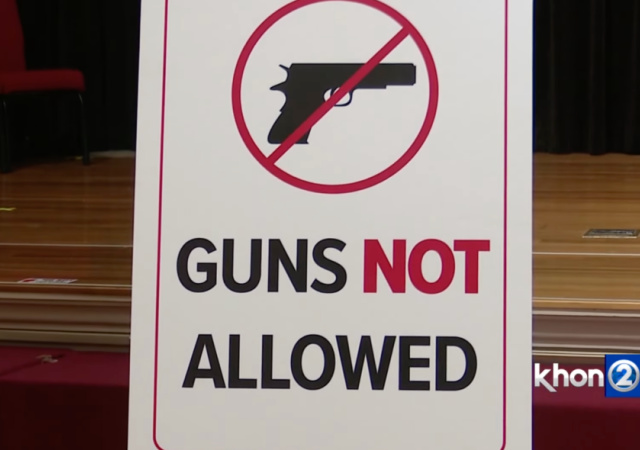
The Second Amendment: “A well-regulated Militia, being necessary to the security of a free State, the right of the people to keep and bear Arms, shall not be infringed.”
It’s so straightforward. Like, how do you misinterpret the meaning of the Second Amendment?
The Supreme Court struck down a law in Hawaii known as the “Vampire Rule,” which required gun permit holders to obtain a business owner’s express permission to carry their guns onto the premises.
“The effect of this new rule is to impose severe restrictions on the daily activities of residents who have satisfied the State’s rigorous requirements for the issuance of a carry permit,” wrote Justice Samuel Alito.
In a 6-3 vote, the majority ruled in Wolford v. Lopez that the law violated the Second and Fourteenth Amendments:
- The restrictions imposed by Hawaii’s challenged law fall within the plain text of the Second Amendment, so the law is presumptively unconstitutional.
- Hawaii’s argument that its “particular customs and laws,” Brief for Respondent 24, support the new default rule fails because the Second Amendment has the same meaning in all parts of the United States.
- The State’s colonial and early state law analogues consist almost entirely of laws that prohibited unauthorized hunting of deer or small game on someone else’s private property.
- An 1893 Oregon law prohibited armed trespass on “enclosed premises,” but it is unclear whether such premises included commercial establishments open to the public. Regardless, a lone statute adopted nearly a century after the adoption of the Second Amendment and well after the adoption of the Fourteenth Amendment sheds little if any light on the meaning of the Second Amendment right.
New York had a similar law, New York State Rifle & Pistol Association, Inc. v. Bruen, which the Supreme Court ruled against.
New York responded with new legislation to prohibit people from carrying guns into “sensitive places.”
Hawaii took the same steps:
However, gun control states piled on with long lists of “sensitive places” to constructively create a broad ban. In Hawaii, the legislature listed 15 categories of property. It also imposed a different “default rule” that said that permit holders are barred unless a property owner expressly allows them, either verbally or in writing, to enter with a weapon.
A federal court in Honolulu issued a preliminary injunction in August 2023, blocking portions of the law. When the state appealed, a Ninth Circuit panel reversed the injunctions as to bars and restaurants serving alcohol as well as beaches, parks and adjacent parking areas. The panel also upheld the default rule.
“When these permit holders leave home in the morning, not only must they take care to avoid all the territory where the possession of a gun is prohibited outright, but they may also be barred from entering many places that people routinely visit in the course of their daily routines, such as gas stations, convenience stores, restaurants, coffee shops, drug stores, grocery stores, ‘big box’ stores, home improvement stores, barber shops or hair salons, dry cleaners, and laundromats,” explained Alito.
I love how Alito doesn’t hold back. The emphasis is mine.
“This regime hobbles what the Second Amendment protects: the right of Americans to carry arms for self-defense as they go about their daily lives,” blasted Alito.
*snort*
Donations tax deductible
to the full extent allowed by law.





Comments
It’s disappointing that three justices voted against the very clear words of the constitution and the very clear intent of those who wrote and argued for its passage.
Citizens get to choose what firearms they wish to own and where they may carry them; the state does not.
This 🐂 💩 will continue until such time as the court strikes down *every* law that touches upon firearms. They are all, by definition, unconstitutional.
And before you start saying things like “Oh, you’re in favor of allowing convicted felons possess guns!” I’ll point out to you that a government that has slipped its leash (like GB, for instance) is *far* more dangerous than a single man with a 9mm.
The overarching theses of the Constitution is to LIMIT the government being therein created.
The only known alternative to limited government is one with unlimited powers. Which is what the left seeks.
Of course they hate the Constitution as written (preferring the ever flexible “living Constitution” dream).
Or as expressed by Hilter’s pal, “Everything in the State, nothing outside the State, nothing against the State.”
“Generally, the Constitution is a charter of negative liberties, says what the states can’t do to you. Says what the federal government can’t do to you. But it doesn’t say what the state or federal government must do on your behalf.”
Barack Obama
Those three dissenting Dhimmi-crat Justices benefit from receiving the security protection of armed U.S. Marshals. Their personal safety and security and their families’ safety and security are ensured by guards carrying weapons that these pukes would deny to aw-abiding American citizens — in true, hypocritically elitist apparatchik fashion.
How would these hypocrites feel if those Marshals’ firearms were confiscated, and they were armed with pepper spray canisters, instead?
As Justice Thomas once eloquently wrote, in his dissent to Peruta v. California: “For those of us who work in marbled halls, guarded constantly by a vigilant and dedicated police force, the guarantees of the Second Amendment might seem antiquated and superfluous.”
You can fairly make the same point about the brazen hypocrisy displayed by the vile and loathsome Obamas, the Bidens and other prominent Dhimmi-crat apparatchiks who’ve undermined the Second Amendment and citizens’ rights to own firearms for protection, throughout the entirety of their corrosive political careers, while personally benefiting from the protection provided by taxpayer-paid, armed security guards.
I am currently re-watching a UK show “The Devils Hour” (absolutely superb show, BTW) and after being severly beaten, one of the detectives obtains a TASER which he keeps in his car, against regulations. I just find it so ironic that we former peasants, who live in America, are able to live with the freedom of being better armed than the typically unarmed UK po po. Our library system, which I noted elsewhere, did hire a security guard with a radio. Gievn the half hour response times by the half dozen police working any shift in Portland these days, I see this as not working out well. Maybe I will go to Home depot and buy a suitable holster for a 23 California Framer that I can strap to side of my geezer cart. At a minimum, that would then require them to post a hammer-free zone sign.
The British prohibition on their average/most common police officer not carrying firearms, is a conceit that’s so profoundly indefensible, stupid and irrational, it defies belief.
This premise seems grounded in British narcissism, as far as I can tell — the Brits’ desire to show how allegedly “civilized” and law-abiding their society is. Instead, it comes across as a callous, naive, emasculated, stupid, narcissistic and dhimmified conceit.
“…prohibition on their average/most common police officer *carrying* firearms,…”
As I understand it the original reason why UK policemen were not allowed to be armed was to allay people’s concerns that they would serve as a domestic army and tyrannise the population. To reassure people, the police were deliberately sent out unarmed, while most people around them were armed. That way they couldn’t impose anything on the public by force. If a policeman had need for a firearm he was expected to borrow one from a bystander.
No, not “all” firearms laws are unconstitutional.
Restricting the civil rights of those convicted of a felony is a principle from long before our 2d Amendment*. It’s a basic premise of protecting the people from those who would harm them.
Banning unsafe things (that is, in their primary method of use they are unsafe to operate given reasonable care) is also a normal restriction recognized as a power of the government.
Preventing people from acting in an unsafe manner (drinking AND driving) is a normal power of government. As would be restricting your rights in places where their exercise might produce unsafe or disruptive conditions (same example, or marching through a neighborhood shouting into your bullhorn at midnight).
(* I would be much happier if the restriction only applied to “while under the judgment of the court” – either in prison or under probation. If you really think the person is so dangerous they can never again legally own a lethal weapon, then they really should be in prison or under lifelong probation of some sort. If you deem them safe enough to let out, then they should be safe enough to live their life as an ordinary citizen.)
“If you really think the person is so dangerous they can never again legally own a lethal weapon, then they really should be in prison or under lifelong probation of some sort. If you deem them safe enough to let out, then they should be safe enough to live their life as an ordinary citizen.”
The logic behind such thinking is faulty. Imprisonment is not the only punishment we apply to crimes. We regularly rescind rights as punishment, and, in particular, the rescission of the right to arms is senseless if it only applies during a convict’s term of imprisonment. We also undoubtedly permanently revoke most rights when we permit life sentences, and we permanently revoke all rights when we allow death sentences. Loss of the right to arms can be applied for life, as the punishments noted above are permanent there is no reason why lesser punishments can’t also be permanent. There is no logical reason to bar the permanent loss of any particular right once a person is convicted of crimes. The threat to the loss of rights (permanent or otherwise) is meant, in part, to be a deterrent. If a person is jealous of his rights and determined to keep them, then he should take care to not commit crimes that would cause their loss, permanent or otherwise.
But even a permanent loss of a right is not necessarily permanent. If the right is dear to the convicted person, he may always apply to have the restriction rescinded. This allows the people (through the auspices of a court) to examine the convict’s post-imprisonment conduct and determine at that time whether or not he is still a threat to society. A sentence that imposes life-long loss of rights encourages good behavior, if the convict wishes to regain his rights.
Your explanation, though, borders (at least) on making the right a privilege.
I would rather the gov’t have to directly impose a penalty through the judicial process than to have the power to strip them just because you’re a previously convicted felon. If you’re serious about restricting rights based on someone’s criminal actions, then impose that penalty the same way you impose imprisonment.
Great outcome. Hopefully local activists in States with similar unconstitutional restrictions will immediately file to overturn them. It is well past time to hold State/Local leaders accountable for their continued efforts to deny 2A rights to the Citizens of their States and hopefully the DoJ will begin looking at the potential for ‘deprivation of rights’ claims/actions to put some serious individual consequences onto these anti liberty scoff laws.
Even Arkansas, which has had an “Ehnhanced” CHCL for a decade now, allows stores to prohibit concealed carry via a sign. Prior to the Enhanced Carry the sign had to have precise wording, and most didn’t, so it was a non-issue. Now pretty much any wording that implies “Guns not allowed” is sufficient. I’m hoping this changes.
Why do you hope it changes?
The current rule allows an owner (operator) of private property to prohibit certain behavior on said property. They should be allowed to control said private property, shouldn’t they? And said current law allows a bearer of arms in their private capacity to carry anywhere, unless the private property tells them otherwise. So, a proper transaction between the private property owner and the bearer of arms that allows the property owner to limit behavior in his castle. And a decent way to do that (so you don’t have to stop every single person and have a conversation with them) is to post a sign.
It places no burden upon the bearer of arms except to respect the private property of others. It places no burden on the owner of private property except to notify their visitors/customers as to the restriction. Same as a No Trespassing sign.
The owner of the private property that is open to the public (such as shops, hospitals, theaters, restaurants, etc.) can’t discriminate against people because they choose to exercise their rights. The state has no authority to discriminate against a citizen because he elects to exercise any particular right, it likewise can’t extend permission to its licensees to do that which it can’t do itself.
Imagine allowing a business to exclude people from entering because they are displaying evidence of their religious faiths, such as wearing crucifixes or yarmulkes. Obviously, discrimination this wouldn’t be allowed. However, when people wearing such displays remove them from their persons in order to enter, they still retain their rights to their preferred religious beliefs – they continue to believe.
Now, consider the citizen who is bearing arms, who must put aside his firearm in order to enter a business otherwise open to the public. This person is actually prevented from exercising a right, and not merely divested from symbols or displays. But this is acceptable?
One of the dissenters in the instant case (I believe it was Jackson) seems to conflate actual “private” property (such as land or a home, or a business not open to the public) with “private” property that is open to the public. Her argument holds when applied to the former, but collapses when it is applied to the latter.
From Marsh v. Alabama: “The State urges in effect that the corporation’s right to control the inhabitants of Chickasaw is coextensive with the right of a homeowner to regulate the conduct of his guests. We can not accept that contention. Ownership does not always mean absolute dominion. The more an owner, for his advantage, opens up his property for use by the public in general, the more do his rights become circumscribed by the statutory and constitutional rights of those who use it.”
I’ll note that above you were advocating for presuming a person convicted of crimes should be allowed his right to arms for having been released from prison, on the principle that if the person is safe enough to let out of prison, it’s also safe to allow him arms. But here you are advocating that anyone bearing arms (even those never convicted of crimes) can be presumed to represent a danger to the public, and that owners of businesses (otherwise open to the public) can prevent them from entering because of this danger (merely inferred by the bearing of arms). A person considered “safe” to bear arms (which would include every non-felon citizen who is mentally competent who has reached the age of majority) can, under some circumstances, be considered a danger, while a convicted person, once released from prison, shouldn’t be so considered? This is inconsistent, at least. Or does the law-abiding citizen bearing arms suddenly become a danger to the public when he enters certain spaces where he has, generally, leave to enter?
This is nonsense. They absolutely can.
The owner is not a licensee of the state, and is certainly not an agent of the state. It’s his property, he is entitled to make whatever rules he likes. If you don’t like it, don’t enter.
The constitution certainly does allow such discrimination. It’s only unlawful because a statute specifically forbids it. A statute could probably likewise forbid owners of public accommodations from banning guns from their property, but no state has made such a law, so it remains lawful.
You forget that even public accommodations are entitled to refuse service to anyone, for any reason whatsoever or none at all, except the reasons specifically prohibited by law.
That is correct. There is no difference between the two.
Marsh v Alabama was a bad decision, but even it only applies to an actual street, which while it’s technically private property functions in all ways as public property. The owners dedicated the street for public use, and invited the public to use it exactly as it uses public streets. That’s very different from a shopping mall or a store, as the court subsequently held in Lloyd v Tanner
GWB wrote no such thing. A property owner has the right to ban guns on his property not because of any danger, but simply because he wants to. Perhaps he is unreasonably afraid of them, but perhaps he simply hates them. His property, his rules.
This person is actually prevented from exercising a right
Because it is still their private property. And your rights don’t extend to that. To say otherwise strips them of their property rights.
It has nothing to do with being a danger – and allowing a business to prevent you from bearing arms in their private space has never been about “being a danger.” The ‘vampire rule’ IS somehow about that, and the Supreme Court just said “No, you can’t do that.”
There I’m gonna disagree. The property owner should decide what goes on within his property. If they clearly mark signage that no firearms are allowed that is totes fine, IMO. It is after all their property so they should be in charge of making decisions about what is/isn’t permitted on their property. It also helpfully informs criminals where the soft targets are located.
The vampire rule is the opposite of that requirement b/c It required affirmative consent. That’s not how property rights generally function. In most every instance to enforce a particular limitation the property owner gotta have signage spelling out what isn’t allowed; no parking, no soliciting, no trespassing, no fishing, no hunting and so on.
The normal rule requires the property owner to communicate to the guest how their behavior must change as they enter said property, basically. “Over there, you have certain assumptions; on this side of the line those assumptions change in this fashion.”
And, even without the signs, the property owner is allowed to communicate those restrictions one-on-one. But the guest is not liable until they are told.
It’s a victory for the Bill of Rights, but recent history suggests that governments in deep blue sh*tholes and #Resistance judges will continue to do as they please.
Yes. It would have been better with a more vigorous statement: “And if you people don’t cut this s**t out, we’re going to have pull the
carnation over and spank you.”The Hawaii Supreme Court expressly stated that the “Aloha Spirit” of the Hawaii state constitution entirely supercedes the US Constitution. When Dems control a state freedom suffers. The Unified Democrat States of the Americas act independently of the USA. UDSA=CSA.
Hawaii should never have been admitted as a state for the principal reason that its traditions were not Christian. This Aloha Spirit foolishness flows from that. Beginning in the 19th Century when many of the open land areas became states, wiser politicians might have worked harder to get Cuba to form itself as a state.
Not being Christian-based explains why Hawaii has since 1959 sent mostly Democrats to Washington. The governor’s office and state legislature have been almost always Democrats.
Hawaii was mostly Republican into the early 1950’s when unionization took place. In part, the elitist Repubs in the state didn’t see that coming. Hawaii is about 10% LGBTQWERTY. It was never a melting pot. Read the “for rent” section of the papers in the early 60’s… “Chinese Only” and “Japanese Only” rental properties.
Watch Hawaii Five-O, too. The original.
Lived on Oahu during the days of the original series. Whenever you saw that red phone booth you knew 5-0 was filming. A friend of ours had an insurance business. 5-0 was filming a scene where a small bomb was to be thrown into an office… turns out that the scene was the business office set up next to our friend’s. When they yelled “action”, the bomb was tossed into our friend’s office and not the set up one next door by mistake. Boom… and all his paperwork was blown out. Quite impressive on film.
-sigh- Gee. Remember when white folks could be selective?
Alaskabob: was he insured?!?
No, it did not. I know it was reported that way on many right-wing sites, including this one, but it was an outright lie. I read the decision; you did not. It simply did not assert that.
The decision was almost entirely about the state constitution and state law. The plaintiff sued under both the state end federal constitutions. The court found that the state constitution, unlike the federal one, doesn’t protect an individual RKBA, and that it requires state laws to be interpreted in the Spirit of Aloha.
On the last page it finally turned to the plaintiff’s federal constitutional claim, and dismissed it because he had never applied for a license. It said had he applied for one and been denied, then it would have to consider whether his rights were violated, but since he never bothered applying there was clearly no violation. This was not a good decision, because at the time this happened it was obvious that there was no point in applying, since all applications were being automatically (and unconstitutionally) denied. But the court said he should still have gone through the motions in order to preserve his rights. That’s wrong, but it’s absolutely not a denial that the federal constitution is the supreme law of the land.
Rumors abound that Hawaii will allow residents from other states to apply for a non-resident CCW.
Hawaii has to allow LEOSA qualified retired LEO to carry in the state with some crazy caveats. Each island is a county. If you carry a firearm and stay more than 5 days on that specific island you have to get a background check and have your firearm registered…..
Hawaii also has a ban on standard capacity magazines. They only allow reduced 10 round magazines.
Hawaii is one of those places I’ve never thought of as a vacation spot. I can get heat and humidity on the Gulf Coadt for far less money, free to carry, and a populace that doesn’t hate me for being white.
I stopped there twice. Once on the way to Guam, and once on the way home.
On the way home, we actually stopped for a couple of days and saw the sights. It was pretty cool, but I knew enough of the racism, politics, and the economy that I really wouldn’t want to stay. (I might have swung a job on Guam as I separated, but that job moved to Hawaii and there was no way I wanted to live there.)
Also, the Gulf Coast doesn’t have volcanoes or tsunamis. You don’t know what you’re missin’, Grizzly. 😉
An uncle was a career Marine. He spent a tour in Hawaii with his family. He hated it.
I’ve known others who served in San Diego. Most hated it. Too sunny. Too much anything becomes boring. Here in the PNW, I miss lightning. When I was stationed on Ft. Knox (in the Ohio River Valley, a superhighway for thunderstorms), a friend and I would stand in a parking lot during thunderstorms. From the lot, we could see three or four water towers and we’d watch as they were struck by lightning repeatedly. Also, out on a tank range one day, four guys were struck by the same bolt of lightning. Not hit by ground current, the lighting passed through three NCOs on the outside deck of a range control tower and then passed through a soldier standing on a tank next to the tower. They suffered only minor injuries.
“Reduced-capacity 10 round”
Better adjective. My inner editor coming out.
Hawaii’s argument positing that its historical “customs” and traditions regarding firearms allegedly override a Constitutional right, represents astounding arrogance and dishonesty.
Aloha spirit is a thing there.. it is part of their laws, for 40 years.
Go figure.
I get that, and, to the extent that that “Aloha Spirit” informs your societal customs, language, hospitality, etc., that’s great. I would say to Hawaiians, when your residents voted to join the Union, and when Congress accepted your request to join, you accepted the supremacy of the U.S. Constitution, over your local, indigenous, “Aloha spirit” and customs. It’s that simple.
No one in Hawaii disputes that the US constitution, and all valid federal laws, are the supreme law of the land, and override the state constitution, including the Spirit of Aloha standard. But the state constitution and laws must still be interpreted in accord with Aloha, and are valid whenever they’re not preempted by the federal ones. The decision we’re discussing was almost entirely about the plaintiff’s claims under state constitution; his federal claim was discussed only briefly on the last page.
It didn’t claim that. It claimed that its customs and traditions shape that right, because that’s more or less what it thinks the supreme court said in Bruen. The thing is, the customs and traditions that Bruen says shape the right are those that prevailed in the nation when the amendment was ratified. It’s not a state-specific determination.
The point is that the amendment says the RKBA may not be infringed, but how do we know what infringes it? The court said that we look at what would have been considered an infringement when the amendment was ratified. If a law was not considered an infringement then, then it’s still not one today; it it was then it still is.
I believe that a store, as private property, can establish rules, including prohibiting guns. I then choose to not shop at said stores as is my right, and said stores also then identify themselves as soft targets. My county has now chosen to designate ALL .gov buildings as gun free zones including the libraries. Feral humans with machetes are still good though, and I have informed a number of the librarians who I am friendly with that at the first sign of trouble, I am now noping out the back door that I am sitting adjacent to, and similarly I am no longer available for medical emergencies. It is important they they understand that there is a cost associated with their wokeness (or the wokeness of their county bosses), and several of them are about one donut shy of a massive coronary.
Speaking of which, six years ago when I was having cardiac issues I had to decline an ambulance ride to the hospital and instead called a friend to drive me, who also took possession of my gat, as they are banned in the hospital.
I then choose to not shop at said stores
Yep. As long as they’re not effectively a monopoly, or a trust formed between multiple stores.
I am old. Old enough to remember seeing “no colored’ signs. I remember asking my mother what that meant. I knew my colors and we called crayons “colors”, but I couldn’t understand how any of that applied.
My mother, no liberal then or ever, snapped: “it means we don’t shop there.”
I still didn’t know what it meant, just that it wasn’t a good subject to ask about.
Why did your mother not shop there? I’m getting the sense she wasn’t prohibited from shopping there herself. Likely, she objected to the principle of barring someone from a place of business for their color, yes?
Yet there are people here who think it’s OK for the same businesses to ban people who have decided to exercise a right that’s meant to be exercised in public. Go figure.
Actually, I do think it’s OK for a business to discriminate in its customers. I do not believe that private property open “to the public” should be required to not control access based on their beliefs – no matter how stupid. They can, after all, make their business private (requiring, say, an appointment) and discriminate in that fashion. The “public accommodation” laws are, IMO, miscarriages of justice against both the 1st (right of association) and 5th (property rights) Amendments.
I also believe that folks who would do that are usually rotten people and I wouldn’t do business with them.
Generally, I would agree with you. But specifically, when it comes to licensees of the state, the license says you play by the state’s rules. The state has no authority to discriminate against persons who are exercising a right meant to be exercised in public, so no licensee that is open to the public and curtail the right. The license is the hook the binds nearly all businesses to the rules set by the state. And the state is limited by the various constitutions such that it can’t discriminate against people for exercising the rights. I believe this is an unsurmountable problem, unless a business shuns licensing. Good luck to them with that.
Before Congress made a law against it, it was lawful for a store to put up such a sign. It was also lawful for people who didn’t approve to refuse to shop there. The same is true with guns. A store is entitled to ban guns, and people who disapprove are entitled to shop elsewhere.
Were these businesses licensed? If licensed, were these bans ever challenged? Here we get to the objection I have to Bruen’s “historicity” test. Something permitted earlier that wasn’t challenged shouldn’t be presumed to have been constitutional. Acts that were challenged, if upheld, weren’t found constitutional, they were found not unconstitutional in the face of the plaintiff’s arguments. This does not mean that the practice couldn’t be found unconstitutional if subject to different arguments. (Notice that I consider the acts of licensed business are what they have either been given leave to do, or are required to do, by the state. Because of state involvement, that makes the “private” business’s actions answerable to our constitutions and laws. “Private” businesses that have spaces open to the public are far from “private” as that term is applied to, say, property owned by an individual citizen, or business property not open to the public.)
Please explain to me how a licensee of the state can be granted license to do something that the state itself can’t do. Because if that’s possible, what would prevent the state from licensing private police and (literally) permitting them to do things no government police department can do?
Additionally, the right to bear arms is a right meant to be exercised in public. If a business is allowed to prevent persons from exercising the right in its public spaces, the right could be extinguished for practical purposes in some cities.
You say that a business has a right to bar firearms from its premises, and that individuals who don’t like it should bring their business elsewhere. But this has the tail wagging the dog. I say we have a right to bear arms in places open to the public and that if business persons don’t like that, they can decide to not set up a business in order to avoid having to permit entry to armed citizens. This latter argument puts the burden of making the decision with the person who is looking to exercise a privilege (extended by the state by way of a business license), rather than putting the burden on the citizen who merely wants to exercise his rights. Businesses would be established by persons ready to recognize and respect the rights of their customers, eliminating the problem. Then people who didn’t like being in the company of people who are bearing arms can go elsewhere. Oh, that’s right – maybe there won’t be an “elsewhere” to which they can go! That’s their problem, because there is no right to not be near persons who may be bearing arms, except on your own (actually) private property.
This is all complete nonsense. A business is NOT an agent of the state. It does NOT operate by the state’s permission. At most a state may, if it so chooses, prohibit operating a business without first obtaining a license, but having jumped through that hoop and obtained that license the owner is operating independently, not as the state’s agent.
Is a licensed driver acting as a state agent every time he drives a car?! For that matter, hunters are licensed; does that mean they’re state agents, bound by the constitutional limits on the states?! Some states require a license to own a gun at all, even at home; does that make you a state agent, with no right to do anything the state doesn’t specifically give you permission to do?! In places where you need a dog license, does that make you or your dog a state agent?! This is all ridiculous.
Since this was decided at SCOTUS, does it apply to all states or does the ruling just find fault with the WAY the law was written in Hawaii?
DJT mentioned he wants nationwide carry to be the law but I fear the way it will be written. We don’t need a law since the supreme law already allows it (2nd amendment). What is needed is to cut off all federal funding for any states that do not allow their non-felon citizens to carry.
It should apply to all states, but it was decided on this particular law. Get Milhouse to explain the precise ramifications of that, I think.
Nationwide carry is not actually what the 2d Amendment is about. Bear with me. The 2d Amendment says the federal legislature can make no laws restricting the right to keep and bear arms. This would be restricted to the jurisdiction the federal gov’t is supposed to have: federal land, federal buildings (post office!), and interstate commerce. And Congress has already passed a law to ensure “interstate commerce” (travel) with a firearm. (Up to a point, and not far enough, IMO.)
A nationwide carry law could only really be an extension of that statute about travelling. It would basically have to place concealed carry permits in the realm of “full faith and credit,” like driver’s licenses.*
The 14th Amendment then extends the national right to the state level. And this is where the “fun” (like this fight, now hopefully ended) happens. And it is where the federal funding can come in – if you defy the 2d Amendment as extended via the 14th, you cannot receive federal monies. (Of course, I would prefer the federal gov’t not fund anything at the state level, mooting this power.)
(* Is there a law (prior to RealID) that specifically defines the full faith and credit on drivers’ licenses, or is it primarily a common law/judicial precedent thing?)
You’re right to consider the Second Amendment as a restriction on the authority of Congress. (Also see the preamble to the Bill of Rights – it’s entire purpose was to guarantee that the Constitution didn’t grant certain authority to Congress no way, no how.) But the amendment takes the form of the declaration of a right’s existence (and many State constitutions explicitly recognize it too). On the principle that natural rights come from God (or, if you will, are ours due to our nature as human beings, rather than animals), it is impossible to create an argument that the right does not exist everywhere there are people. It’s just that there are places where governments don’t recognize the right. When a State joins the Union, it is at least tacitly agreeing to recognize and protect all the natural rights of its citizens.
Not until the 14th amendment. At the beginning of the republic there were states that censored newspapers, had established religions, imposed religious tests on public office, and violated other rights that the Bill of Rights forbade the USA from violating. This was not considered a problem, or any of the federal judiciary’s or government’s business.
That is incorrect. The USA has jurisdiction throughout the USA. Congress can legislate on any topic that it is authorized to by Article 1 § 8, or by various other parts of the constitution as amended. You are thinking of the areas where Congress exercises exclusive legislation.
“An 1893 Oregon law prohibited armed trespass on “enclosed premises,” but it is unclear whether such premises included commercial establishments open to the public”
Entering a business open for business is NOT trespass.
Open to the public for business.
Or, otherwise having an appointment for business,
“to the public”
That’s the rub. The bearing of arms is a right meant to be conducted in public. It is unconstitutional for a “private” business (which is, in fact, a licensee of the state) to prevent its exercise in the space it makes available to the public. (Licensed businesses are constrained to conduct permitted by their licenses. The ability to discriminate against persons who are exercising a right is extremely limited to nearly non-existent. The state can’t authorize its licensees to do that which it can’t do itself. This should be self-evident.)
This is nonsense. Businesses are not licensees of the state, and do not exercise the state’s power, and are therefore not constrained to things the state can do. Businesses can discriminate on any basis except those explicitly prohibited by law.
Should have treated Hawaii like the Canal Zone (before it was given away) and Guantanamo Bay. This is ours (Pearl Harbor and other military installations) and the rest is yours, Should have annexed them period and made them federal land. Should do that now with Diego Garcia. Otherwise get rid of all external territories that have no military/strategic purpose (cough Puerto Rico).
Relieved to see that they avoided a trap of their own contrivance, the “historical” test (however, there are obviously justices who welcome the trap). It presumes that any such law or regulation was constitutional. The constitutional status of a statute never challenged can’t be known and can’t be presumed to be constitutional. Statutes challenged and not struck can’t be known to not be unconstitutional, because our courts don’t rule that statutes are constitutional, they rule that statutes are not unconstitutional for the reasons argued by plaintiffs. Even discounting the possibility of error (on the part of the court), a ruling upholding a statute only means that the statute hasn’t yet faced a successful challenge, it doesn’t mean it is impervious to ALL challenges. Today’s statutes that have withstood challenges to their constitutionality may be tomorrow’s unconstitutional laws, if they happen to face challenges capable of demonstrating their flaws. Therefore the existence of any law, no matter how long-standing nor its temporal proximity to the founding, is not evidence of its constitutionality, and it should not be used as a standard against which to compare any other law.
The point of the historical test is to see whether a law infringes the RKBA. If a similar restriction was accepted without protest at a time when people took the RKBA seriously, and it was applied to people whose rights were thought to matter, then it can be presumed that it doesn’t infringe.
Obviously laws that only applied to people whose rights weren’t thought to matter don’t count; if you’d asked a normal person in 1800 whether a certain law violated the 2A he might have said, “Yeah, I suppose it does, but it only affects n****s so who cares?” The important part of that is the “Yes it does”.
Bit off topic. Would the SC make it unconstitutional to pack the Supreme Court? This is an attempt to allow Democrats to violate the constitution.
No, the supreme court has no such power. The constitution clearly puts it in Congress’s hand to decide how large or small the court should be, with the only caveat that it can’t remove justices (except for bad behavior), so if it want to reduce the court size it can only do so by attrition.