


SCOTUS Allows Alabama Congressional Map Likely to Net GOP House Seat
Alabama’s 2nd Congressional District, currently represented by Democratic Rep. Shomari Figures, is now widely viewed as a likely Republican pickup.
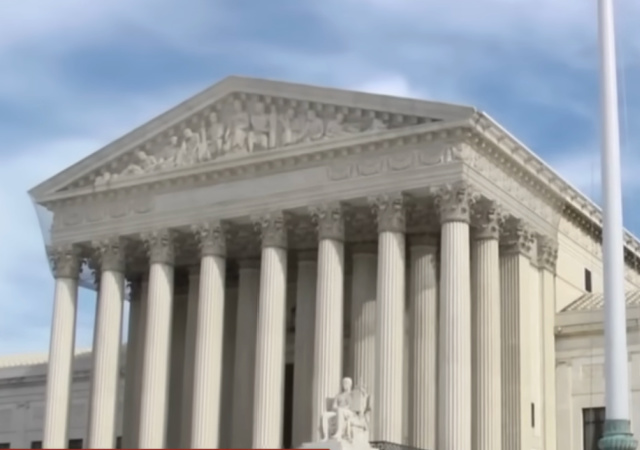
The Supreme Court ruled 6–3 on Tuesday night that Alabama may use a congressional map drawn in 2023 for this year’s elections, reversing a lower federal court’s decision that the plan unlawfully diluted the voting power of black residents.
This ruling reduces the number of majority-black congressional districts in the state from two to one and is widely expected to give Republicans one additional House seat in the upcoming midterm elections.
As a result, Alabama’s 2nd Congressional District, currently represented by Democratic Rep. Shomari Figures, is now widely viewed as a likely Republican pickup.
The ruling can be viewed here.
BREAKING: By a 6-3 vote, #SCOTUS will allow Alabama to use its never-implemented 2023 districts in this year's elections. They're likely to result in a 6-1, R-D split and the loss of 1 of 2 majority Black AL districts. Doc: https://t.co/GQBJsMmeJe Earlier: https://t.co/0W2HPLC0yh
— Josh Gerstein (@joshgerstein) June 3, 2026
The SCOTUS blog reported:
In a four-page, unsigned order, the court held that that “the District Court’s analysis departed from” the Supreme Court’s April 29 decision in Louisiana v. Callais, in which the court (among other things) made it more difficult for plaintiffs to prevail on a claim that a map violates a key provision of the Voting Rights Act.
The majority opinion stated, “States are free to decide for themselves whether last-minute changes to an election are in their best interests.”
Justice Sonia Sotomayor wrote the dissent that was joined by her fellow liberal justices, Elena Kagan, and Ketanji Brown Jackson:
Before the Court are two paths. Down one lies an orderly election, held under a tried-and-tested congressional map that protects Black Alabamians’ right to vote and with which all voters, elections officials, and candidates alike are familiar.
Down the other lies a chaotic election, held under a never-before-used congressional map that intentionally discriminates against Black Alabamians, that Alabama adopted in unashamed defiance of a prior court order directly affirmed by this Court, and that will require officials to change the voter registrations of hundreds of thousands of voters in just days at best, a task that Alabama previously represented would take months.
The majority chooses the second path and disregards both democratic values and the rule of law. I respectfully dissent.
On May 26, the U.S. District Court in Birmingham, Alabama, temporarily blocked the new map, claiming that it “intentionally discriminated based on race.” The three-judge panel issued a preliminary injunction against the state’s new congressional map.
Mary covered this story here and here. She wrote that following the Supreme Court’s April 29 ruling in Louisiana v. Callais, which concluded that Louisiana’s redistricting map was an “unconstitutional gerrymander” and that “race cannot be used as a factor in drawing a congressional district,” Alabama took their case to the Court.
Mary reported that in early May, “the Supreme Court remanded the case back to the lower court “for consideration in light of Louisiana v. Callais.”
“Did the court listen?” she asked rhetorically. “Nope.”
Despite the Supreme Court’s instruction to reconsider the case in light of its recent Voting Rights Act decision, the district court maintained that Alabama was required to draw two majority-black congressional districts.
The lower court judges concluded, “Ultimately, we cannot see our way clear to requiring Alabamians to cast their votes in the 2026 elections under a districting plan tainted by intentional race-based discrimination.”
In Tuesday night’s majority opinion, the justices noted that the lower court had “failed to follow our instruction.”
Democrats, naturally, are incensed by the Supreme Court’s ruling because it likely puts the GOP one seat closer to holding onto the House majority in November.
NAACP General Counsel Kristen Clarke issued a statement torching the decision. She wrote:
The Supreme Court continues to unleash chaos in our democratic process, and with this latest action, gives Alabama approval to use a congressional map that had previously been found to be intentionally discriminatory.
This is a Court that is stripping Black voters of power and voice at a speed that would put Jim Crow jurists to shame. Our message to communities remains the same — the best way to express dissent is by showing up at the ballot box this election season.
Elizabeth writes commentary for Legal Insurrection and The Washington Examiner. She is an academy fellow at The Heritage Foundation. Please follow Elizabeth on LinkedIn.
Donations tax deductible
to the full extent allowed by law.






Comments
Figures… 🙂
Great minds…. I thought of writing “Shomari? Figures….!”
The issue before the Supreme Court was that the District Court ignored the SC ruling from last month. This should have been 9-0, but the liberals on the SC seem fine with lesser courts overruling the Supreme Court.
The fig leaf seems to be that one of the allegations back in 2023 was that the legislature’s map not only failed to discriminate for blacks but actually intentionally discriminated against them. Technically that allegation deserves to be considered by the courts in light of the new doctrine from SCOTUS, but there’s no time for that, and it’s in any case unlikely to be sustained.
You misspelled “crones…’
For values of “tried-and-tested” that include “used only once, in 2024”.
But that is unconstitutional under Callais.
It does the exact opposite; rather than intentionally discriminating against black voters, it fails to intentionally discriminate against white ones, which is what previous court decisions said it had to do.
It did, but Allen v Milligan is now overruled. It was a bad decision, and now it’s in the recycling bin.
This is true, and it’s not ideal, but it can be done. The main problem with this sort of thing is voters showing up on the day at the wrong location. The solution is that each location where this is likely to happen should service both districts.
I don’t know how they do it in Alabama, but here in New York City it’s completely normal for each polling location to serve multiple districts. When someone shows up to vote, the first thing they have to ascertain is which table they need to approach; they can consult an app, or the information table, or if they do go to the wrong table the staff there will redirect them to the correct one. The worst that happens is that they have to stand in line twice.
Doing it the ideal way, where everyone gets adequate notice of where they vote long in advance, does take months; but it’s not necessary.
The key point here is that the “intentional discrimination” against black voters is in fact simply a deliberate refusal to intentionally discriminate for them; until just now the courts had held that such intentional discrimination was required by law, but that doctrine has at long last been rejected, so people have to adjust.
Voting in Alabama is very old school. The polling place(s) within each County is granular to the precinct usually tied to a combo of whatever State House district and/or municipality with separate polling places for unincorporated areas. In rural.Counties the smaller Towns will often have a single central voting place and the unincorporated areas of that County will have several spread around usually at local Volunteer Fire Stations. Same holds for larger population Counties/Cities but with several more neighborhood polling places in larger Cities usually divided up by City Council districts.
The local newspapers are good at cooperation for this sort of thing. They’ll run stories with printed maps. The State and Counties will post maps on websites. The questions of ‘where’s the polling place’ ‘who are the candidates for my district’ will be asked/answered in unofficial channels at barber shop/beauty salon, Churches, civic organizations, VFW,/American Legion, Masonic Lodge, youth sporting events and so on.
Absolutely correct that the prior Court imposed ’24 map was intentional race based discrimination against ‘white’ voters. That’s the problem with using race as a determining factor in zero.sum decisions such as this. Can’t create a race based district favoring group A within that district unless you simultaneously disfavor group B, C and D. There’s no real way around the fact that ‘majority minority’ districts are themselves are drawn with the intent to discriminate against group B,.C and D.
Doing it the ideal way, where everyone gets adequate notice of where they vote long in advance, does take months; but it’s not necessary.
Perhaps in the olden days. But we have this thing called “the internet” now that allows us to publish the information for voting precincts nearly instantaneously.
That sounds like snark, but with some game playing that went on in the recent past where I live, I had to do exactly that: go to the internet and look up which precinct/district I was now in, so I knew which candidates to research. I now do it EVERY ELECTION, just to make sure I know.
Was going to make exactly the same comment. This information is literally at everyone’s fingertips these days, and is available through every cell phone and in every library and most homes.
Democrats are hobbled in dredging up their usual greasy claim of “this disadvantages poor people with no access!” as they continue to pay for those people’s Obamaphones.
District court judges defying the Supreme Court should automatically be impeached and removed. The judge has failed to up hold his oath of office. The oath states to “ protect and defend the constitution”. Disobeying a Supreme Court ruling fails on both counts.
that is the problem, federal judges can get away with anything judicially, and the recourse is a reversal which in no way hold a judge accountable
“It is hard to imagine a more stupid or more dangerous way of making decisions than by putting those decisions in the hands of people who pay no price for being wrong.”
Thomas Sowell
The problem is when the Supreme Court doesn’t uphold the Constitution. Then you get good judges being thrown out for defying a bad ruling.
Lower CT are ‘required’ to follow the rulings of their Circuit and SCOTUS so a ‘good lower CT judge’ applies the interpretation/precedent of his Circuit and the Circuit CT follows SCOTUS. What happened here is the lower CT panel didn’t apply the criteria that SCOTUS not only ruled upon but then directed the panel to apply on remand.
At least under that framework SCOTUS can eventually be persuaded to alter a prior decision with new members replacing old members and a long enough historical record of the failings of the old ruling, even when the older ruling was widely acknowledged as a bad ruling; see Roe.
Under the methodology at notogerrymander.com, the democrat plan was 84% more gerrymandered than the legislature’s plan. The methodology looks at inequality where the legislative plan was trivially worse. It also looks at respect for local jurisdictions where the democrat plan is materially worse because it unnecessarily splits the city of Mobile. But it is on the sprawl measure where the districts snake across the state on the democrat plan, but are better-behaved in the legislature’s plan.
That said, there are still some weirdnesses in the legislature’s plan which are also found in the democrat plan– the little hook around Birmingham– that would get eliminated if there were a contest to find the fairest map.
But the final conclusion is that the Supreme Court acted to limit a gerrymander.
the plan unlawfully diluted the voting power of black residents
And there is the problem, though I don’t think a lot of people see it under there.
Quite simply, no group has any rights in America. Individuals have rights. And one of those rights is to band together in affinity groups based on whatever criteria they want: veterans, skin color, gender, left-handed redhead hermaphrodites, etc. But those groups have no rights unto themselves or because of their affinity. Period.
So, blacks do not have the right to be represented in Congress, as a group. They have the right to pool their political power to try and get someone elected who represents them, but they have no right to that representation as a group.
This is one of the pillars of “equality under the law.”
Anyone saying they have a right to be represented as a group immediately loses all legitimacy on topics of the law, IMO.
Also, the “mark” tag apparently doesn’t work in comments here.
Nor do tables.
IMG worked exactly once. I used it shortly after joining LI to post a historic illustration of the John Brown hanging/ I guess that wasn’t a “feature” because it never worked again.
Exactly. No group has any more or any less rights/privileges nor any more rights/privileges than another group. We have individual rights in the USA not the ‘collective’ group rights fantasy created/sought by the leftists to privilege some while punishing others. Nobody is more than/less than based on group/tribe.
for a group of people (blk) who CLAIM they are powerless or have less than
they do pretty damn good in the usa
murdering riots takeovers lowiq>>no education 70+ percent fatherless homes mothers will multiple kids from many men etc etc etc
I’ve seen people say how racist America is, and I usually say, “If it is as racist as you say it is, we’re apparently doing a piss poor job.”
No one seems interested in challenging the bedrock racist assumption of the gerrymander that a white person cannot or will not represent black constituents adequately.
The assumption is that black people must be allowed a majority to elect strictly black candidates, but no mention is made of the white residents of a black-majority district who clearly have been stripped of their own rights to elect THEIR racial teammates, if the obverse is also true.
And that somehow the interests and needs of black voters is intrinsically different from white votes.
Core racist beliefs of the Democrat party.
There is no such assumption. Steve Cohen is the proof that that was never the assumption.
The assumption is that white and black voters have very different interests, so that someone (black or white) who was elected by a white majority can’t represent the interests of his black constituents. Therefore districts must be drawn so that wherever possible black voters are a majority in their district and can thus elect someone (again, black or white) to represent their interests, while the white voters in such districts are intentionally unable to elect someone to represent their interests. Because their interests will be adequately represented by the representatives that other white people elect in other districts, since all white people obviously have the same interests.
“Steve Cohen is the proof that that was never the assumption.”
No he isn’t. He’s quite likely only proof that sometimes people’s clear assumptions are unwarranted.
Sotomayor complains the map “intentionally discriminates against Black Alabamians.” How so? Does it deny their right to vote for their favored candidates? No, it does not. Does it prevent them from voting for black candidates? No, it does not. Does it prevent them from electing their preferred candidates? No more so than any congressional district map prevents any block of voters from electing their preferred candidates, as maps in blue States prevent Republican voters (largely white) from electing their preferred candidates. Think about this – Sotomayor is complaining that black voters in Alabama are being treated the way Republican voters are treated in blue States. In other words, they (Alabama’s black voters) are being treated the way minority party voters are treated in nearly every State. And, arguably, they’re being treated this way for the same reason – not because they’re black, but because they’re Democrats. For Sotomayor, race is just an excuse to treat them differently.
“When you’ve spent your entire life entitled, equality will feel like discrimination.”
Thomas Sowell
More to the point, black Democrat voters are being treated the same as white Democrat voters. Until now it was fine to treat white Democrats that way, but black Democrats had to be given special treatment. No more.