


B-52 Stratofortress Crash at Edwards Air Force Base Reported to Have Claimed 8 Lives
“Initial indications are that the crash was not survivable.”
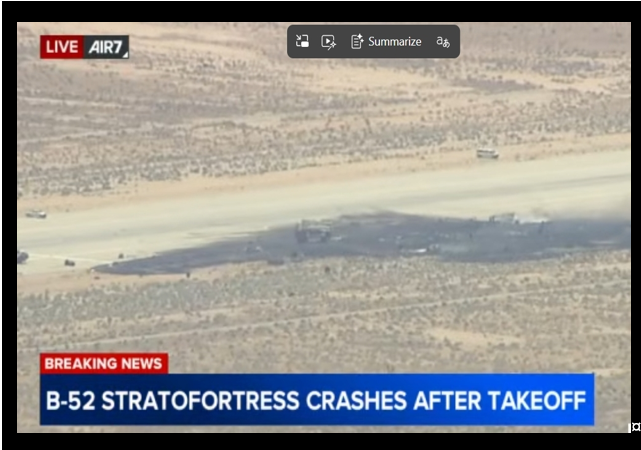
Tragedy struck at Edwards Air Force base, as eight crewmembers are believed to be dead after a B-52 bomber crashed shortly after takeoff from a base northeast of Los Angeles Monday morning.
Emergency crews responded immediately to the crash involving the B-52 Stratofortress, which left a towering black plume in its wake, the base said.
The bomber was on a routine test mission that took off at 11:20 a.m. local time, officials said, and “initial indications are that the crash was not survivable.”
…The base’s runway was left with a large blackened scar on the sandy runway, as well as some residual smoke, but it was difficult to make out any distinct parts of the wreckage, video from CNN affiliate KCAL shows.
#BreakingNews: Emergency crews are responding after a B-52 bomber crashed shortly after takeoff from Edwards Air Force Base in California on Monday. https://t.co/yyzTyuaWeU pic.twitter.com/PAOKVF2zVp
— KTLA (@KTLA) June 15, 2026
In the wake of the incident, the airfield was closed and all inbound aircraft were being diverted.
Visitor passes were also being suspended for the day “to focus entirely on emergency response operations,” the update said.
It wasn’t immediately clear what agencies were responding to the incident, but Edwards Air Force Base has its own fire department, with five fire stations located across the base.
…Edwards Air Force Base is located primarily in rural southeast Kern County, but part of the base stretches into east San Bernardino County and north L.A. County, not far from Lancaster.
The B-52 Stratofortress is described by the military as a “long-range, heavy bomber that can perform a variety of missions,” known as the “backbone of the manned strategic bomber force for the United States.”
Last year, there was a near miss incident.
Last year, a regional airliner pilot flying over North Dakota made an unexpected sharp turn to avoid a possible midair collision with a B-52 bomber that was in its flight path.
Edwards Air Force Base, covering 480 square miles in Kern County, is used for research, development and testing of U.S. Air Force aircraft, weapons systems, software and components.
The base was where famed pilot Chuck Yeager broke the speed of sound in 1947. It served as the West Coast base for dozens of NASA Space Shuttle landings and a testing ground for the now-retired orbiters. Atlantis was the last shuttle to land at Edwards AFB in 2009.
This sad loss at Edwards Air Force Base stands as a heavy reminder of the risks carried by those who defend our nation.
God bless the eight crew members who were dedicated to duty. Let us remember the quiet courage that too often goes unseen until it is gone.
Donations tax deductible
to the full extent allowed by law.







Comments
RIP. Perhaps we need to get new hardware rather than upgrading?
We don’t know the reason for the crash yet.
True, but, the age of the B-52 fleet seems a fair point of concern, regardless. These airframes are pushing ~64 years. That’s not trivial. There’s a reason that commercial passenger jets are retired at around 25 years of age.
The current fleet of B-52s went through a life extension rebuild two or three decades ago. Also every so many years Air Force aircraft undergo depot level maintenance. At one time it was referred to as IRAN (Inspection and Repair As Necessary); they basically took the airplanes apart and fixed anything and everything and did upgrades.
I wonder if this was one of the two aircraft in the re-engining program?
This aircraft was flying test missions (That’s what Edwards does). If any upgrades were onboard, they were either well-proven or experimental.
Airlines retire/replace their fleets for economic reasons. Age is only relevant as to the cost to maintain/operate the aircraft.
Military aircraft are designed and maintained for mission effectiveness, not profit.
Apples and oranges.
Perhaps we need to know what caused the accident before we decide on a solution.
RIP sweet heros
~salute~
Very sad. These talented individuals are some of our very best. Im starting to get concerned. Our military has improved so much. Any one loss is too much right now.
The mention of the “near miss” over ND is a non-sequitur.
This crash bugs me, as there is NO mention of the behavior of the aircraft or how far into the takeoff it was. At least it wasn’t some jackoff pilot – I hope. (I was there for the Fairchild crash, and was watching the maneuvers; I went inside just prior to the crash.)
(I was there for the Fairchild crash,
________________________________
as soon as holland came around, banking left at 45 degrees and increasing, you knew he was going to tip stall it–and he took them all with him
I worked the WSA during that time but was off that day. Had to guard the wreckage while they cleaned it up.
He crashed right across the runway from our squadron building.
rotation / landing are typically the most dangerous events in the flight for any aircraft–buffs are big airplanes and, just like with big boats, things happen a bit more slowly than with smaller aircraft–specifically response times
curious how much of the aircraft was torched completely–rather small debris field ( at least from the photographs )
very little info available at this time–still, rest in peace to the warriors
condolences to their families / loved ones
I’ve always had a fondness for the B-52. They flew one in to an airshow when I was stationed at NAS Bermuda. We all came out to see it come in and land.
I flew many hours in the BUFFs as a flight surgeon, and it was and is one of the most consistently reliable airframes in the inventory. It is also equipped with 6 ejection seats, so whatever happened must have been sudden and catastrophic. Our last loss in 2016 happened during a rapid descent when the controls became ineffective. They were on approach back to Andersen AFB in Guam, and only had seconds to respond to the emergency before impacting the ocean. Anytime you are that close to the ground everyone should be strapped in and ready to punch out, so after a midnight launch in the black hole of the desert I’m wondering if this was spatial disorientation, and they flew it into the ground. Very sad news, but the thorough investigation that follows will hopefully reveal something that can reduce further risks.
Two of the eight were Boeing employees.
Yes. The fact 8 died (only 5 or 6 necessary for a regular full crew nowadays) and there’s no mention of ground casualties made me think they must have had test engineers on board. It was either new engines, new structural stuff, or some kind of equipment they were testing.
Criminy, that makes me wonder if it was new flight control software or hardware. Not good.
The B-52H was the one of a kind testbed for the newest radar and AI paths for upgrades. Major setback in development…. as such…. always more questions as to why this particular aircraft. RIP.
The lack of a sizable debris field would indicate the velocity vector at impact was vertical, or very close to vertical.
In most cases that points to a stall, in this case fairly soon in the climb profile as the impact appears to have occurred on a runway.
Any B-52 experts correct me please, but my recollection is that due to body mounted gear configuration, B-52s do not actually “rotate” in the conventional sense when lifting off?
So, a possible major flight control malfunction resulting in an excessive AOA during initial climb. This gave rise to.an unrecoverable stall with a wing drop into a vertical descent to impact.
The center line main landing gear gimbles to allow the plane to crab into the wind while the gear is correctly pointed down the runway. It elevates rather than rotates on takeoff. which also has the benefit of not stressing the engine pylons which happens at liftoff (see recent MD-11 loss of engine and then airframe). The small footprint of the crash site suggests severe roll to stall or flat spin pancake…weird.
Correct…. see Fairchild demo practice and Anchorage C-17 demo practice for that type of crash. I learned that lesson on a departure stall practice when I got all out of coordination…. the left wing dropped and dummy… I reflexively immediately fed in right aileron and super stalled the left wing even more… nothing like rolling over the top and seeing the world begin to turn upside down. Flew out of it without the instructor have to save me… although I could see him edging for the controls. After that he demonstrated that the rudder is your best friend. On FAA check ride the left wing dropped a little on departure stall and I slammed in right rudder and all was well. I’d hate to have had that happen at night into a pitch black world
The lack of a sizable debris field would indicate the velocity vector at impact was vertical, or very close to vertical.
____________________________________________________________________________
understand with regard to the physical size of the debris field–meant that there are virtually no structural components of the aircraft present–this was an aircraft with a 185′ wingspan, a fueselage length of ~ 155′ and 8 engines–jet fuel doesn’t burn hot enouugh to vaporize steel–requires much higher temperatures–at least 2,750 farenheit or more–only thing can think of that burns that hot is maybe white phosphorous ?–what were they carrying ?–or perhaps some fail-safe device to completely destroy the aircraft/ cargo in the event of a crash ?
just seems curious, given the size of the aircraft, there is so little wreckage in the debris field
Prayers for crew and family.
Preparing for war is dangerous.