


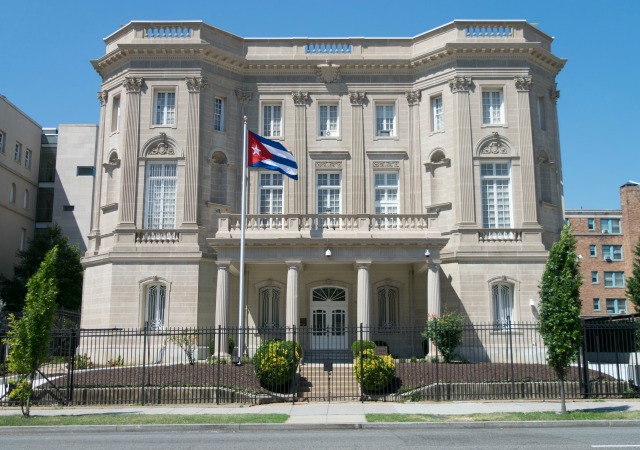
Cuba is once again in the international spotlight—and for good reason. Recent developments have reignited a long-standing question: Is the island nation finally approaching a decisive break from decades of totalitarian communism? For generations, the Cuban people have endured murderous political repression, chronic economic failure, and the systematic denial of fundamental freedoms. Yet today, a convergence of political pressure, legal accountability, and historical resonance suggests that the regime’s grip may at last be weakening. What once seemed distant now feels increasingly possible: the taste of enduring freedom.
On May 20, 2026—Cuban Independence Day—U.S. Secretary of State Marco Rubio delivered a direct and unapologetic video address to the Cuban people. He blamed Cuba’s hardships on the communist regime and the military-run conglomerate GAESA, announced $100 million in humanitarian aid to be distributed through the Catholic Church, and emphasized solidarity with the Cuban people. It was a moving affirmation that their struggle has not been forgotten. Rubio spoke with urgency and moral clarity, underscoring that the demand for liberty remains alive despite decades of suppression. At a time when silence can be mistaken for indifference, such a message is vital. It signals not only solidarity, but a palpable hope of deliverance.
This moment also calls to mind the extraordinary Pedro Pan mission of the early 1960s—a defining and deeply human chapter in Cuba’s history. Between 1960 and 1962, more than 14,000 unaccompanied Cuban children were sent to the United States by parents desperate to shield them from communist indoctrination and oppression. Operation Pedro Pan was organized by Father Bryan O. Walsh and the Catholic Welfare Bureau, with support from the U.S. State Department and the Catholic Church. The Church played an indispensable role in sustaining this lifeline, standing as a beacon of faith and resistance in a time of fear. That legacy still resonates powerfully. As highlighted by a recent exhibit at the Victims of Communism Museum in Washington, D.C., those 14,000 children were given a chance at free and prosperous lives. One of them was the father of Jeff Bezos—an enduring reminder of how opportunity, once granted, can echo across generations.
Legal developments have further intensified the sense that regime accountability may finally be within reach. On May 21, 2026, the U.S. Supreme Court ruled 8–1 in Havana Docks Corp. v. Royal Caribbean Cruises, Ltd., siding with the U.S. company whose property was confiscated by Cuba in 1960. The Court held that cruise lines that used the port of Havana between 2016 and 2019 could be liable under the Helms–Burton Act, thereby reinstating a $440 million judgment. Crucially, the Court affirmed that victims of confiscation do not lose their claims simply because time has passed. The message is unmistakable: theft and expropriation under Cuba’s dictatorship can still carry consequences.
Even more consequential is the mounting legal pressure surrounding former leader Raúl Castro. On May 20, 2026, the U.S. Department of Justice unsealed an indictment charging Castro and five co-defendants with the 1996 shootdown of two Brothers to the Rescue planes, which killed four people. The charges include murder and conspiracy to kill U.S. nationals. His indictment marks a significant and long-overdue shift—a clear signal that even those who once appeared untouchable may be held responsible for decades of repression. This is not symbolic posturing; it is a warning that the era of impunity for Cuba’s ruling elite may be drawing to a close.
Meanwhile, conditions within Cuba continue to deteriorate at an alarming pace. The centrally planned economy is collapsing under its own inefficiencies, leaving citizens facing chronic shortages of food, medicine, and other basic necessities. Blackouts, inflation, and mass emigration are no longer temporary hardships—they are daily realities. Layered atop this is a system of strict political control that suppresses dissent and punishes those who dare to speak out. Yet even under these conditions, protests have emerged, revealing a population increasingly unwilling to remain silent. The regime may still wield force, but it is steadily losing ground.
Taken together, these forces point to a system not merely under strain but nearing collapse. Internal dissatisfaction is rising. External pressure is intensifying. Legal accountability is no longer theoretical. The regime faces challenges on every front, and its ability to contain them is doubtful.
For decades, the promise of freedom in Cuba has seemed perpetually deferred. But this moment feels different. Thanks to strong and unapologetic leadership in Washington—willing to confront communism and other brutal regimes directly rather than accommodate them—the conditions for meaningful change are taking real shape. That clarity of purpose matters. It sends a signal not just to Havana, but to the Cuban people: they are not alone, and their cause is just.
Cuba may finally stand on the threshold of liberation. May the Cuban people at last seize the freedom, dignity, and prosperity they have so long been denied!
Nora D. Clinton is a Research Scholar & Project Manager at the Legal Insurrection Foundation. She was born and raised in Sofia, Bulgaria. She holds a PhD in Classics and has published extensively on ancient documents on stone. In 2020, she authored the popular memoir Quarantine Reflections Across Two Worlds. Nora is a co-founder of two partner charities dedicated to academic cooperation and American values. She lives in Northern Virginia with her husband and son.
Donations tax deductible
to the full extent allowed by law.



Comments
I am thrilled that Cuba may become free from Communism. I have a friend who is one of those who came to the U.S. under the Pedro Pan program. He went on to become an U.S. Army Officer and an attorney. I travelled to Miami with him in 2018 (?) to meet his father who had escaped from Cuba – my friend hadn’t seen him since he was a little kid.
Having said that, there is one technical point on which I am a little concerned: charging Raúl Castro with murder. Isn’t this the same theory under which it was argued that American generals who bombed Berlin and Tokyo should be charged with war crimes? Am I wrong here?
IANAL, it would seem to me that the difference between the charges of murder against Raul Castro and the flag officers of WW II is that there is no declared war between Cuba and the U.S.A. while WW II was a declared war by the U.S.A. against both Germany and Japan who I believe had already declared war against the U.S.A.
Will Cuba Taste Freedom Soon?
I think they can already taste it and it tastes good, they want more.
Make Buena Vista Social Club Great Again!
https://youtu.be/o5cELP06Mik?si=l8sQrckcQYTCVo_j
Cuba will become free of communism while America becomes more communist like?
If Karen Bass is re-elected LA mayor, maybe offer the Cuban communists LA in exchange for the island. She’s one of them anyway, so we’d not be giving up much.
I’ve been reading variations of this article since the beginning of the year. Get back to me when it actually happens.
I was teaching a class of English Language Development high schoolers a number of years ago, when Obama was in the White House. As the class was gathering, in walks this dark, Caribbean-looking girl. She spotted a Che Guevara icon on another girl’s bag, and audibly let out a horrified gasp, “¡El asesino!” It turned out that the dark girl had just arrived from Cuba. She had to have been born and raised under The Revolution.
This being said, I would rather the USA sit back and let the internal contradictions raised by anti-American revolutionary regimes do their work. My fear about the Iran conflict is that after all those anti-regime protests, our bombs would cause the Iranian population to rally behinf the mullah-ocracy. I would fear a too pro-active US policy towards Cuba might cause its suffering population to rally behind the Communist regime. After all, Japan went into China in the 1930’s ostensibly to save it from Communism; but succeeded in nothing save causing a temporary Nationalist-Communist United Front and having nearly a million Japanese troops tied down in a quagmire–and one in which China’s native anti-Communist forces were worn down (even the pro-Communist Hemingway admited such after his wartime trip to China), paving the way for Mao Zedong’s victory.
Anyone fighting the US only has to wait four years, eight at most. We will probably have a Democratic Congress and President after Trump leaves office–and hence a government that entertains the rosiest of illusions about the heirs of Castro, Mao, and the 1979 Iranian Revolution.
Ukraine? Iran? Yes, fine and well. But Cuba is in our own hemisphere, 90 miles off our shore. We’ve already “shaken the cage” in Venezuela. Time to invoke the Monroe Doctrine again and rid the Cuban people of decades of murderous oppression and free them to become once more the prosperous island nation they once were. If Raul “Slappy” Castro is feeling a bit anxious right about now, well he should be. Tick-tock, Slappy.