


Spencer Pratt Vows to Bring Art Deco Architecture Back to Los Angeles
Meanwhile, what is Pratt’s opponent promising? Free teeth for meth-heads.
Has there ever been a more effective grassroots campaign for a mayoral position than the one Spencer Pratt and his team are running?
It would be hard to imagine one that has been so inspirational. Pratt’s effective debate appearance and common sense vows (i.e. to get rid of the conditions causing medieval diseases) see him surging in the polls and in striking distance of current Mayor Karen Bass.
🚨 HOLY CRAP IT'S HAPPENING! Los Angeles mayoral candidate Spencer Pratt just SURGED +12 points in the polls, and now only trails Karen Bass by single digits
The voters are *BEGGING* for common sense
He has overtaken Nithya Raman already 🔥
"New polling showing political… pic.twitter.com/fzYlaexTBJ
— Eric Daugherty (@EricLDaugh) May 13, 2026
California is so bereft of good news when it comes to an election that the fact that Pratt appears to be at least able to survive the June 2nd primary to compete in the general election has me almost giddy.
Pratt continues to make intriguing promises, prompting people to recall LA’s past glories and consider the possibilities for the future. This time, he promised to bring Art Deco Back to the area.
“We’re going have LA so beautiful. No more of these high density, SP79 prison-like structures. We need to bring Art Deco back… I’m going to have a canal… bike lanes going through the sky through tunnels.”
This line is how you know Spencer Pratt is radically different and will win.
“We’re going have LA so beautiful. No more of these high density, SP79 prison-like structures. We need to bring art deco back… I’m going to have a canal… bike lanes going through the sky through… pic.twitter.com/j1OSyP6w1F
— Sean Semanko (@SeanSemanko) May 12, 2026
I must admit, few campaign promises have brought me more joy.
Art Deco is a style of visual arts, architecture, and product design that emerged in Europe in the 1910s and became a major international style in the 1920s and 1930s. It is characterized by bold geometric forms, streamlined shapes, stylized decoration, and extensive use of industrial materials like chrome, aluminum, and plastics to convey luxury and modernity.
The style expressed optimism about progress, technology, and the relationship between people and machines, often suggesting speed, power, and glamour.
Additionally, as the era coincided with the 1922 discovery of King Tutankhamen’s tomb, Art Deco incorporates geometric patterns, hieroglyphic motifs, pharaonic imagery (such as scarabs, lotus flowers, and sphinxes), and stepped pyramid forms. “Egyptomania” provided the style with a visual vocabulary that merged ancient symbolism with modern streamlined aesthetics.
The 1920s also saw the birth of a new, strangely specific kind of building — the Egyptian Theatre, uniting cinema and Ancient Egypt and Art Deco into one fantastical mix.
The first and grandest was Grauman's in Los Angeles, from 1922, though it now looks somewhat different: pic.twitter.com/P1aaeLlGTO
— The Cultural Tutor (@culturaltutor) October 1, 2024
Interestingly, Art Deco recently celebrated its 100th anniversary. As we are celebrating our nation’s 250th anniversary, it must be noted that the style evolved from European influences to something Americans could call their own.
Emerging post-World War I, machinery and industry were the major cultural forces shaping Art Deco. Architecture in the U.S. evolved quickly after these influences arrived. At first, Americans were imitating European design. However, as times shifted from the Roaring Twenties to the Great Depression in the 1930s, American designers made the style their own.
Designers took something that had been expensive and exclusive, made from precious materials, and democratized it. This trend appeared largely through industrial and product design, which was just emerging as a profession. As electricity spread into homes, consumers wanted new products such as vacuum cleaners, radios, and toasters, and designers had to decide what these objects should look like. Even during the Great Depression, many Americans had stable jobs and consumer power, and manufacturers realized design was key to selling products. That made design, and Art Deco in particular, part of everyday life.
Art Deco rose just as Los Angeles exploded in population and economic power in the 1920s, as it was on its way to becoming a center for aviation, shipping, and especially the movie industry. Developers and studio-era Los Angeles embraced the style because its vertical lines, futuristic motifs, and sense of opulence fit the city’s self‑image as a modern, glamorous metropolis.
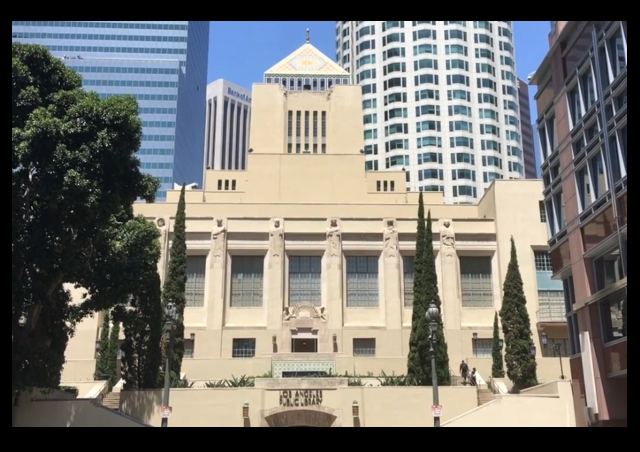
Many landmark buildings (e.g., the Los Angeles Central Library, Union Station), and numerous theaters and office towers still showcase the style, making Art Deco a visible part of LA’s architectural identity.
Los Angeles Central Library pic.twitter.com/fARqmd29qo
— Hyperion (@Ortgeist) March 13, 2025
Meanwhile, what is Pratt’s opponent promising? Free teeth for meth-heads.
“How many people who are unhoused that you meet have no teeth at all? They don’t have teeth. Why? Because meth rots your teeth. You can’t succeed without teeth! So there needs to be comprehensive health care provided for the people…”
LA Mayor Karen Bass demands free dental care for meth heads because "you can't succeed without teeth." pic.twitter.com/YdOHUu14rl
— Libby Emmons (@libbyemmons) May 13, 2026
If nothing else, the Pratt campaign has exposed just how low the bar has sunk in Los Angeles politics: one candidate is talking about restoring beauty, functionality, and civic pride, while the other is focused on managing the fallout of societal decay.
That contrast alone explains his momentum.
Whether Pratt ultimately prevails or not, the fact that a grassroots effort built on common-sense fixes and a dash of unapologetic optimism is even competitive should be a flashing warning sign to the entrenched political class. Voters may finally be less interested in managing decline and far more open to someone willing to reverse it.
Donations tax deductible
to the full extent allowed by law.





Comments
Does Los Angeles deserve Spencer Pratt and his common-sense, rational and long overdue policy proposals?
Most L.A. voters reflexively or gleefully voted for incompetent, criminal-coddling and corrosive Dhimmi-crat apparatchiks, over decades, and thus directly enabled the very same policies that they now vociferously complain about.
Now that their city has hit rock-bottom, these same dupes have finally and tardily figured out that Dhimmi-crat governance leads straight to hell.
“…I’m going to have a canal…:
This went over extremely well in Providence. Seriously.
I remember in my salad days comparing a LOT of stenches to “the Providence River at low tide.”
In fairness Bass is promising root canals for meth heads so they are even.
I love art deco,
As for loud mouth bass I think she might be meth head,
It’s my favorite style and I can’t seem to put my finger on it as to why that is so.
Someone needs to explain to Spencer Pratt what the adage means, “politics is downstream of culture.” It’s not up to politicians to be driving fashion, architectural or otherwise. That’s how you get things like brutalism, courtesy of the commissars.
“You can’t succeed without teeth.”
Teeth or no teeth, you can’t succeed on meth in the first place, you stupid bint.
That was my first thought. Give them all the free dentures and crowns you want, they are still an unemployable meth head. Just more “throw endless money at a problem” crud that hasn’t worked. What do you bet her plan involves millions to 1 or 2 NGO’s where it will disappear right back into Bass’s campaign coffers? A lot of people will make a lot of money and none of the meth heads will get teeth.
Would prefer Art Nouveau myself but whatever. It still beats Brutalism.
Beats the steel and glass monstrosities that seem to make up contemporary design. It’s one thing to utilize steel for structural components, but there’s no need to let the ugly hang out for all the world to see.
Surged 12 points and now behind by single digits? He has to be ahead by 12 points just to have a better than decent chance of winning.
LA is 50% registered Democrat and 65% of likely voters are Democrats — and, if that’s not sobering enough, Bass’ friends count the votes. It’s possible for Pratt to win but the odds are too long.
Not to Soviet Revival Obama brought to Chicago.?
Anyone is better than Bass and Raman, but are Spencer Pratt’s ideas visions? Plans? Ideas? Hopes?
“I’m going to build a canal……”
Paid for by who? How?
“Bike paths in the sky…..”
Paid for by who? How?
“Bring back art deco…..”
If I want to build a building, a home, an office. etc. on property that I own, I, andI pay taxes on, why should some one or some committee have the right and the ability to tell me – to force me – into a certain design style? What if I don’t like Art Deco? Why should the government have the right or ability to say “you have to build this structure in a style you don’t like?”
Either people are free to do what they want with their property (subject to zoning laws) or they are not.
While I would rather tax dollars go to more “tangible” programs than many of the social programs that are wasteful and ineffective, the bottom line is still that the government is imposing the will of a few bureaucrats on the many people.
That is not “representational” government because no one ever votes for a bureaucrat.
“I’m going to build a canal……”
“Bike paths in the sky…..”
Do BOTH, and 86 the bikes.
This is the kind of dumb thing that hurts Republicans.
No, the mayor isn’t going to actually change the freaking architecture, and who cares what buildings look like?
This is like 500 on the list of things people care about.