


Opinion: Treasury is Rightly Focused on Nonprofit Transparency
Could certain changes reap a world of change?
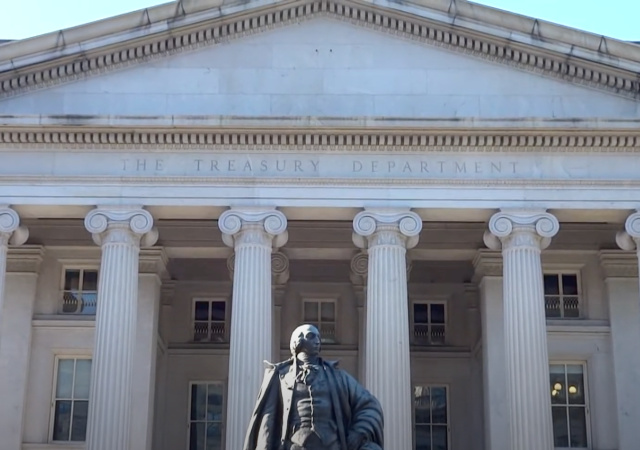
The Treasury Department recently announced the IRS would be proposing revisions to Form 990, the annual return that most nonprofits are required to file with the IRS. While the regulatory language has yet to be released, the Department’s focus appears to be on two issues that indeed warrant further scrutiny within the tax-exempt sector: government funding for nonprofits and fiscal sponsorship. This makes the announcement welcome news.
Form 990 is a public document, and the most comprehensive source of information about the financials and operations of American nonprofits. Public transparency is the 990’s core purpose, and the Treasury Department’s press release promises to improve this by providing “clearer reporting” in two specific areas.
The first of these concerns government grants and contracts, a topic that has been of heightened interest amid recent allegations of fraud and mismanagement in federal funding. Many nonprofits receive substantial funding from the federal government, and some receive almost all of their revenue from taxpayers. In other instances, public dollars flow to activist groups with clear ideological agendas. This places the American taxpayer in the position of not only incentivizing these groups with favorable tax treatment, but also directly funding their operations.
While it would seem wise to favor robust transparency in such cases, Form 990 currently provides almost no detail regarding government funding to the filing nonprofit. There is merely a single revenue line aggregating all contributions from federal, state, local, and foreign governmental entities into a single lump sum. More detailed public disclosure of government funding on the 990 would give Americans a much more comprehensive picture of a given nonprofit’s finances. Moreover, it raises none of the legitimate privacy concerns that accompany other forms of donor disclosure.
The second area of focus concerns fiscal sponsorship, an arrangement through which a nonprofit “sponsor” houses a “project” group, providing it with administrative support and allowing it to make use of the sponsoring nonprofit’s tax-exempt status in exchange for a fee. Fiscal sponsorship has become increasingly common, and it offers legitimate benefits. However—intentionally or not—it can also conceal details about the sponsored projects from public scrutiny. Those sponsored projects do not file their own Form 990s, and the current version of the form does not require nonprofits to disclose their fiscal sponsorship activities; in practice, very few do.
The Capital Research Center has previously called for reforms along these lines, suggesting that a new schedule could be appended to Form 990, in which basic details regarding projects and their financials would be reported by the sponsoring nonprofit. This would significantly improve fiscal sponsorship transparency without meaningfully restricting any of its legitimate purposes.
Notably, the Department’s press release refers only to section 501(c)(3) public charities. If the proposed regulations end up excluding section 501(c)(4) social welfare organizations, that would be a significant oversight.
501(c)(4)s engage in fiscal sponsorship as well, but unlike 501(c)(3)s they can do so in partisan ways. The Sixteen Thirty Fund and Beyond Impact (formerly Tides Advocacy) are two examples of major 501(c)(4) fiscal sponsors that operate in an explicitly political manner. Any requirement to report fiscal sponsorship on Form 990 should apply equally across all nonprofit categories.
Ultimately, details like these can be worked out through the public comment process, and there may be other important considerations to address once the regulatory text is officially released. For now, the Department is to be commended for its attention to this important and overlooked matter of nonprofit transparency.
_____
Robert Stilson is a senior research analyst at Capital Research Center in Washington, DC.
Opinions expressed in this post do not necessarily coincide with the views of the Legal Insurrection Foundation
Donations tax deductible
to the full extent allowed by law.


Comments
I hold NGOs in utter contempt.
This article covers transparency – an absolute must considering the pitch darkness that surrounds these groups – but more importantly we need to discuss the caustic effects these groups have on our politics.
That which cannot be accomplished through the democratic process is accomplished through sue and settle type lawsuits, failure to warn lawsuits and the like. The burden these groups put on our economy and our marketplace is far greater than most people recognize.
And the motivations are far from altruistic. The employees of these NGOs contribute *nothing* to society, they simply pour acid in the face of commerce for a fat paycheck.
Other than that, I’m fine with them.
Even better prohibit Federal grants and contracts with every/any NGO in addition to a prohibition on fiscal ‘sponsoring’ as well as prohibiting shifting/transfer of funds among NGOs even on contracts for ‘services’. Put substantial criminal penalties in place and stop pussyfooting around with these opaque slush funds for leftist causes. If a donor to ‘save the squirrels’ wanted to send $ to some other cause they would have done so directly and doubly so for arguments that taxpayers should fund X,.Y, Z nice sounding cause/ideal b/c ‘America is a wealthy Nation’. Bump that noise, individuals can directly fund whatever causes they wish without the assistance of armed agents of the Federal gov’t doing, as Tolkien put it, the ‘gathering and sharing’.
NGO taking federal money is a PGO (Pseudo Government Organization)
btw there should be no such thing as tax exempt ..pure lies and bs about the church cnat be taxed ..separation of church and state…pure bs
also the lefty wingies are cryn ,,but of course,, over the new rule that bank regulators need to drop the dei enforcement and stick to making sure the banks are financial sound…the msm goes wayyy out of the way to make sure they dont use the term dei and talk about
trump turning the bankers more hateful by not forcing them to hire dei
Didn’t they love this when it was about going after Southern churches and Tea Party groups?
their game is well known as is their hypocrisy
f the left
I think I found the issue. “Many nonprofits receive substantial funding from the federal government”
Cut off every penny of that for starters. EVERY PENNY.
I know this came out after this article, but worth noting – Hasan Piker admitted the CCP is funding activist NGO’s in this country through cut-outs – Neville Roy Singham
As has been said elsewhere, if a “non profit NGO” receives most or all of it’s funding from the government it’s not a NGO is it? NGO’s are the governments favorite way, put on steroids by Obama/Biden, of getting done what the government is prohibited from doing directly. On trick we saw during the Obama years was for the government to fund an NGO, the NGO then sue the government over something like powerplants and the government then settle behind closed doors avoiding Congress where what they wanted to do would never get passed.
I think we’re all agree that the entire concept of the government-funded or subsidized NGO is anathema in a republic.
I also think we are slowly, painfully being made explicitly aware that an enormous percentage of our tax money is being used for purposes that are entirely beneficial only to the bank balances of a small group of players. Besides that, many of the purposes being funded are actually inimical to American citizens and the country as a whole.
All of these NGOs are performing “social welfare” or political activities of some sort, correct? I mean, none of them are building bridges or highways (maybe a few help maintain trails in the national parks)
So what social metric, of ANY kind, has been steadily improving over the last 60 years? What have all the billions expended actually accomplished, other than creating a new class of upper middle class wealth?
I believe the Catholic Church disclosed some time ago that half of its revenue globally comes from governments. Let that sink in.
First thing is to stop any and all government funding in the US and the world at large. Second get rid of 501c3’s and 501c4’s. They are both breeding grounds of corruption. Third go after these legacy trusts. If a trust was established 65 years or more prior to 2026 force them to dissolve. Their legacies have turned into a liberal/socialist/commie slush funds. Fourth, ban paid protesters. I don’t care if someone wants to pay for signs, no payments to protesters. Fifth, any one subsidizing protests via signage or staging be held responsible if the protesters vandalize or damage public/private property. Hold the money guys criminally responsible.
None of this is going to change. Too many influential grifters are making too much to ever let that happen, and will pull out all the stops to protect their public funding and conceal the subsidies provided by our enemies. It would take a major revolution to dislodge them, and that would destroy too much of the wealth of others to ever be initiated or supported by the political or financial elites. Therefore the worst culprits will be symbolically scolded and advised to keep a much lower profile, and the rest will just accelerate their vigorous lawfare against any who dare to expose them regardless. Corruption, incompetence, and disloyalty are simply overhead that we all apparently have to endure in order to extract whatever benefits we can from our imperfect societies of self absorbed humanity.
Left unmentioned is one of the biggest issues with non-profits: the student loan forgiveness. This is a big give-away to non-profits, and a great source of scams. I live near DC and it is common here for people to start their own “non-profit” with a nice-sounding name, do very little and get not only tax-free status but their school loans forgiven. Amazingly enough each of them gets donations (from their spouse?) that is the maximum that the non-profit can receive without having to do detailed disclosures.