


FBI Director Kash Patel Files Defamation Lawsuit Against The Atlantic
“Defendants are of course free to criticize the leadership of the FBI, but they crossed the legal line by publishing an article replete with false and obviously fabricated allegations designed to destroy Director Patel’s reputation and drive him from office.”
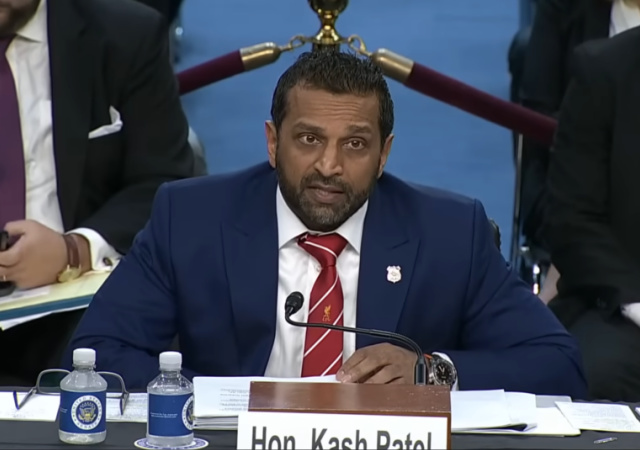
FBI Director Kash Patel filed a defamation lawsuit against The Atlantic this morning in DC over allegations in a recent article by Sarah Fitzpatrick that he frequently drinks and racks up job absences.
Ben wrote about the upcoming lawsuit on Sunday.
The lawsuit described The Atlantic‘s article as a “sweeping, malicious, and defamatory hit piece.”
“Defendants are of course free to criticize the leadership of the FBI, but they crossed the legal line by publishing an article replete with false and obviously fabricated allegations designed to destroy Director Patel’s reputation and drive him from office,” according to the lawsuit.
Jesse Binnall, Patel’s attorney, posted the letter they sent to The Atlantic before it published the piece. It included all the claims Patel disputed and the fact that The Atlantic had reached out to the FBI’s Office of Public Affairs two hours before publication.
This is the letter we sent to The Atlantic and Sarah Fitzpatrick BEFORE they published their hit piece on FBI Director @FBIDirectorKash. They were on notice that the claims were categorically false and defamatory. They published anyway.
See you in court. pic.twitter.com/Ke8cqNh8hY
— Jesse R. Binnall (@jbinnall) April 17, 2026
Binnell identified seven claims Patel considers defamatory, which Ben emphasized in his piece:
“Claim #5 — Director drinks “to the point of apparent intoxication” at Ned’s (DC) and The Poodle Room (Las Vegas) “in the presence of White House and other administration staff”;
Claim #7 — “on multiple occasions in the past year, members of his security detail had difficulty waking Patel because he was seemingly intoxicated and this information was supplied to DOJ and White House officials”;
Claim #8 — “breaching equipment” was requested at HQ because Patel had been “unresponsive behind locked doors” and there were concerns about reaching him “in an emergency”;
Claim #9 — Director Patel’s conduct is a “threat to public safety” including in the event of a domestic terrorist attack;
Claim #11 — Director Patel is “dragging his feet on terror cases,” delaying/refusing FISA warrants;
Claim #14 — alcohol played a role in Patel’s public statements about active investigations “including the murder of Charlie Kirk”;
Claim #19 — Director Patel had security detail shut down the FBI Association Store so he could shop alone and expressed frustration that merchandise “wasn’t intimidating enough.”
Patel and his attorneys insist that The Atlantic published the article with actual malice, which is the threshold they must prove:
Defendants published the Article with actual malice, despite being expressly warned, hours before publication, that the central allegations were categorically false; despite having abundant publicly available information contradicting those allegations; despite obvious and fatal defects in their own sourcing; despite The Atlantic’s welldocumented, long-running editorial animus toward Director Patel; despite a request for additional time to respond that Defendants refused to honor; and despite deliberately structuring the pre-publication process to avoid receiving information that would refute their narrative. Defendants cannot evade responsibility for their malicious lies by hiding behind sham sources.
“Indeed, Fitzpatrick could not get a single person to go on the record in defense of these outrageous allegations, instead relying entirely on anonymous sources she knew to be both highly partisan with an ax to grind and also not in a position to know the facts,” they added.
[Featured image via YouTube]
Donations tax deductible
to the full extent allowed by law.




Comments
I’m curious whether there is ANYONE at The Atlantic who isn’t motivated by “actual malice” toward each person in the Trump administration.
“Actual malice” is a legal term of art in defamation that has nothing to do with motivation.
“Actual malice” = “reckless disregard for the truth or falsity of an assertion of fact”
That defines the entire left.
An impossible burden of proof, since the left usually defines “truth” in terms of s*t they make up (like “men can have babies”).
Exactly why Palin lost her case against the NY Times
Caribou Barbie lost her case because opinion is protected. I can’t stand the NYT, but I would have voted “not guilty.”
It wasn’t opinion. Even the NYT didn’t try to argue it was an opinion. It was a clear factual statement, which was false and defamatory, and its only defense was that while the NYT as an institution knew the truth and had reported it, the writer of that specific article had either not read the report or had forgotten it, and was unaware that what he wrote was false.
I’m not sure how I would have voted, because the defendant was the NYT as a corporate entity, and my question is what can a corporation be said to “know”? It had reported the truth, so how can it institutionally say that it didn’t know it? As for the individual employee, did he not have a duty of due diligence to at least read his own newspaper’s previous reporting on the subject?
I would be inclined to vote for the plaintiff, because if you want to treat corporations as persons then treat them as persons, and an individual would not get away with publishing such a falsehood after having been demonstrably aware of the truth just a few years earlier.
But in any case it wasn’t an opinion.
Well, I’ll be doggone. Patel actually followed through with his statement to Maria B. on her Sunday Show yesterday. I didn’t believe he would follow up and through as quickly as he claimed. Good for him. It wouldn’t surprise me if lawyers and the political strategists behind Comey and Brennan were the ones who initiated this attempt to tarnish Patel and get rid of him. The Deep State won’t stop until Trump is gone and a Democrat is back in the WH.
He had to. Had he not filed, it would be taken as a sign that the allegations might be true. Filing puts his side on the record. Even if he loses because he can’t prove they knew they were lying, he’ll probably still get an admission that “Well, now we know it wasn’t true and we’re surely sorry”, which is at least a moral victory.
The real point of this is to force the Atlantic to either admit this crap was made up – which means he automatically wins – or forces them to reveal their so-called ‘sources’ so he can fire them.
I’m fine with either outcome.
Will they reveal their sources, even behind closed doors in a confidential setting? Names, or there’s nothing to it and The Atlantic is toast.
.
Not a lawyer here but am very well versed in defamation law by journalism education, training, and practice when it was a reasonably honorable calling. As I believe that I understand it:
1. The Atlantic’s assertions of fact and the conclusions therefrom are prima facie libelous, so that shouldn’t be an issue at trial.
2. The question is whether the factual assertions were true. If I’m Patel and they were true, I drop the lawsuit and resign. Otherwise, I focus on the narrowest assertions and show that they were false. Then I go after the other ones on the list.
3. If I’ve shown that they were false, the next issue is whether the Atlantic showed reckless disregard for whether or nor they were false. Only then will the Atlantic have to open the kimono and show what information they got, when they got it, how they they got it, and from whom they got it. Unless Patel can credibly show that the assertions were false, I don’t think they’ll have to reveal the sources; but if he does show that even some of the libelous statements were false, the kimono opens wide.
4. I’ve separate #2 and #3 above, but if I’m Patel and have the goods on the Atlantic, this likely ends in an undisclosed settlement because the Atlantic will not want to open the kimono. But if I’m Patel and have the goods on the Atlantic, nothing says that I have to settle. I can take it to a jury and force the Atlantic to reveal its sources and methods.
5. The ultimate question is not libel; it was. If the story was true, the case gets tossed for that reason. If not, then it becomes a matter of the damages. Patel won’t get anything remotely close to $25o million. That was for the headlines. And by the way, from what I’ve seen, Patel’s lawyer has a history of political grandstanding, but I don’t know one way or the other what his actual track record is (win/lose, how much damages) in these kinds of cases.
6. I have followed defamation cases for decades. It’s one of those interests of mine. As a reporter, I was ethical, and had (and have) no sympathy for defamation. I have never seen one as clear-cut as this. No ambiguity whatsoever here. This isn’t a matter of, say, the protection for opinion. The Atlantic made specific assertions of fact that were either true or false. Someone will win, and someone will lose. I will watch with close interest.
^ Sorry for the typos. I’m getting old, and my copy editing ain’t what it once was.
No, that’s not how it works. They can claim to have had sources, whom they will not name, but who had proved reliable in the past so they trusted them. The onus would be on Patel to prove they didn’t, which is almost impossible.
That’s how TIME got off when Arik Sharon sued it. It never revealed its source’s name, but assured the court that it regarded this person as trustworthy and had no idea that this time they were lying. Of course they would never trust this person again, but everyone understood that was a lie.
I answered this in detail below.
So, what you’re saying is that as long as the author of a defamatory article can claim, “But our anonymous and unnamed sources have proven reliable in the past, so we trusted them when we wrote the alleged defamatory article.” they will never be held accountable for publishing outright lies and falsehoods no matter how outrageous they are. Is that correct?
That’s what the law currently is, if the plaintiff is a public figure. That’s the only reason Sharon lost his case against TIME. (He also sued TIME in Israel, and won there, because Israel doesn’t have the “public figure” rule.)
That is NOT why Sharon lost. He NEVER concealed his source. It was the Israeli report’s unpublished appendix. That was mentioned in the Time story and at the trial.
I assume that was a typo, and you meant to write TIME never concealed its source. But that is incorrect.
No, the source was not Appendix B, because TIME never saw that. The false and defamatory statement which the entire suit was about, was TIME’s claim that Appendix B contained information about Sharon’s condolence call to the Gemayel family, and that it stated that: “Sharon reportedly told the Gemayels that the Israeli army would be moving into West Beirut and that he expected the Christian forces to go into the Palestinian refugee camps. Sharon also reportedly discussed with the Gemayels the need for the Phalangists to take revenge for the assassination of Bashir.”
The sources for that claim were never disclosed. As the court said when refusing TIME’s application for summary dismissal: “Time’s correspondents have refused to identify the sources from whom they obtained the evidence that supports Time’s story, and they also have refused to reveal fully the information they obtained.”
That was what the case was about, and the jury’s conclusion was that the story was both false and defamatory, i.e. Sharon never indicated to the Gemayels that they would be allowed to take revenge, and that the allegation that he did harmed him, but that it could not conclude that TIME knew its sources were lying to it.
Which is exactly why the two tiered system of injustice created by SCOTUS’ NY Times v Sullivan case needs to be overturned.
14th Amendment makes it crystal clear that all persons shall have “equal protection of the laws”.
Sullivan ignored that and set a much higher bar for plaintiffs deemed “public figures” to prove defamation than is required for non-public figures.
In most cases, it is literally impossible without documents provided by the publisher proving their own guilt. All they have to do to avoid liability is to simply not document their own malice.
I agree. I don’t think the standard should be different, but that’s the way it is for now.
Argued properly, I think the only way to prove you weren’t simply out to get him, regardless of truth, is to toss your sources under the bus. If you keep them hidden, then you basically admit you made crap up.
I think Patel has to show that at least some of the libelous assertions of fact are false before the Atlantic can be forced to either a) reveal the sources, or b) write a big, fat check.
“Every dog is allowed one bite.”
But not per victim.
They won’t reveal their sources. If they do they’re toast going forward both to potential future sources and their media peers.
Then sue them into bankruptcy. Their choice.
.
No, you have to prove they’re lying. They can say we had sources and we trusted them, and now we’re very disappointed that they lied to us. We promise never to trust those people again, but since you don’t know who they are we can never be held to that promise.
In theory, yes, but in practice, maybe not. After all, how do you prove a negative? The answer is that you trot out a bunch of people to say that you are not a drunk and that you weren’t known for getting s***faced in the place that the article mentioned. If the Atlantic says something like “sorry, we were wrong and we were lied to, but we won’t say who lied to us” then they will be writing Patel and his lawyers some big, fat checks.
Really, from everything I was taught and practiced, you cannot shoot from behind rocks in an influential national publication — not in the way that the Atlantic story did — and think you’ll get away with it. Each side has been unequivocal on this; either Patel resigns and goes away, or the Atlantic walks the plank. And that will include either naming sources or writing checks with plenty of zeroes in them. We shall see.
I agree with that. All Patel has to do is round up enough people who were at the places described in the article, and who have witnessed his behavior, who will swear that he’s never been drunk in their presence, and the writer via her employer will have to show her sources and methods of verification.
This one reminds me of the Rolling Stone’s article about the University of Virginia rape story, which turned out to be a fabrication. I’m not saying that this one was fabricated (we really don’t know), but if it was, then the Atlantic will throw in the towel.
That’s what has me scratching my head. This one is so clear cut that either Patel or the writer is lying or not, yet they are going to the mat over it. Hmm.
I think that’s easier than that. You don’t need a dozen character witnesses (even if Patel can produce them). But you can look at the other factual claims. He supposedly gets wasted at two different private clubs. Patel can probably get a dozen agents to say he doesn’t get wasted at those clubs, as well as the owners to testify that they directly contradicted the claims (or at least never discussed those claims) when the Atlantic called to get the details.
I agree with you. I think we are both pretty much saying the same thing.
Hard to prove actual malice. In this instance it should get as far as discovery. If gets to that point the Atlantic will fold like a cheap suit.
Not as hard as you think. “Actual malice” means showing reckless disregard for the truth or falsity of a false statement. If Patel can demonstrate that some of the article’s assertions of fact were false, then the Atlantic will be on the hook to show that their writer pursued the truth. In the real world, that means disclosing original sources and methods of verification.
My guess is that if Patel can show that some of the story’s claims were false, the Atlantic will indeed fold like the proverbial cheap suit. This is going to be one interesting case, because there are clear assertions in the story, and neither side is equivocating at all.
TIME never revealed its source for its false and defamatory story about Arik Sharon. It still got off because it claimed to have trusted this unnamed source, and Sharon couldn’t prove otherwise.
I found the Time story and I failed to see anything false about it. Sharon claimed it was false; Time said otherwise, and that question was never really decided. Time did make an error in a citation, but (keep reading) it was inconsequential.
https://time.com/archive/6859765/the-verdict-is-guilty-an-israeli-commission-and-the-beirut-massacre/
When I took a Law of Mass Communications course at one of the country’s top journalism schools, I recall learning that quotation of official documents of the sort mentioned in the Time story protects the publication from a defamation claim. It’s reasonable to note that Time’s reference was incorrect, but read on.
The lawsuit against Time hinged on a single assertion in the middle of a long article whose overall thrust was very far from some pack of lies. This is completely different than the Atlantic article, which is chock full of accusations that Patel, in essence, is an incompetent drunk whose drinking has endangered national security. Those accusations may well be true, but the two articles could hardly be more dissimilar.
In fact, Time DID reveal its source: an unpublished appendix to the official report in question. Arguably a bit mischaracterized, but there was no failure to reveal the source and it’s not why the jury returned a not guilty verdict. Time got off because the jury found that it did not commit actual malice, i.e. reckless disregard for the truth of falsity of its assertion. Again: The verdict had nothing to do with the sourcing, which Time disclosed both in the story itself and the trial.
I don’t think Time committed actual malice either. If I’d been on the jury, I’d have voted “not guilty” too, because Time’s error was a) minor in the context of the article, being one bit in one sentence of the 22nd paragraph of a long story, and b) Time relied on an official report and was up-front about it.
Past that, without having any particular opinion about Sharon (and, incidentally, generally supporting Israel over there), I come away from reading that whole thing with the view that, at least as far as the case is concerned, Sharon was, to put it charitably, a thin-skinned squirrel who should have taken his official rebuke like a man.
I followed the case closely at the time. As I recall it, the entire case was over TIME’s assertion that Sharon told the Gemayel family that he understood their anger at Bashir’s assassination, and would allow them to take revenge.
TIME refused to disclose its source for this allegation, but asserted that the source had proved reliable in the past. And that was the basis on which the jury found it not liable, even though it found that the allegation was both false and defamatory.
The source was in the unpublished appendix. That was the attribution, but the attribution turned out to be incorrect. Time didn’t argue that the attribution was correct, but that, in context, it didn’t matter. I just wasted a bunch of time today looking it up, and that’s what happened.
Sharon might or might not be a hero or a goat, but for purposes of that whole thing I think he was a sniveling, thin-skinning baby. Not to put too fine a point on it. And I am absolutely NO friend of defamation. But that was ridiculous. And so you and anyone else knows, I am very far from being anti-Israel either.
TIME claimed that it was in the appendix, but they acknowledged that that was incorrect. So the question was how they knew it was there, and/or how they knew that the conversation had taken place. And they refused to reveal their sources for that but merely claimed that these secret sources had proved reliable in the past. And that was the basis on which the jury found no actual malice.
Souring had NOTHING to do with the verdict, period.
As per all the news reports at the time, yes it did. And what I’ve been able to find now backs that up.
TIME falsely claimed that the secret appendix to the commission report, which it never saw, contained this allegation. But it refused to say who told it that. It also claimed that it had reliable sources on Sharon’s conversation with the Gemayels, but again refused to identify them.
The jury found that the story was false and defamatory, but that Sharon hadn’t proven that TIME knew it was false, because TIME claimed to have relied on unidentified sources.
just going after him so they can once again divert attention away from business and maga is forced to use funds/personnel etc to fight these a holes
Is he known to be a drinker of some ability?
That would be Sewell
Being a drinker is one thing. The story went a lot further than that.
“He is known” as such mostly due to a video of him chugging a beer in the locker room with the USA ice hockey team after they defeated Canada. It’s thin evidence, but when you work for the Trump administration it’s all the lefties need.
Ahhh, weasel words:
to the point of apparent intoxication
because he was seemingly intoxicated
I guarantee this is how they play it. “We said it was all accusations and opinions of people.”
If you read the article closely, they won’t be able to weasel out of it. It made several very clear assertions of fact. There will be no “opinion protection” for those.
That Director Patel “is known to drink to the point of obvious
intoxication, in many cases at the private club Ned’s in
Washington, D.C., while in the presence of White House and other
administration staff.”
Yes, ParkRidge, that one is quite traceable. I hope the lawyers for both sides at least buy drinks for the people they’ll be harassing. Oh wait. Not drinks. LOL
Yes, these are assertions of fact. “Apparent” and “seemingly” are not themselves opinions, they’re assertions of fact about other people’s opinions.
Their escape route, if they have one, is not to say these are opinions, but to say that we trusted our sources, whom we won’t name so you can’t prove they don’t exist or that we had no reason to trust them.
We shall see, but I think the only way the Atlantic can skate is if Patel cannot conclusively show that the accusations are false. It being difficult to prove a negative, I think that will hinge mainly on what others say about him, unless the Atlantic has specific, verified evidence. If it’s “spy vs spy,” a/k/a sources vs sources, I think the Atlantic is going to have to open the kimono.
Maybe Patel and DoJ get creative using some of the cold war era anti communist statutes still on the books. Shame these guys got scooped up and sent to CECOT as high risk commie agents while the investigation proceeds…. built from anonymous sources …sorry can’t disclose them b/c the Judiciary is compromised by TDS infected lefty, commie sympathetic Judges.