Recent developments, such as the concept of “woke right,” may cause some terminological confusion. The terms “left” and “right” originated during the French Revolution, when royalists sat to the right of the president of the National Assembly and anti‑royalists to his left.
The Baron de Gauville explained:
We began to recognize each other: those who were loyal to religion and the king took up positions to the right of the chair so as to avoid the shouts, oaths, and indecencies that enjoyed free rein in the opposing camp.
Over time, these seating arrangements changed. The political meanings attached to “left” and “right” evolved through multiple permutations before becoming a generalized political shorthand. These terms are linear and directional, making historical sense when applied to specific legislative arrangements. In modern politics, however, they have become increasingly confusing and analytically unhelpful, particularly when used to describe “radical” ideologies.
Communism is routinely described as a radical left‑wing ideology, while Nazism is labeled radical right‑wing. Yet these systems are not opposites but the two sides of the same coin; they are manifestations of rather similar collectivist and totalitarian impulses. If “right” is defined as authoritarian and “left” as democratic, then communism must be classified as right‑wing, given its consistent elimination of freedom and democratic governance wherever it has been implemented. Conversely, if “right” is understood to represent Western tradition and individual worth, and “left”—collectivism and radicalism —then National Socialism clearly occupies the leftward pole.
Authoritarian and libertarian tendencies exist across what is conventionally described as both “left” and “right.” The left–right dichotomy obfuscates essential moral and political distinctions. It separates ideologies that share fundamental premises while grouping together systems that differ profoundly in their treatment of individual rights. Fascism and National Socialism share core collectivist assumptions, a rejection of inherent individual worth and rights, and the subordination of human beings to abstract goals. Their socialist and Marxist roots and practices are well documented. As Ayn Rand observed, “racism is the lowest, most crudely primitive form of collectivism.” Marx himself rejected his Jewish heritage and expressed racist and antisemitic views, illustrating the similarity between class‑based and race‑based forms of collectivist thought.
A far clearer distinction can be drawn between classical liberal and conservative attitudes—both of which are normal and necessary components of Western political life. Conservative, from the Latin conservo, means “to preserve,” and reflects a disposition toward conserving good traditions, Biblical values, and social practices. Liberal, derived from Latin liberalis, means “pertaining to freedom” or “generous.” Properly understood, both conservatism and classical liberalism affirm individual dignity, moral responsibility, and liberty under the rule of law. Totalitarian ideologies do not represent extreme versions of these traditions; they exist on a different plane, outside of them altogether.
Classical liberalism begins with the moral primacy of the individual. It affirms innate rights to life, liberty, property, conscience, and the pursuit of happiness. Socialism, by contrast, subordinates individual rights to a claimed collective good and treats the individual as a dispensable unit in the state-run social machinery. Pol Pot reportedly remarked: “Since he is of no use anymore, there is no gain if he lives and no loss if he dies.” This cynical outlook reveals the logical endpoint of totalitarian reasoning once individual rights are forfeited. Once a society permits the state to override individual rights in the name of ostensibly noble goals, there is no principled limit to governmental power. History repeatedly confirms that such power expands beyond its original justification.
Classical liberalism respects individual rights; socialism restricts them. Friedrich Hayek addressed this confusion in the foreword to the 1956 American edition of The Road to Serfdom:
It has been part of the camouflage of leftish movements in this country, helped by the muddleheadedness of many who really believe in liberty, that “liberal” has come to mean the advocacy of almost every kind of government control. I am still puzzled why those in the United States who truly believe in liberty should not only have allowed the left to appropriate this almost indispensable term but should even have assisted by beginning to use it themselves as a term of opprobrium.
Hayek’s concern extended beyond semantics. He identified linguistic manipulation as a primary mechanism by which collectivist ideologies advance within liberal societies. When the language of freedom is employed to justify coercion, citizens lose the conceptual tools necessary to recognize the erosion of their own liberties. Restrictions are presented as expansions of freedom, and control is reframed as care. This inversion collapses vital moral distinctions. Systems that protect individual choice and systems that extinguish it are not contrasted but debated as variations and progressions along a single left–right continuum.
As Hayek showed, the road to servitude in free societies seldom begins with explicit tyranny. It advances incrementally, through measures introduced in the name of efficiency, equality, or the common good, until freedom has been subverted long before it is officially renounced. Socialism, from the Latin socialis (derived from socius, meaning “companion”), was conceived in explicit opposition to liberalism. Henri de Saint‑Simon and other early socialists advocated shared ownership of resources and an authoritarian reorganization of society. This vision anticipated not a socialist government by workers, as in the later, Marxist tradition, but technocratic rule—an idea that resembles present globalist forms of administrative and corporate‑bureaucratic collectivism.
Within Marxist theory, socialism represents a transitional stage between capitalism and communism, the latter envisioned as a utopian society without states, borders, private property, money, or other “bourgeois” institutions. Communism itself derives from Latin communis, meaning “common.” In practice, every attempt to realize these ideas has resulted in extreme centralization of power and the systematic suppression of individual rights.
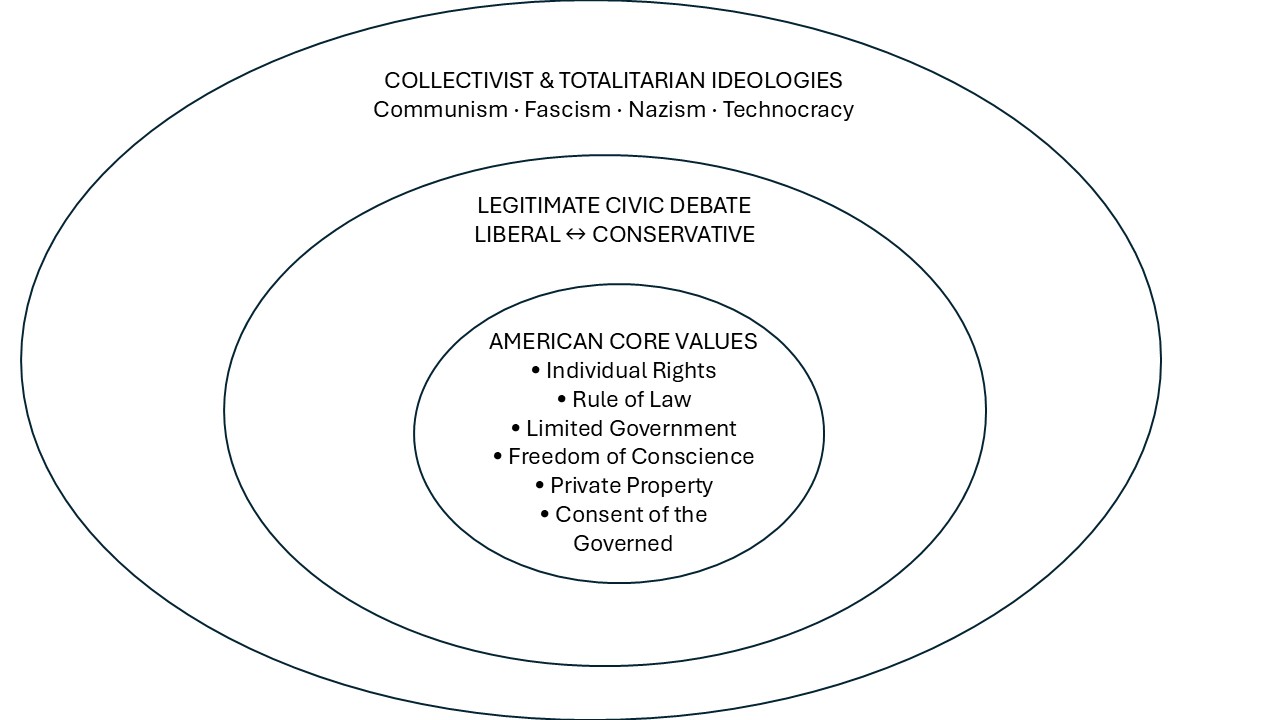
The persistent attempt to interpret modern politics along a left–right axis does not address the moral status of the individual. A better visual representation of the political spectrum would be via concentric circles (or ovals) with core American values in the middle and deviations from them in the periphery.
The American foundational values are not partisan talking points. They make up the philosophical and constitutional blueprint of the American republic and include key concepts such as inherent human rights; equality before the law; limited government; freedom of speech, religion, and association; private property and free exchange; consent of the governed; and personal responsibility.
Political disagreements consistent with these core assumptions—between classical liberal and conservative temperaments—are focused on how best to preserve and transmit these principles. Such disagreements are legitimate, necessary, and healthy. What lies outside this framework are ideologies that negate the individual as a moral end and subordinate human beings to collective abstractions such as group identity or technocratic necessity. These systems are not meaningfully “left” or “right.” They reject core American values.
Hayek’s analysis helps explain why the conventional spectrum is unhelpful: it tracks rhetorical positioning rather than moral philosophy. A values‑centered framework instead assesses political systems by the relationship they establish between the individual and the state. In this proposed model, extremism is defined not by the intensity of belief, but by distance from the individual as the fundamental moral unit. Liberal and conservative traditions orbit the same center; totalitarian ideologies fall outside the framework altogether.
Political language has been distorted to the point that it conceals rather than clarifies moral reality. The linear “left” and “right” notions are historical artifacts conscripted into service as philosophical categories they were never meant to represent. Classical liberalism and conservatism, properly understood, are complementary traditions rooted in liberty and enduring Western principles. Socialism and its ideological descendants are not merely alternative policy preferences, or pathological progressions of healthy worldviews, but fundamental rejections of core American values.
Recovering political clarity requires abandoning the linear left–right spectrum and returning to first principles: natural rights and the limits of power. As Hayek warned, a society may surrender its freedom long before it abandons the word “liberty.”
Nora D. Clinton is a Research Scholar at the Legal Insurrection Foundation. She was born and raised in Sofia, Bulgaria. She holds a PhD in Classics and has published extensively on ancient documents on stone. In 2020, she authored the popular memoir Quarantine Reflections Across Two Worlds. Nora is a co-founder of two partner charities dedicated to academic cooperation and American values. She lives in Northern Virginia with her husband and son.
CLICK HERE FOR FULL VERSION OF THIS STORY