


Beyond Left and Right: Reclaiming Political Meaning Through American Core Values
The political meanings attached to “left” and “right” evolved through multiple permutations before becoming a generalized political shorthand.
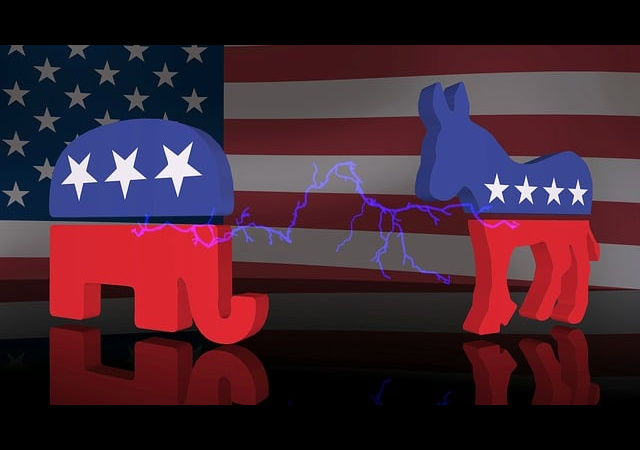
Recent developments, such as the concept of “woke right,” may cause some terminological confusion. The terms “left” and “right” originated during the French Revolution, when royalists sat to the right of the president of the National Assembly and anti‑royalists to his left.
The Baron de Gauville explained:
We began to recognize each other: those who were loyal to religion and the king took up positions to the right of the chair so as to avoid the shouts, oaths, and indecencies that enjoyed free rein in the opposing camp.
Over time, these seating arrangements changed. The political meanings attached to “left” and “right” evolved through multiple permutations before becoming a generalized political shorthand. These terms are linear and directional, making historical sense when applied to specific legislative arrangements. In modern politics, however, they have become increasingly confusing and analytically unhelpful, particularly when used to describe “radical” ideologies.
Communism is routinely described as a radical left‑wing ideology, while Nazism is labeled radical right‑wing. Yet these systems are not opposites but the two sides of the same coin; they are manifestations of rather similar collectivist and totalitarian impulses. If “right” is defined as authoritarian and “left” as democratic, then communism must be classified as right‑wing, given its consistent elimination of freedom and democratic governance wherever it has been implemented. Conversely, if “right” is understood to represent Western tradition and individual worth, and “left”—collectivism and radicalism —then National Socialism clearly occupies the leftward pole.
Authoritarian and libertarian tendencies exist across what is conventionally described as both “left” and “right.” The left–right dichotomy obfuscates essential moral and political distinctions. It separates ideologies that share fundamental premises while grouping together systems that differ profoundly in their treatment of individual rights. Fascism and National Socialism share core collectivist assumptions, a rejection of inherent individual worth and rights, and the subordination of human beings to abstract goals. Their socialist and Marxist roots and practices are well documented. As Ayn Rand observed, “racism is the lowest, most crudely primitive form of collectivism.” Marx himself rejected his Jewish heritage and expressed racist and antisemitic views, illustrating the similarity between class‑based and race‑based forms of collectivist thought.
A far clearer distinction can be drawn between classical liberal and conservative attitudes—both of which are normal and necessary components of Western political life. Conservative, from the Latin conservo, means “to preserve,” and reflects a disposition toward conserving good traditions, Biblical values, and social practices. Liberal, derived from Latin liberalis, means “pertaining to freedom” or “generous.” Properly understood, both conservatism and classical liberalism affirm individual dignity, moral responsibility, and liberty under the rule of law. Totalitarian ideologies do not represent extreme versions of these traditions; they exist on a different plane, outside of them altogether.
Classical liberalism begins with the moral primacy of the individual. It affirms innate rights to life, liberty, property, conscience, and the pursuit of happiness. Socialism, by contrast, subordinates individual rights to a claimed collective good and treats the individual as a dispensable unit in the state-run social machinery. Pol Pot reportedly remarked: “Since he is of no use anymore, there is no gain if he lives and no loss if he dies.” This cynical outlook reveals the logical endpoint of totalitarian reasoning once individual rights are forfeited. Once a society permits the state to override individual rights in the name of ostensibly noble goals, there is no principled limit to governmental power. History repeatedly confirms that such power expands beyond its original justification.
Classical liberalism respects individual rights; socialism restricts them. Friedrich Hayek addressed this confusion in the foreword to the 1956 American edition of The Road to Serfdom:
It has been part of the camouflage of leftish movements in this country, helped by the muddleheadedness of many who really believe in liberty, that “liberal” has come to mean the advocacy of almost every kind of government control. I am still puzzled why those in the United States who truly believe in liberty should not only have allowed the left to appropriate this almost indispensable term but should even have assisted by beginning to use it themselves as a term of opprobrium.
Hayek’s concern extended beyond semantics. He identified linguistic manipulation as a primary mechanism by which collectivist ideologies advance within liberal societies. When the language of freedom is employed to justify coercion, citizens lose the conceptual tools necessary to recognize the erosion of their own liberties. Restrictions are presented as expansions of freedom, and control is reframed as care. This inversion collapses vital moral distinctions. Systems that protect individual choice and systems that extinguish it are not contrasted but debated as variations and progressions along a single left–right continuum.
As Hayek showed, the road to servitude in free societies seldom begins with explicit tyranny. It advances incrementally, through measures introduced in the name of efficiency, equality, or the common good, until freedom has been subverted long before it is officially renounced. Socialism, from the Latin socialis (derived from socius, meaning “companion”), was conceived in explicit opposition to liberalism. Henri de Saint‑Simon and other early socialists advocated shared ownership of resources and an authoritarian reorganization of society. This vision anticipated not a socialist government by workers, as in the later, Marxist tradition, but technocratic rule—an idea that resembles present globalist forms of administrative and corporate‑bureaucratic collectivism.
Within Marxist theory, socialism represents a transitional stage between capitalism and communism, the latter envisioned as a utopian society without states, borders, private property, money, or other “bourgeois” institutions. Communism itself derives from Latin communis, meaning “common.” In practice, every attempt to realize these ideas has resulted in extreme centralization of power and the systematic suppression of individual rights.
The persistent attempt to interpret modern politics along a left–right axis does not address the moral status of the individual. A better visual representation of the political spectrum would be via concentric circles (or ovals) with core American values in the middle and deviations from them in the periphery.
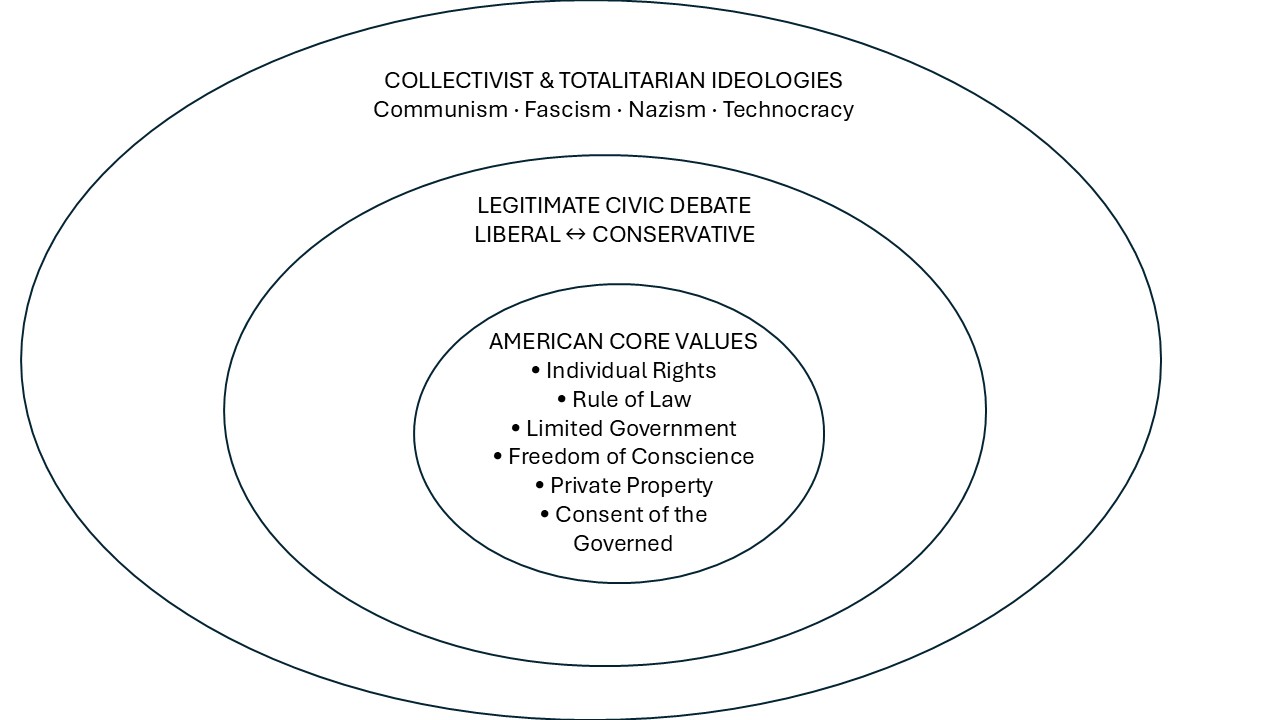
The American foundational values are not partisan talking points. They make up the philosophical and constitutional blueprint of the American republic and include key concepts such as inherent human rights; equality before the law; limited government; freedom of speech, religion, and association; private property and free exchange; consent of the governed; and personal responsibility.
Political disagreements consistent with these core assumptions—between classical liberal and conservative temperaments—are focused on how best to preserve and transmit these principles. Such disagreements are legitimate, necessary, and healthy. What lies outside this framework are ideologies that negate the individual as a moral end and subordinate human beings to collective abstractions such as group identity or technocratic necessity. These systems are not meaningfully “left” or “right.” They reject core American values.
Hayek’s analysis helps explain why the conventional spectrum is unhelpful: it tracks rhetorical positioning rather than moral philosophy. A values‑centered framework instead assesses political systems by the relationship they establish between the individual and the state. In this proposed model, extremism is defined not by the intensity of belief, but by distance from the individual as the fundamental moral unit. Liberal and conservative traditions orbit the same center; totalitarian ideologies fall outside the framework altogether.
Political language has been distorted to the point that it conceals rather than clarifies moral reality. The linear “left” and “right” notions are historical artifacts conscripted into service as philosophical categories they were never meant to represent. Classical liberalism and conservatism, properly understood, are complementary traditions rooted in liberty and enduring Western principles. Socialism and its ideological descendants are not merely alternative policy preferences, or pathological progressions of healthy worldviews, but fundamental rejections of core American values.
Recovering political clarity requires abandoning the linear left–right spectrum and returning to first principles: natural rights and the limits of power. As Hayek warned, a society may surrender its freedom long before it abandons the word “liberty.”
Nora D. Clinton is a Research Scholar at the Legal Insurrection Foundation. She was born and raised in Sofia, Bulgaria. She holds a PhD in Classics and has published extensively on ancient documents on stone. In 2020, she authored the popular memoir Quarantine Reflections Across Two Worlds. Nora is a co-founder of two partner charities dedicated to academic cooperation and American values. She lives in Northern Virginia with her husband and son.
Donations tax deductible
to the full extent allowed by law.




Comments
The left doesn’t care about your core values. They utterly detest EVERYTHING you stand for because everything you believe in stands for America.
Damn…
That’s one hell of an essay.
A tip of the hat to you, Nora. Well said.
The average successful, upper-middle-class adult is a careerist consumer, living only in the moment. He does not have the patience or attention span to read this lady’s article. He has no respect for or interest in the past; therefore can pass on no sense of heritage to his offspring.
Given this, he will not participate in a reawakening of the republic, and in sheep-like fashion will be led to the slaughter by the twisted, intellectual monomaniacs who have so successfully degraded our culture.
Only war, disease or famine can turn things around.
Sad, but I fear true for too large a segment of the population. Most only care about football, what Taylor Swift is wearing and horrendous network TV pablum. Ignorance will destroy the Republic. Not enough of us truly care.
Hard times create strong men. Strong men create good times. Good times create weak men. And, weak men create hard times.
use to get into this argument in grade school
the teacher insisted that nazism was nationalism which was patriotism
knew right then that the leftists were liars and while too young to understand at that time why they were…it became very clear quickly
I remember two disagreements with my second-grade teacher. She told me that Muslims had an equal claim to Israel because of what was written in the Qur’an after I had defended Israel by referring to the Holy Bible. Second, while she was talking about President Lincoln, I raised my hand and asked whether violating the Constitution made Lincoln a bad president. She replied that violating the Constitution made Lincoln a great president. I was flabbergasted.
Nice essay. Unfortunately there’s no reasoning with the current make up of the d/prog coalition. The ‘adults’ the doyens of the d/prog foolishly allowed the radicals to flourish in hope of using their enthusiasm to carry them to electoral power. They now face the consequences of having watered, fertilized and strengthened their own Little Shop of Horror carnivorous plant monster which demands infusions of blood to survive. The monster they nurtured will take their blood or our blood …any blood will suffice but the monster demands blood.
yeah agree
but they dont care about being sacrificed for their evil ways
same way throughout history
thats why they want the civil war ..one of the reasons
Liberty may mean freedom, and liberal associated with this notion, libertine means freedom from morals, thus absolute freedom is anarchy and lawlessness. True freedom entails limits..
“then National Socialism clearly occupies the leftward pole.” Or it is simply the way to define a Democrat who is being honest. I don’t know how the actual Democrats of today come back to the normal Overton Window of the recent past. We all know some normal Democrats though they are most likely well up in years.
The article doesn’t even mention the real political divide of the present age. The real divide is between Nationalism and Globalism, not left and right. Both Nationalism and Globalism have right wing and left wing variants. Most of the Reagan coalition were Right Wing Globalists. Trump is a Nationalist, mostly of the Right wing variety. The Leftists today are all pretty much Globalists. Most of the former “conservatives” who are now backing the Left, like Kristol, are Globalists.
What do Globalists want? Mass migration, global warming rules to limit human population, unrestricted trade with China, Feminism (which also limits reproduction), global governance with supremacy over nations, transgenderism (which also limits reproduction), global redistribution of wealth.
What do MAGA Nationalists want? The USA to be on a path to US Galactic Empire.
That was great until the last sentence. Many of us occupying the center/right populist stance from Perot Movement/Tea.Party/MAGA absolutely reject the proven disaster of globalism but we definitely don’t want an empire. The USA as the dominant (even bullying) regional hegemony in our hemisphere? Sure. Largest, strongest militarily and economically in the world while unafraid to occasionally slap down true threats Internationally or settle old scores with long-standing foes who had it coming like Iran? Sure….but not an ‘Empire’.
The problem with Empires is expansion and cost. It takes ever-increasing blood and treasure to take, hold, maintain and grow an empire. That expansion also requires a sharp rise in bureaucracy both numerically and in actual power. The bureaucracy becomes over entitled seeking special privileges as separate pseudo caste or neo aristocracy, neo clerisy. Instead we’d prefer limited govt for our continental size Nation that’s powerful enough militarily and economically to ward off challenges and willingness to use that power before a minor threat becomes big enough to grow into something more potent. Far easier to smash smaller threats away in the same manner we’d swat a mosquito ….pretty much automatically and matter of.factly without much conscious thought and at little effort with zero concern for the rights/desires of the mosquito.
If we are to survive we must expand, whether you like it or not. And the only place to expand to (besides Greenland and Antarctica) is outer space. We must take control of the moon before China does, and make the moon US territory and eventually a new State. If China gets the moon first they will turn it into a military bastion and have complete control of space travel to and from Earth. Whoever controls the moon will be in a position to control Earth. We can’t let that happen – that control must be ours. Likewise, we must grab the resources of the asteroids before someone else beats us to them. There are probably only a few dozen mineable solid metal asteroids out there, and we must take them. The resources of Jupiter and its moons are probably very valuable for interstellar expansion since Jupiter can be mined for Helium-3, a fusion fuel. From a position of dominance in the Solar System, we must develop a warp drive (or whatever technology allows interstellar flight), and expand into the Galaxy. Eventually China will expand into the Galaxy too, and I would envision two rival empires expanding into the Milky Way for millions of years.
Space exploration and eventually establishing colonies isn’t the same as creating a ‘Galactic Empire’. Why couldn’t the private sector underwrite the cost in exchange for exclusive mineral rights with an independent governing system? Colonies inevitably become weary of exploitation and limits on self rule by a distant Capital City run by people who share less and less in common as the years go by from the era establishing the settlement. I’d suggest that would intensified given the distances involved.
.
And that, children, is why we’ve had Nolan Charts since 1969.
The “oval” representation described is nothing but a topological transform of that chart, with the center shifted to be legacy America — much like the famous New Yorker cover that depicted a map of “Manhattan” that collapsed flyover country all the way out to the Pacific Ocean.
The Soviets were international socialists, evangelists. The Nazis preferred to be national socialists instead, and keep the “advantages” of socialism to their own country. Both movements were leftist, but neither one would profess any comradeship with the other… not because they were national or international socialists, but because they were Germans and Russians — a tribal hatred that went back as far as anyone could remember.
Despite the spittle-flecked imprecations of the contemporary left, not even actual fascists were on the right. Mussolini took great umbrage at the Italian socialist party demanding their ID card back, telling them, “Do not imagine that by tearing up my membership card in the Socialist Party you can forbid my socialist faith or prevent me from continuing to work for the cause of socialism and the revolution.”