


VIDEO – Trump Anti-DEI Executive Orders One-Year Later
“It’s really a fight in the trenches. It’s a fight to get them to comply. And it’s not easy.”
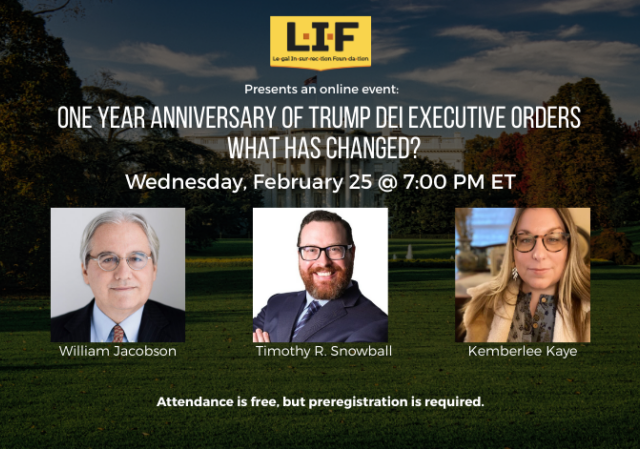
What difference does a year make? When it comes to Trump’s anti-DEI Executive Orders – a lot. We discussed that and more at our online event on February 25.
WATCH the VIDEO
TRANSCRIPT EXCERPTS (selected by speakers)
(Transcript auto-generated, may contain transcription errors, edited for transcript clarity, including combining separate sections without section breaks.)
Timothy Snowball
An executive order is a written directive with the force of law signed by the president that orders the federal government to take specific action. When you think of the federal government, think the bureaucracy, like the different departments going back to the FDR era would’ve been called the alphabet soup agencies. For example, an executive order might be telling the Department of Education to implement a certain regulatory rule or declaring a new policy priority. Interestingly, executive orders are not legislation, and they do not require approval from Congress, and Congress cannot simply overturn them. So again, they, they occupy a unique kind of niche within our constitutional structure.
I think there’s probably four main ways that President Trump’s DEI orders have been responded to. The first was a legal challenge. I’ll talk about that. That was actually recently decided by the Fourth Circuit. There has been large compliance, especially among federal agencies. There’s been some hiding going on, I think, by educational institutions in particular that have DEI programs. And then there’s been out and out ignoring these executive orders and proceeding with DEI business as usual.
The thing that I would like to see the Trump administration continue to do, and they’ve already started this, is to take some of the policy prescriptions stated in the executive orders and actually engaging in regulatory rulemaking and getting those new rules on the books. It’s much more difficult process to undo those rules once they’ve gone through the regulatory process of becoming part of the code of federal regulations. It’s easy to roll back an executive order, unfortunately. But what you want to do is you want to bake it into the system, so it’s much harder to dislodge that way. Of course, if I could wave a magic wand, I’d have Congress take some kind of action. But I think we all know that that’s probably unlikely.
I think that you have seen a cultural shift, right? So in the last year, just in the last year, it’s become okay to call out some of this nonsense. It’s been okay. People have felt safe and come out and said, ‘Wow, that sounds really racist,’ or ‘Wow, that sounds really weird.’ And I think that the farther we can push it, obviously a number of years would be great. The antidote for bad ideas is good ideas.
And these things should be challenged head on. And to the degree that people feel more and more comfortable doing that, I think hopefully you’ll see a shift in culture.
William Jacobson
You may recall that around this time a year ago, we did a program about the newly issued executive orders. At that point, they were a couple of weeks old, three weeks old, and now we have a year to look back on it. So we’re pretty excited about this….
My favorite rebranding comes from, I guess, my favorite university. Cornell <laugh>. Not only have they changed diversity, equity, and inclusion to understanding and belonging, the Office for Diversity Hiring Initiatives has now been turned into the Office of Academic Discovery. <laugh>. You can’t really make this stuff up.
And that’s what we’re facing. We are facing a situation where the aggressiveness of the Trump administration, at least at the executive order level, and to some extent, the enforcement level, has caused people to hide… One of the things, the Equal Protection Project, we have definitely noticed is that web pages are being taken down. You could almost hear the clicks taking down webpages soon after the 2024 election because they knew what was coming.
They are putting increasingly material that they used to brag about and was open to the public on the internet. They’re putting it behind login walls. So there is a wide range of evasiveness….
Our approach has been at the Equal Protection Project to fight this, to use an analogy, house by house, street by street. There is a publication that’s the premier publication in, uh, higher Education, the Chronicle of Higher Ed. And they did a profile of me and a profile of our efforts against DEI and said that we are “committed to rooting out race consciousness from higher education one program at a time.” And that’s pretty much what we’ve been doing…
And so now we’re going literally school by school. We’re now up to, and these may be a little out of date, we might be a little higher right now, at the Equal Protection Project we’ve challenged 275 schools regarding over 750 programs and scholarships, resulting in 40 federal investigations. And over 175 of what we call wins and impacts…..
It’s really a fight in the trenches. It’s a fight to get them to comply. And it’s not easy, and I don’t want to to kid you about that because they are hiding stuff. They are concealing it, and they are trying to word around it…. So this is where the fight is going. It’s trench warfare against these programs because the schools don’t want to get rid of them.
Kemberlee Kaye
This conversation just reminded me of what I think is definitely a cultural victory, and one which we were able to help produce.
The fact that when we started this several years ago, we would talk to state level legislators and stakeholders, especially in red states, about how pervasive this [DEI] problem was, even on publicly funded campuses in these very deep red locations – no one believed us. We were laughed at about this issue,because there was this belief that because in a red state, surely we wouldn’t be dealing with this Marxist ideology. But because of our work, because we have been diligent in multiple ways to continue to expose this issue everywhere – we’re not just looking at Ivy League schools, we’re not just looking at the largest state sponsored schools, we’re looking at community colleges like, no one is safe from the EPP reach. And I want it that way.
We’re not just trying to educate the general public. We’re not just filing complaints with federal agencies. Of course, we’re always looking for plaintiffs for cases that we can make a broader impact in, in that way as well. But it’s also in communicating to everyone involved that has the opportunity to make a difference and to make a change here. We’re communicating what is happening and what our research is exposing.
But more broadly, what we are doing and what we’re focused on painting a broader picture of how deeply entrenched this ideology is. Because it’s not just race. It’s not just sex discrimination, it’s all of these things that are encompassed under the umbrella of intersectionality. And our research is beginning to reflect that.
So we’re looking at how schools are handling transgender issues. We’re looking at how they’re handling immigration response. We’re looking at how they’re handling discrimination response, even how they’re handling antisemitism and anti-Americanism on campus, because those are just as important. And they’re all part of the same ideology that is being pushed in multiple facets in education, not just in higher education, but in K through 12. So we have adjusted our research, we have moved, from just updating the data, which has been a tremendous tool.
We’ve heard from state legislators, parents, and students. I love that our data is neutral enough that the feedback we get is about 50-50. About half the people that respond say that they love it and it’s been a tremendous resource for them the other half think that we’re promoting CRT, which we’re obviously not. We are just shining a light on what’s happening so people can do what they want to with it. But we have moved beyond simply updating and growing our data set to conducting original research into what’s happening on these campuses, really as we notice trends towards one direction o another. And any of what, I guess I would call one of the bullet points that falls under intersectionality
Donations tax deductible
to the full extent allowed by law.


Comments
heres another reason its not easy as a judge throws out potus djt and kari lakes actions and then worst yet read how this VOI is not even promoting America:
A federal judge ruled Saturday that Kari Lake unlawfully led the US Agency for Global Media (USAGM) for several months last year and voided mass layoffs and other actions taken during that period to dismantle the agency.
https://www.theguardian.com/us-news/2026/mar/08/kari-lake-us-media-agency-voice-of-america?utm_source=firefox-newtab-en-us
BUT THEN you read up on the communist lovn Fks who are supporting anything but trump and america:
Patsy Widakuswara is an Indonesian–American[1]
November 2023. US senators were annoyed that the VOA was refusing to use the term “terrorists” to refer to the Hamas in Gaza. The VOA’s line at the time was in line with the BBC’s in that they only used the term when it was from a quote. They argued that the word was politicised and the listener should be allowed to decide who was in the wrong and who was in the right.[11]
https://en.wikipedia.org/wiki/Patsy_Widakuswara
so its much appreciated that the LI fights for america
but how much of a fight can we have when are hands are tied behind our backs with the dei and the voa etc etc??!?!?!?!!