


NASA Scraps Lunar Station, Directs $20 Billion to Moon Base and Mars Nuclear Push
Meanwhile, Artemis II is poised to take advantage of early April launch opportunities while the race to build the lunar landers continue.
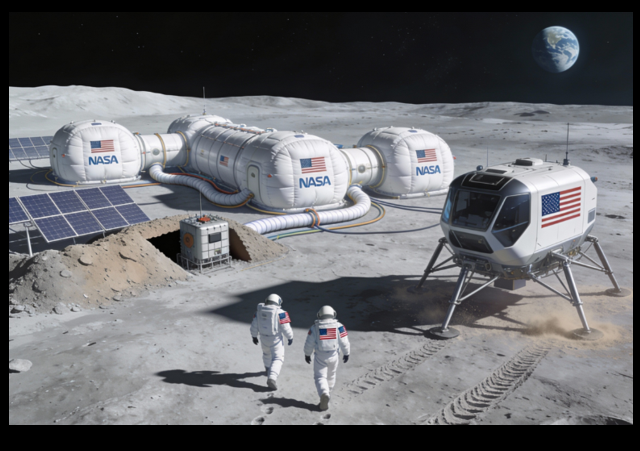
Earlier this month, I reported that the National Aeronautics and Space Administration (NASA) had substantially revised its launch timing and mission scope for the Artemis program. These missions are geared to landing on the Moon.
But how about staying there?
I noted that when he first became NASA’s administrator, Jared Isaacman promised to build a Moon Base.
We are going to build a Moon base
— NASA Administrator Jared Isaacman (@NASAAdmin) December 27, 2025
Now, the agency has further revised its lunar plans. It is jettisoning plans for a lunar space station to focus on building a Moon Base.
NASA announced on Tuesday it has canceled plans to deploy a space station in lunar orbit and will instead use components from the project to build a $20 billion base on the moon’s surface, while also planning to send a nuclear-powered spacecraft to Mars.
U.S. space agency chief Jared Isaacman, an appointee of President Donald Trump who took charge at NASA in December, announced an array of changes to the Artemis moon program including an aim to send more robotic landers to the moon and lay the groundwork for using nuclear power on the lunar surface.
NASA also disclosed plans to launch a spacecraft called Space Reactor 1 Freedom to Mars before the end of 2028 in a mission it said would demonstrate advanced nuclear electric propulsion in deep space. NASA called this a major step forward in bringing nuclear power and propulsion from the laboratory to space. NASA said the spacecraft, once it reaches Earth’s planetary neighbor, will deploy helicopters for exploring Mars.
To build a sustained human presence on the Moon, we are building @NASAMoonBase, prioritizing surface operations and scalable infrastructure.
– Frequent robotic landings and mobility testing including MoonFall drones
– Starting in 2027 nearly monthly cadence of equipment and… pic.twitter.com/3T00Y450kO— NASA Administrator Jared Isaacman (@NASAAdmin) March 24, 2026
The announcement was the first time NASA had revealed a timeline and road map for such efforts.
Plans for a moon base would proceed in three phases, Mr. Isaacman said. The first would seek to replace one-off bespoke missions with a “templated approach that will generate significant learning through experimentation,” he said.
That will include small robotic landers, the delivery of vehicles that can drive astronauts along the surface and the development of other systems like communications and scientific instruments.
The second phase will consist of “semi-habitable infrastructure” that will allow regular visits of astronauts on the lunar surface. The third phase would begin the construction of permanent infrastructure that would allow a continuing human presence there.
“The moon base will not appear overnight,” Mr. Isaacman said. To cover the first two phases, he said, “we will invest approximately $20 billion over the next seven years and build it through dozens of missions.”
The goal is not just to reach the Moon, but to stay. 🌘 https://t.co/b24OqEEQb9 pic.twitter.com/5WPHYRNmeO
— The White House (@WhiteHouse) March 24, 2026
Meanwhile, Artemis II is poised to take advantage of early-April launch opportunities while the race to build lunar landers continues.
Currently, Jeff Bezos’ Blue Origin and Elon Musk’s SpaceX are also racing to develop the lunar landers needed to ferry astronauts from Orion down to the moon’s surface. Recent NASA oversight reports have warned that the companies’ efforts lag behind schedule and risk pushing the agency’s plans to land humans on the moon beyond the 2028 goal. Both companies have submitted proposals to NASA for expediting their lunar lander development, but officials have declined to provide details about the plans.
Speaking to a room of industry personnel and other space officials, Isaacman warned: “Expect uncomfortable action” if companies underperform on their contracts. That could suggest Isaacman is more willing than his predecessors to pull the cord on projects that turn out to be more costly, difficult and time-consuming than initially thought.
And there is a strong incentive for these missions to succeed.
The rush to return to the satellite first reached by the Apollo 11 mission in July 1969 comes as China works on its own moon mission, aiming to land on the orb in 2030. China and Russia have also touted plans to build a nuclear power plant on the orb’s south pole, as they aim to develop their International Lunar Research Station (ILRS) by 2036.
NASA’s new direction makes one point crystal clear: This time, we are not going back to plant a few flags and footprints, but to build a foothold on the lunar surface that rivals anything Beijing and Moscow are planning.
With a $20 billion moon base, nuclear power on tap, and a tough administrator promising “uncomfortable action” for underperforming contractors, the Artemis reboot looks like a serious bid to secure the ultimate high ground before China’s 2030 deadline comes due.
Here’s hoping all systems are go!
There’s more destiny to manifest. https://t.co/qRBVQwar2V pic.twitter.com/anqAQys5dl
— memetic_sisyphus (@memeticsisyphus) March 24, 2026
Donations tax deductible
to the full extent allowed by law.






Comments
From “keeping up with the Jones” to “keeping up with the Musks.”
Can we admit Artemis has been the same kind of boondoggle California is trained in nowhere is? We’re decades behind and way over budget and we’re still messing around here well it’ll be next week next month how long before we can actually stick a fork in it and do something that works.
How can we proceed with any of this? We’re bankrupt.
Monopoly money. Same as everything else.
What’s the difference between a ”lunar station” and a “moon base”?
Probably several tens of billions to the “right” government contractors.
I believe the plan was to build a station in lunar orbit to be used as a gateway to either the moon or mars.
Nothing, since NASA isn’t going to actually build either of them. They can’t even put people in space and they’re BSing about building moon bases.
“NASA announced on Tuesday it has canceled plans to deploy a space station in lunar orbit“
If the SpaceX Starship is successful, it will be a paradigm shift. Everything will change when we can get out of the gravity well at a modest cost. All the plans will be disrupted.
Yeah, the SpaceX Falcon Heavy has already reduced the cost of lifting cargo into orbit by 10-20X compared to less than a generation ago. Starship will supposedly reduce it another 10-100X from there.
Musk just thinks on a different scale. All his talk lately about data centers in space is mind boggling… no cooling problem, massive amounts of consistent solar energy.
I am not sure Musk thinks on a different scale rather than having the people who work for him think on a different scale (and then Musk signs on.)
One of the differences between government and private enterprises is the government wants to create “boxes” in which to keep ideas and people in, while private enterprise looks to escape those boxes and constraints.
Well, partly true. Yes, there is much more solar energy available per square foot. However cooling is always one of the biggest problems in space. There is no atmosphere, so heat, once generated, does not naturally dissipate. You have to build heat radiators to get rid of the heat, and they have to operate in the shadows where there is a heat differential. You cannot dissipate heat in the sunlight.
Similar problems on the lunar surface — two weeks of sunlight generates very high temperatures, then two weeks of darkness makes it really cold. Heat management will be a critical part of any Moon base.
I suspect that this has a couple of purposes – but this is just me talking – so I’m open to other theories.
1. Remember the Space Race with the Soviets? Well this is the Chinese variant of the same game. It’s not so much that we want to beat the Chinese as that we don’t want them to beat us. If the Chinese establish a base or station on the moon before we do they are never going to shut up about it.
2. Remember Tang, the astronaut’s drink? There was a lot of research stimulated by the space program in the 1960’s. Here, I think the focus is on
development of small nuclear power plants. Where better to test them safely than in space? This would fit in very well with Trump’s pro-nuclear energy independence plans. NASA also disclosed plans to launch a spacecraft called Space Reactor 1 Freedom to Mars before the end of 2028 in a mission it said would demonstrate advanced nuclear electric propulsion in deep space..
3. $20 billion ain’t much in the bigger scheme of things. That amount doesn’t really signal a huge commitment.
as long as
1) we can destroy anti maga forces from there..its all good
2) the dems never take control
I don’t believe the timeline. Anyone know where I can bet against it?
As for the plans itself, sorry, Considering our financial state I;m not sure we can do this alone. I’m not sure we should do this alone. Of course I’m not sure who I trust to partner with.
China and Russia can proceed with their plans because they aren’t world policeman and can afford to screw their populations to provide money to their space efforts. The US can’t do that, Well it does screw its population but it has to be careful how it screws it over and by how much.
This is a big improvement over the current state. However, there is one detail I think is in error and needs to change: while nuckear systems engineering is a great idea and should occur in parallel, at least one goal depends on nuclear system where a chemical system would suffice. This adds significant mission risk since such advanced technology programs are routinely cut from budgets. The most recent example was the patient attempt to resurrect NTR. The result: cancelled. When we have a real human space flight program again and it is time to do a mission that requires nuclear, it will get done. Finding a reason to add it into the current mix is a too-good-to-be-true kind of risk add-on.
Using so many rockets is stupid, when for far less money, we can solve the materials science challenges, and build a space elevator.
The space elevator represents a material science and construction challenge far in excess of a suitable rocket development program. Would be cool, though.
Aside from the materials issue the challenge of a space elevator is you have to build it on the equator. So where would you build it?
The Democratic Republic of the Congo. That way a highly educated local labor pool could build and operate it.
Argentina, Brazil, India perhaps. I am not sure it has to be right on the equator, although I haven’t researched it. I think it’s likely building it on a mountain would help.
One of the drawbacks? Perhaps the biggest terrorism target ever. Think of it being severed and then you have 20,000 miles of super strong nearly indestructible cable falling back to earth. Of course, severing it would probably be a major technical challenge.
A lunar space station would never work, there is no truly stable orbit around the moon. The gravity changes too much. It would need constant station keeping thrusts.
The lunar toll booth also defeats the purpose of going to the moon. The point is to stay and work on the moon, not to minimize contact with the moon in favor of a complicated, expensive, vendor-driven mission architecture.
The advantage of a lunar space station is that two types of ships could be used. One between earth and the station and the other between the station and the moon, Of course this could also be accomplished by having the station in earth orbit but the station to moon ship would be different.
I don’t recall why a lunar station was proposed originally other than to use it for staging missions to mars.
“Directs $20 Billion to Moon Base and Mars Nuclear Push”
NASA is to Republicans what USAID is to Democrats.
I’m sorry to have arrived there, but there I am.
$20B so a government agency can establish a base that they can’t actually use for anything we want or need because the pin-striped cookie-pushers will insist it’s undiplomatic, or against some treaty, or something.
It’s like colonizing the moon only to house another 53 Republican senators.
And what’s the goal? “Scientific progress?” No thanks, I’ve already seen what the government turns into when it thinks it is the arbiter of science. Science is nowhere a delegated constitutional power (patents and standards are commercial constructs).
Let a moonbase be commercially funded and profit goals be commercially established. Colonizing is a tried and true economic model, complicated only by the presence of indigenes, but… guess what?