


Squeezing California – Equal Protection Project Fighting Higher Ed DEI Discrimination Statewide
My Op-Ed at the California Post: “Higher education in the state is addicted to group identity, stacking educational benefits and opportunities based on race and ethnicity…. Trying to get discriminatory group identity politics out of higher education is like trying to get soap out of a sponge. We are going to keep squeezing.”
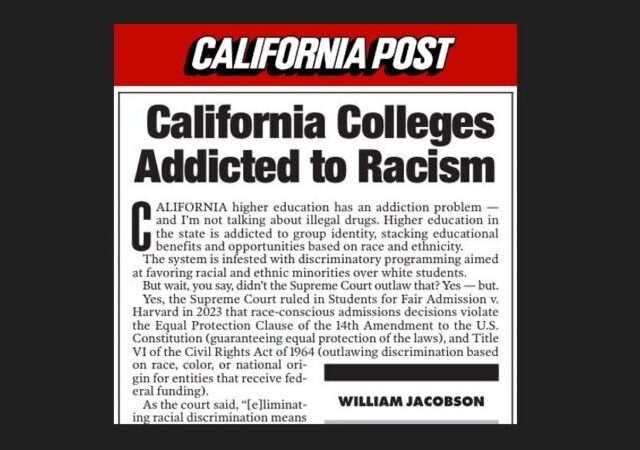
Since its launch in February 2023, The Equal Protection Project has challenged over 275 colleges and universities regarding over 750 programs that discriminated as part of Diversity, Equity, and Inclusion (DEI) efforts. We have over 175 wins/impacts and have seen over 40 federal investigations launched after our civil rights complaints, and absolutely massive earned media. (See EPP Year-end 2025 Impact Report.) We are rapidly expanding, adding just today our third full-time in-house attorney and new Chief Counsel – more on that to come.
We’ve had many cases in California for obvious reasons – its where so many of the problems are. Our most recent was a filing earlier this week against UC-Berkeley regarding five racially-discriminatory programs. That generated substantial media, so much so that we received a request from the newly-launched California Post to write about the DEI problems in the state.
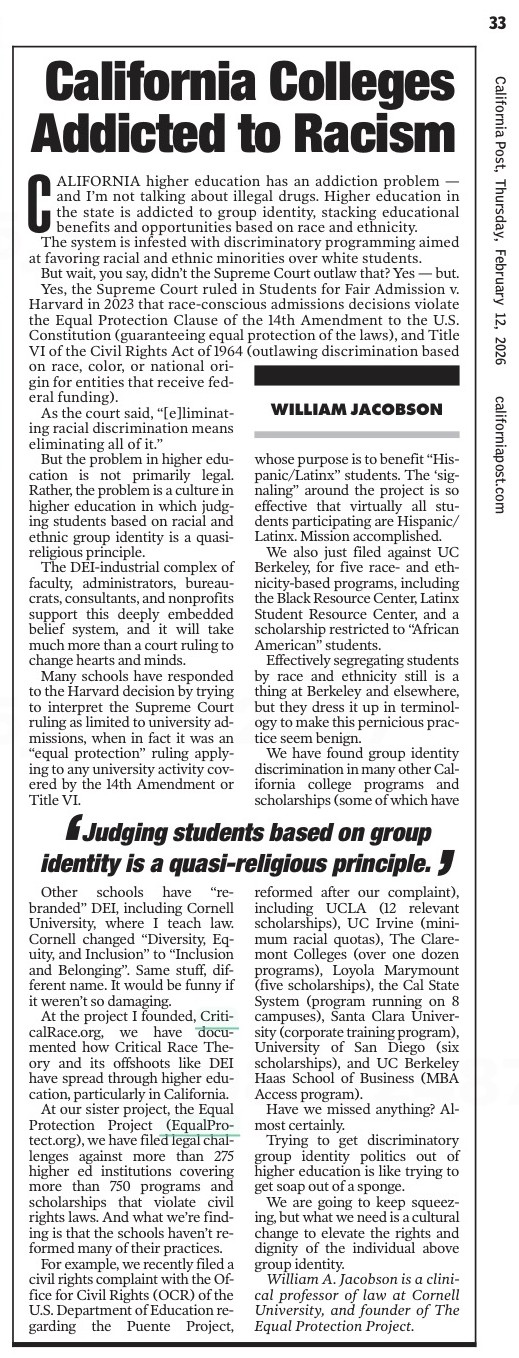
My Op-Ed is now out, and ran in both the California Post and the NY Post, Racism survives on California campuses — here’s how we’re fighting it:
California higher education has an addiction problem — and I’m not talking about illegal drugs.
Higher education in the state is addicted to group identity, stacking educational benefits and opportunities based on race and ethnicity.
The system is infested with discriminatory programming aimed at favoring racial and ethnic minorities over white students.
But wait, you say, didn’t the Supreme Court outlaw that?
Yes — but.
Yes, the Supreme Court ruled in Students for Fair Admission v. Harvard in 2023 that race-conscious admissions decisions violate the Equal Protection Clause of the 14th Amendment to the U.S. Constitution (guaranteeing equal protection of the laws), and Title VI of the Civil Rights Act of 1964 (outlawing discrimination based on race, color, or national origin for entities that receive federal funding).
As the court said, “[e]liminating racial discrimination means eliminating all of it.”
But the problem in higher education is not primarily legal. Rather, the problem is a culture in higher education in which judging students based racial and ethnic group identity is a quasi-religious principle.
The Diversity, Equity, and Inclusion (DEI)-industrial complex of faculty, administrators, government bureaucrats, consultants, and nonprofits support this deeply embedded belief system, and it will take much more than a court ruling to change hearts and minds.
Many schools have responded to the Harvard decision by trying to interpret the Supreme Court ruling as limited to university admissions, when in fact it was an “equal protection” ruling applying to any university activity covered by the 14th Amendment or Title VI.
Other schools have “rebranded” DEI, including Cornell University, where I teach law. Cornell changed “Diversity, Equity, and Inclusion” to “Inclusion and Belonging.” Same stuff, different name. It would be funny if it weren’t so damaging.
At the project I founded, CriticalRace.org, we have documented how Critical Race Theory and its offshoots like DEI have spread throughout higher education, particularly in California. We cover more than 700 higher education institutions, including medical schools, and it’s horrifying how much mental and monetary effort is expended on checking racial and ethnic boxes and racially gerrymandering education.
At our sister project, the Equal Protection Project (EqualProtect.org), we have filed legal challenges against more than 275 higher ed institutions covering more than 750 programs and scholarships that violate civil rights laws. And what we’re finding is that the schools haven’t reformed many of their practices.
For example, we recently filed a civil rights complaint with the Office for Civil Rights (OCR) of the U.S. Department of Education regarding the Puente Project, which runs at 65 California community colleges. The Puente Project provides widespread educational benefits for students transitioning to state universities — including counseling, mentoring, academic courses, priority registration, and advantages in consideration of their University of California (UC) and California state college applications.
The Puente Project’s purpose is to benefit “Hispanic/Latinx” students. The “signaling” around the project is so effective that virtually all students participating are Hispanic/Latinx. A program designed and promoted as being for Hispanics attracts almost exclusively Hispanics. Mission accomplished.
We also just filed against UC Berkeley, for five race- and ethnicity-based programs, including the Black Resource Center, Latinx Student Resource Center, and a scholarship restricted to “African American” students.
Effectively segregating students by race and ethnicity still is a thing at Berkeley and elsewhere, but they dress it up in terminology to make this pernicious practice seem benign. Yet under well-settled law set forth in our Civil Rights Complaint, racial and ethnic signaling (such as naming a program as being for a certain group) is a civil rights violation because it would likely dissuade students from other racial and ethnic groups from applying or attempting to participate.
Trying to get discriminatory group identity politics out of higher education is like trying to get soap out of a sponge.
We have found group identity discrimination in many other California college programs and scholarships (some of which have reformed after our complaint), including UCLA (12 relevant scholarships), UC Irvine (minimum racial quotas), The Claremont Colleges (more than one dozen programs), Loyola Marymount (five scholarships), the Cal State System (program running on 8 campuses), Santa Clara University (corporate training program), University of San Diego (six scholarships), and UC Berkeley Haas School of Business (MBA Access program).
Have we missed anything? Almost certainly.
We are going to keep squeezing, but what we need is a cultural change to elevate the rights and dignity of the individual above group identity.
====================
Reminder: we are a small organization going up against powerful and wealthy government and private institutions devoted to DEI discrimination. Donations are greatly needed and appreciated.
Donations tax deductible
to the full extent allowed by law.





Comments
What is happening in California higher education and elsewhere is the new Lost Cause. After the Civil War, the former confederates were successful in thwarting true civil rights for 80+ years. They did this by promulgating the Lost Cause myth. The central element of this myth is to never talk openly about their true cause of black subjugation but to pursue it ruthlessly at all times.
At this time, the DEI forces are in retreat, but this is only temporary.
The new DEI Lost Cause will continue cleansing higher ed of all non-DEI thoughts, words, and personnel. Students will either agree or be forced to keep their mouths shut. The racial quotas will return. DEI statements will again be required in job applications and used to screen out the impure applicants. These California administrators and professors are angry, and they are biding their time until they can rise again.
Racism doesn’t just survive on campus; it thrives.
Consider how fast and virulently racism, socialism/communism, transgenderism, critical race theory etc. has infested higher “education.”
I recall once that some hypnotist once said that scientists etc. were the easiest to hypnotize because their hubris insisted that they did not have the kind of “weak mind” that would succumb to such a thing.
It seems like the easy submission to hypnotism was the tip of the iceberg seeking to sink the country.
These programs are clearly illegal under California’s constitution and Proposition 209. How are the colleges able to get around this prohibition?
Enforcement, or lack thereof.
Professor, does Cornell still have commencement ceremonies for specific races or LGBTQ+++members? And dormitories only for “Latinx or Black or Pacific Islanders”? Or have you successfully eradicated those?
Please do not fail to overlook that the preference systems — since the inception of “Affirmative” [sic] Action in 1972 — have aimed at giving preferences to TWO “categories” of persons: (1) “minorities”; and, (2) females.
^^^this^^^