


Rubio Warns Europe: Climate Self-Sabotage and Open Borders Weaken the West
“In a pursuit of a world without borders, we opened our doors to an unprecedented wave of mass migration that threatens the cohesion of our societies.”
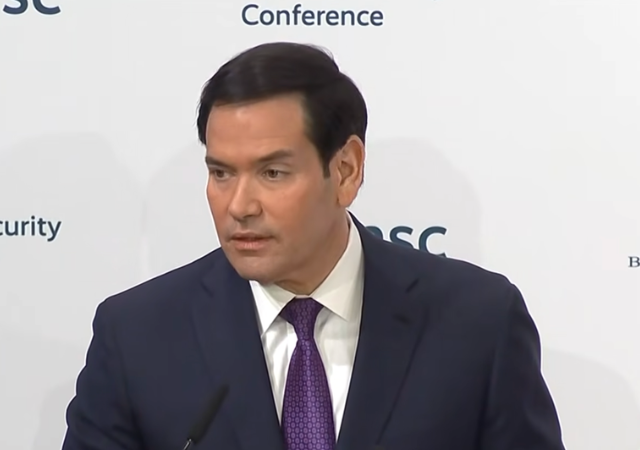
When Marco Rubio addressed the Munich Security Conference, he did not deliver the jolt that Vice President JD Vance delivered a year earlier. The temperature was lower. The message was not.
What Rubio offered was not simply policy criticism. It was a reframing of the transatlantic alliance around sovereignty rather than supranational management. His argument was that the West’s central error since the end of the Cold War was not insufficient cooperation, but the erosion of national self-determination in the name of global consensus.
Rubio described the post–Cold War era as a “dangerous delusion” that history had ended, that nationhood would dissolve into trade flows, and that borders would become obsolete. That assumption, he argued, produced a generation of policy choices that weakened Western economies and hollowed out political cohesion.
Rubio did not shout. He did not scold. But he was unmistakably clear. Watch:
‼️‼️‼️🇺🇲🇪🇺 Putin's dream, which involves the collapse of the transatlantic unity between the US and Europe and the sowing of alienation between them, was shattered by the US Secretary of State a few hours ago during his historic speech at the Munich conference.
🇺🇸🇪🇺🇬🇧🫡 Marco… pic.twitter.com/LrwOu1arPB
— Visioner (@visionergeo) February 14, 2026
Two examples carried the weight of his argument: climate policy and mass migration.
On energy, Rubio rejected what he framed as economic self-constraint imposed in pursuit of moral signaling.
“To appease a climate cult, we have imposed energy policies on ourselves that are impoverishing our people, even as our competitors exploit oil and coal and natural gas… not just to power their economies, but to use as leverage against our own.”
The critique was not about environmental stewardship in the abstract. It was about asymmetry. While European governments tighten industrial regulations and energy mandates, geopolitical competitors expand fossil fuel output without hesitation. Rubio’s warning was strategic: unilateral contraction in the name of climate virtue reduces leverage and increases dependency.
Migration formed the second pillar of his case.
“In a pursuit of a world without borders, we opened our doors to an unprecedented wave of mass migration that threatens the cohesion of our societies, the continuity of our culture, and the future of our people.”
He anticipated the pushback.
“Controlling who and how many people enter our countries… is not an expression of xenophobia. It is not hate. It is a fundamental act of national sovereignty.”
That language increasingly reflects European politics as well. Across the continent, voters have elevated parties promising border control, energy realism, and resistance to technocratic overreach. Rubio’s critique is not merely American pressure. It mirrors growing public dissatisfaction within Europe itself.
The Associated Press described the speech as “a less aggressive but still firm tone.” The softer delivery likely mattered in the room. But the substance was unmistakable.
As the AP framed it:
“U.S. Secretary of State Marco Rubio offered a reassuring message to America’s allies on Saturday, striking a less aggressive but still firm tone about the administration’s intent to reshape the trans-Atlantic alliance and push its priorities.”
That description captures the stylistic shift. Rubio reaffirmed that America “will always be a child of Europe” while simultaneously rejecting an alliance “paralyzed… by fear, fear of climate change, fear of war, fear of technology.”
The divide he articulated is philosophical. Brussels speaks of digital sovereignty, managed interdependence, and regulatory consensus. Rubio spoke of nationhood, industrial capacity, border control, and civilizational confidence. He is not arguing for isolation. He is arguing for alliances of sovereign states rather than systems that subordinate national decision-making to institutional orthodoxy.
The tone may have been diplomatic. The doctrine was not.
If the post-1991 era was defined by faith in borderless globalism, Rubio’s Munich address signals something different: a Western alliance rebuilt not on managed decline, but on the recovery of national control.
And if there is any doubt about how firmly he meant it, his full remarks leave little ambiguity.
Donations tax deductible
to the full extent allowed by law.




Comments
Well done Marco. Unfortunately our local communists and those in Europe don’t care especially those in government elected and hired.
It’s cute that he still thinks that they don’t know what’s going on. This is by design, Marco. They want this.
I’m sure he is well aware of what they want. He’s no dummy.
The EU bureaucrats and their politcal stooges in France, Britain, and Germany are not going to pay any attention to what Rubio and Trump are telling them, and they ae quite prepared to jettison elections in order to maintain their grasp on power.
True in US for progressives except instead of jettisoning elections they are corrupting them while attempting to maintain the fiction of fair elections.
Revoking Karl Popper’s and his graduate student George Soros’ “Postwar Consensus”. One hopes it is not too late.
Mar o Rubio is once again “The Man”. Bravo sir!
The Europeans in power, and many who aren’t, consider Americans inferior – even though we saved their hides twice in the first half of the twentieth century and a third time in the second half. Calling them Eurosnobs is accurate but they’re too arrogant to learn from it and modify their behavior.
Prove me wrong.
.