Maine is now exhibiting the same early-stage warning signs that preceded Minnesota’s rapid descent into open conflict with federal immigration enforcement. What began in Minnesota as rhetoric and “resistance” language from elected officials quickly escalated into coordinated obstruction, organized street confrontations, lawsuits against the federal government, and ultimately violence against Immigration and Customs Enforcement (ICE) agents. Maine’s trajectory, driven by policy decisions and internal directives from the Secretary of State’s office, closely mirrors that same path.
The flashpoint in Maine centers on Secretary of State Shenna Bellows, who abruptly revoked confidential license plates used by undercover federal law enforcement vehicles. These plates are a long-standing safety measure designed to prevent agents from being identified, tracked, or targeted while conducting sensitive operations. Federal officials were notified of the change without prior consultation, prompting immediate concern from multiple agencies.
Supervisory Deputy U.S. Marshal Ryan Guay confirmed the scope of the disruption:
“I have received several inquiries from other federal law enforcement agencies that are now facing the same issue when they are trying to renew their undercover vehicle registrations.”
The longer statement was released on Twitter/X:
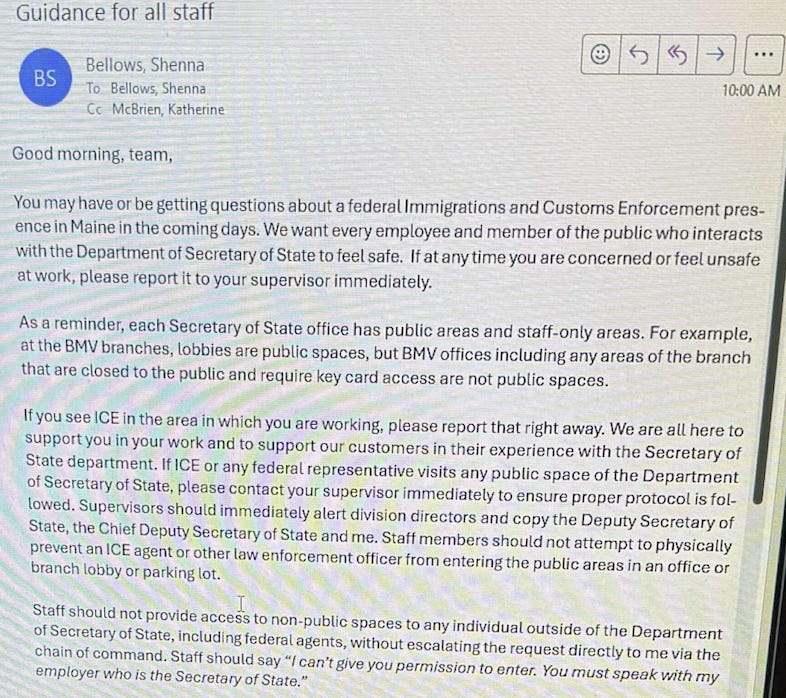
Even more alarming was what happened the same day the confidential plates were revoked. Bellows issued an internal email instructing state employees to actively monitor ICE activity and report it directly to her office, not only inside government buildings, but in the surrounding areas as well:
“If you see ICE in the area in which you are working, please report that right away.”
The email effectively transforms taxpayer-funded state employees into a surveillance apparatus aimed at federal law enforcement. This is not passive non-cooperation; it is active intelligence gathering against ICE, precisely the environment that allowed Minnesota activist networks to flourish.
Legal Insurrection documented how similar rhetoric and signaling from Minnesota officials emboldened activists to interfere physically with ICE operations, culminating in organized efforts to identify agents, block enforcement actions, and “de-arrest” detainees:
“What the Renee Good case ultimately revealed is a well-worn strategy: delegitimize law enforcement, distort the facts, and inflame public emotion before the truth has any chance to surface.”
That atmosphere did not remain theoretical. Minnesota Gov. Tim Walz publicly urged residents to film ICE agents, compile databases of alleged “atrocities,” and engage in what he openly described as “resistance.” The result was a predictable escalation.
As Legal Insurrection warned at the time:
“Incendiary rhetoric like this is exactly why agents are being harassed and assaulted.”
Once tensions boiled over, Minnesota officials responded not by de-escalating, but by suing the Department of Homeland Security in an effort to halt ICE operations entirely, effectively asserting state veto power over federal law enforcement:
“You don’t get to veto enforcement of federal law.”
Maine has not yet reached that stage. But the sequence is unmistakable: unmask federal agents, mobilize state employees to monitor ICE, legitimize resistance, then feign surprise when confrontations and instability follow. Minnesota’s experience shows that once this process begins, it accelerates rapidly and rarely ends well.
The lesson is clear. Maine is no longer merely flirting with sanctuary politics. It is actively adopting the same structural and rhetorical choices that turned Minnesota into a national cautionary tale. If state leaders continue down this road, Maine may soon discover, too late, that becoming “the next Minnesota” comes with consequences they can no longer control.
CLICK HERE FOR FULL VERSION OF THIS STORY