


Appeals Court: Judge had No Jurisdiction to Release Mahmoud Khalil
“Did the Immigration and Nationality Act (INA) strip the New Jersey District Court of subject matter jurisdiction? It did.”
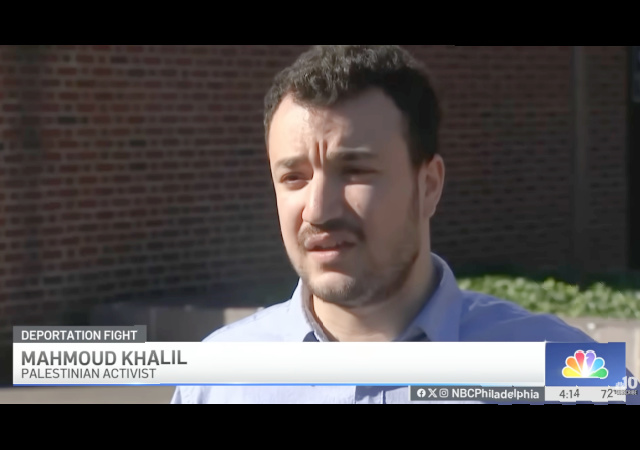
The U.S. Court of Appeals for the Third Circuit ruled that District Judge Michael Farbiarz in New Jersey did not have jurisdiction to release anti-Israel Columbia University student Mahmoud Khalil.
From the opinion:
Our conclusion about habeas jurisdiction requires us to answer a second question: Did the Immigration and Nationality Act (INA) strip the New Jersey District Court of subject matter jurisdiction? It did. Because the INA channels “[j]udicial review of all questions of law . . . arising from any action taken or proceeding brought to remove an alien from the United States” into a single petition for review filed with a federal court of appeals, we hold that the District Court lacked jurisdiction over Khalil’s removal proceedings. 8 U.S.C. §1252(b)(9).
Khalil shot to fame during Columbia’s anti-Israel protests as the lead negotiator.
The drama started last March. ICE detained Khalil in compliance with President Donald Trump’s orders prohibiting antisemitism.
The administration said that Khalil led activities aligned with Hamas, so it revoked his visa.
Links:
- March 9: ICE Detain Columbia Activist in Trump Crackdown on Pro-Palestinian Protests (Update: White House Responds)
- April 11: Judge Says Trump Can Deport Mahmoud Khalil
- June 11: Judge Temporarily Blocks Mahmoud Khalil’s Deportation, Allows His Release
- June 21: Judge Orders Release of Mahmoud Khalil
Well, there’s a pesky rule called district-of-confinement, which states that district courts can grant habeas relief only “within their jurisdictions.”
Let’s concentrate on the INA. The Third Circuit said that the District Court has habeas jurisdiction, but it needed subject-matter jurisdiction:
The District Court correctly held that it had habeas jurisdiction over Khalil’s petition. But that was only half of the jurisdictional puzzle. The District Court also needed subject-matter jurisdiction over the action. Yet various provisions of the INA limit an alien’s ability to collaterally attack (challenge) ongoing immigration proceedings through habeas. The District Court did not see those limits as barring subject matter jurisdiction over Khalil’s claims. We disagree. As we explain, 8 U.S.C. §1252(b)(9) strips the District Court of jurisdiction, requiring Khalil to wait to raise his claims until he files a petition for review (PFR) of a final order of removal. So we need not reach the government’s alternative argument that §1252(g) also bars jurisdiction.
Besides jurisdiction, the Third Circuit cited 8 U.S.C. §1252(b)(9) to dispute Khalil’s claims that his removal and detention are unlawful.
The Third Circuit stressed: “That subsection provides: ‘Judicial review of all questions of law and fact . . . arising from any action taken or proceeding brought to remove an alien from the United States . . . shall be available only in judicial review of a final order [of removal].’ (emphasis added).”
Language is important, which is why the court emphasized those phrases:
Khalil does not dispute that his detention is an “action taken” as a part of his removal proceedings. See Carlson v. Landon, 342 U.S. 524, 538 (1952) (detention is “necessarily” a part of the removal process). And removal proceedings are “proceedings brought to remove an alien.” E.O.H.C. v. Sec’y, U.S. Dep’t of Homeland Sec., 950 F.3d 177, 184 (3d Cir. 2020). The question is whether Khalil’s claims “aris[e] from” that action or proceeding.
Khalil described his claims as “now-or-never ones” since “his injuries are ongoing and his rights are ‘being violated, now.'”
Well, a “now-or-never” claim “raises questions that cannot be reviewed later, on a petition for review of a final order of removal.”
In other words, there is a process, and if it’s not followed, we end up in chaos.
“Letting petitioners raise now-or-never injuries through habeas based on claims that can be litigated later would subvert that channeling scheme,” wrote the court. “If, for instance, a detained alien claimed that the INA section that made him removable was unconstitutionally vague, he could bring that claim right away on habeas (because illegal detention cannot be remedied later).”
You’re not special, Khalil:
Each of the legal questions Khalil raises in his petition can be decided later, on a PFR. He challenges a broad array of alleged governmental misconduct under the First and Fifth Amendments, as well as the Administrative Procedure Act (APA) and Accardi v. Shaughnessy, 347 U.S. 260 (1954). (He also seeks release on bail, but that is a remedy, not an independent claim.) But addressing any of those claims would require deciding whether removing Khalil would be unlawful—the very issue decided through the PFR process. To be sure, the immigration judge’s order of removal is not yet final; the Board has not affirmed her ruling and has held the parties’ briefing deadlines in abeyance pending this opinion. But if the Board ultimately affirms, Khalil can get meaningful review.
[Featured image via YouTube]
Donations tax deductible
to the full extent allowed by law.







Comments
Just get the kid out of the country and be done with it.
Tell the judges if they want him, go and get him.
That’s not what the court said. Once there is a final order of removal, then he will be entitled to challenge it in a real court. Until that is heard and decided, he cannot be removed.
This decision was not on the merits, but merely on the procedure. He’s entitled to habeas eventually, but not yet.
still a win for lefty
he is a hero as their criminality is rewarded b/c the rinos keep funding the welfare state
it all adds up together
sure we’ll take any and all victories but it allows us/some to become complacent
maga
In fairness it ain’t all on the rinos b/c the President can veto legislation so he shares responsibility for enactment of overly generous, fraud prone welfare state programs if he signs them into law instead of exercising his veto.
That said the folks in Congress who refuse to pay attention to our growing national debt and their refusal to cut spending down to at least somewhere closer to actual federal revenue coming in is eventually gonna bite us. Not a lot of road left to keep trying to kick the can down instead of sacking up and taking the political risks to PO a great many voters by cutting spending.
Once again I’m appalled and sickened by the fact that such articles don’t have a “LIKE” button… 🙂
Does this mean Boasberg goes to CECOT??? 🙂
I’d pay a dollar to see that!
It’s Fabiarz, but…
It’s way past time to impeach one of these clowns pour encourager les autres, and Fabiarz is in today’s spotlight,
Law of Self Defense author and former LI contributor Andrew Branca suggested a process declaring abhorrent rulings as “bad behavior” and in some cases such magistrates could potentially be removed under article III “during good behavior..” by a simple majority
Seems where they are overruled by higher courts (Especially like this decision) bolsters this possibility IMO
No, it’s got nothing to do with Boasberg.
Deport this Jew-hating, Islamofascist/Muslim supremacist, piece of excrement, already.
As this decision says, that is impossible until he’s been all the way through the immigration “courts” and then had his one application to the real courts.
If his visa was canceled for expressing his opinions within the USA, as the government seems to be saying it was, then it’s almost 100% certain that when it does finally get into a real court it will be overturned and the government will be ordered to reinstate his visa. It is unconstitutional for the government to take any action — even one it may take for any other reason — if the purpose is to punish someone for exercising his freedom of speech.
“District Judge Michael Farbiarz is a United States federal judge serving on the United States District Court for the District of New Jersey. He was nominated by President Joe Biden on January 3, 2023, to fill the seat vacated by Judge Noel Hillman, who assumed senior status. Farbiarz was confirmed by the U.S. Senate on May 2, 2023, by a vote of 65–34, and received his judicial commission on May 5, 2023. “
Meh. Tomorrow #Resistance Federal judges will issue equally illegal orders – and the whole dreary mess starts all over again.
Pretty sure this is a thing we already knew. That’s why we have immigration judges
The point is that they are not real judges, and every person is entitled to challenge their decisions before a real judge. All this decision says is that he only gets one opportunity to do that, and he has to wait for it.
IANAL so this is deep into the judicial weeds.
Could anyone ‘splain it to me in words that a layperson can understand?
Very over simplified:
He’s allowed to make these challenges… But under the Immigration and Naturalization Act (INA) he has to have a final removal order…which means the Immigration Court including review board are totally complete.
In addition he went to the District Court when the INA reserves jurisdiction to the Circuit (appeals) court…
1. He can’t appeal until the immigration court process is final. It isn’t.
2. Even then he can’t go to District Court b/c the INA specifically removed the District Court of jurisdiction.
There’s other factors at play but that’s the meat for what this ruling held and why.
Will telling a Commassar Judge to stay in his lane really work.?
I have my doubts
Impeach! Impeach!
Maybe just ‘resist’ in the Federal Court House like the peaceful folks in MN?
Flush this turd out of the country