


Appeals Court Grants Stay on Restrictions Placed on Agents in Minnesota
The vague injunction “requires federal agents to predict what the district court would consider ‘peaceful and unobstructive protest activity.’”
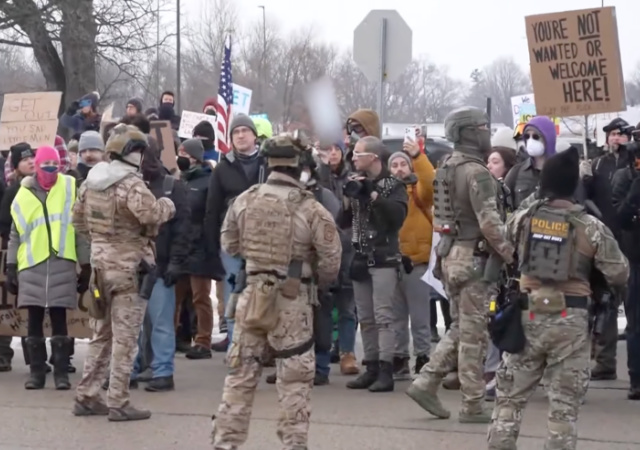
The 8th U.S. Circuit Court of Appeals granted the DOJ a stay of a lower court’s order that restricted agents in Minnesota, finding the limits were too broad and vague.
Judge Raymond Gruender partially dissented.
The stay will remain in effect until the Eighth Circuit fully reviews the case and issues its final decision. I don’t know when that will happen, but I read that the court expedited the case.
From the opinion (I omitted citations):
For at least two reasons, the government has made “a strong showing” that its challenge to the injunction “is likely to succeed on the merits.” First, the grant of relief to such a broad uncertified class is just a universal injunction by another name. Even if “courts may issue temporary relief to a putative class,” this one has no chance of getting certified. And overlooking the difficulties of certification, as the Supreme Court did in A.A.R.P., is not necessary “to preserve our jurisdiction.”
Six people sued the federal government over Operation Metro Surge, claiming federal agents violated their “First Amendment right to free speech and Fourth Amendment right to be free from unreasonable seizures.”
The preliminary injunction ordered by U.S. District Judge Katherine Menendez of the District of Minnesota banned federal agents from arresting or using pepper spray on protesters.
The Eighth Circuit came to its decision from the videos involved in the case (I omitted the citations again):
We accessed and viewed the same videos the district court did. What they show is observers and protestors engaging in a wide range of conduct, some of it peaceful but much of it not. They also show federal agents responding in various ways. Even the named plaintiffs’ claims involve different conduct, by different officers, at different times, in different places, in response to different behavior. These differences mean that there are no “questions of law or fact common to the class,” Fed. R. Civ. P. 23(a)(2), that would allow the court to decide all their claims in “one stroke” (issuing a temporary injunction because every member of the putative class needed to receive the “same” constitutionally adequate notice before removal from the country).
The judges also found the injunction too broad:
Second, in addition to being too broad, the injunction is too vague. See Fed. R. Civ. P. 65(d)(1)(B)–(C) (explaining that an injunction must “state its terms specifically” and “describe in reasonable detail . . . the act or acts restrained or required”). Directions not to “[r]etaliat[e] against persons who are engaging in peaceful and unobstructive protest activity” or “[s]top[] or detain[] drivers . . . where there is no reasonable articulable suspicion” are simply commands to “obey the law,” which are “not specific enough.” Daniels v. Woodbury County, 742 F.2d 1128, 1134 (8th Cir. 1984) (explaining that such injunctions do not provide “a clear idea of what conduct is prohibited”); see Sessler v. City of Davenport, 990 F.3d 1150, 1156 n.3 (8th Cir. 2021) (deciding that a prohibition on “restricting and limiting [the plaintiff’s] rights to peacefully share his message” would be “an obey-the-law injunction”); Elend v. Basham, 471 F.3d 1199, 1210 (11th Cir. 2006) (declining to order an injunction to “ensure there’s no violation of the First Amendment” because it would “merely command the [defendant] to obey the law”).
The judges even targeted a few provisions that specified weapons, such as pepper spray:
Even the provision that singles out the use of “pepper-spray or similar nonlethal munitions and crowd dispersal tools” requires federal agents to predict what the district court would consider “peaceful and unobstructive protest activity.” The videos underscore how difficult it would be for them to decide who has crossed the line: they show a fast changing mix of peaceful and obstructive conduct, with many protestors getting in officers’ faces and blocking their vehicles as they conduct their activities, only for some of them to then rejoin the crowd and intermix with others who were merely recording and observing the scene.
The judges cited Trump v. CASA, which states, “[F]ederal courts do not exercise general oversight of the Executive Branch.”
Therefore, “the structural injunction imposed here, given its breadth and vagueness, is too big a step in that direction.”
The judges also noted that the broad injunction could cause the agents “to hesitate in performing their lawful duties” and “threatens to irreparably harm the government and undermine the public interest.”
In other words, chaos would ensue. Dogs and cats living together…mass hysteria!
[Featured image via YouTube]
Donations tax deductible
to the full extent allowed by law.






Comments
Translation: The district court “judge” is a clown who shouldn’t be anywhere near the practice of law, much be a federal judge.
Just like the overwhelming majority of D appointed federal judges – including, sadly, all three of their current SCOTUS Justices.
Some common sense. Finally.
You should not be able to get in someone face. If you’re in my face I can’t protect myself. There should be some distance between us. Say you can’t get closer to me than 6 feet or 8 feet. If you do I can regard you as a threat and act appropriately to neutralize you. That is common sense and sets up a clear red line that can’t be crossed (let’s not quibble about distance).
IMO there’s different distances for different situations. Along a line of barriers with police on one side and protesters on the other I’d say 10 feet from the barrier is reasonable. It allows the police to have enough distance to create space/time to deploy non lethal tools like pepper spray or rubber projectiles if the mob or members in the mob suddenly rush forward. For an active crime scene/operation? More like 25-30 feet away from the activity, the LEO, vehicles and the subject. No way the mob should be allowed close enough to try and prevent a detention/arrest by pulling the subject from the grasp of LEO or block the path to the vehicles or egress.
I was thinking more of individual space. I’ve seen videos where protesters get literally in the face of random people. This occurred a lot on college campuses. There is no way I;m going to let someone get in my face and body bump me without pushing them away or throwing a punch. Yet if I did so I would likely be cited for assault.
Sure and that’s what I was referring to. With a physical barrier separating the mob from LEO then 10 feet is probably enough but without a barrier 25-30 feet is needed. IMO of someone or a group approaches close enough to another person that that that person could deliver a ‘punch’ they are way too close and are inviting that punch by their physical proximity. Obviously circumstances dictate when that applies. Not in a normal situation such as a line to check out at the grocery or in a crowded bar but definitely when strangers start screaming at someone else on the sidewalk.
Following today’s decision staying Menendez’s ruling in the ACLU case, and today’s hearing in the Keith X case, I doubt that Menendez wants to go for a two-fer. We shall see.
Directions not to “[r]etaliat[e] against persons who are engaging in peaceful and unobstructive protest activity” or “[s]top[] or detain[] drivers . . . where there is no reasonable articulable suspicion” are simply commands to “obey the law,” which are “not specific enough.”
This was my initial take on the order. It didn’t amount to more than a requirement to follow a ROE that seemed would very closely comport with ICE ROE. Effectively, the court hadn’t told ICE to do anything differently and was just flapping its lips.
Except for the pepper spray bit.
Once again, judges taking away non-lethal options on the spectrum of force, leaving them with no options between a stern talking to and a round to the face.
Since the left loves Europe so much, let’s have ICE respond to rioters the same way they do… by giving them a beat down. Leftist think they can form mobs, riot, get violent and police are supposed to write paeans to their bravery. And to Judge Menendez … when you tell violent rioters that law enforcement is prohibited from defending themselves or arresting people violating the law, you get more violent rioters. It’s also not even remotely in her wheelhouse.
I certainly would love the opportunity to share my opinion with a journalist, but for some reason I have yet to asked for my stance.
I don’t. I refuse to answer polling calls and I would refuse to answer any so called journalista, First I don’t think I could control my words once I get going and so I would look like an unhinged lunatic (NO COMMENTS), Second I live in progressiveland and I don’t want to get harassed by neighbors or denied service by local businesses or my growing collection of doctors.
Why are no Minnesota patriots protesting at Judge Menendez’s home? It was Minnesotan’s that won the day at Gettysburg.. Protesters that go beyond marching with placards are by my definition not peaceful and those close enough to harm officers doing lawful duties should be subject to sufficient violence needed to restore a safe distance for officers. Those following officers in cars should be stopped under reasonable suspicion of stalking.
In other words, it got in front of a judge who isn’t a retard.
I’m a little confused on the original suit. They want to be protected from “seizure”? Isn’t the 4th Amendment (in that phrase) speaking of property? Have the LEOs been seizing property? Or are they (as I think) using it to mean arrest?
You are mistaken. “The right of the people to be secure in their persons, houses, papers, and effects, against unreasonable searches and seizures, shall not be violated,”
To arrest a person for a misdemeanor that he did not witness, a policeman needs a warrant. Arrest for an offense he witnessed, or for any felony for which he has probable cause, doesn’t need a warrant because it’s not an unreasonable seizure.
Thanks, Milhouse. I didn’t have time or inclination to look up ATM. Still bugs me using that word, but understand.
the lefts goal and successfully reached at theat,, has always been they can attack you you cant attack back
they even pulled that sh off in DV cases where the females were allowed to do as the pleased and the male was out of luck and of course that was backed up in the courts anyways
you cant claim to want fairness…but only for our side
but lefty has become a master of getting that codified