


Waymo Robotaxis Stall and Snarl San Francisco Traffic After Massive Blackout
San Francisco was plunged into darkness when nearly 30 percent of the city was struck by a power outage that appears to be the result of a substation fire.
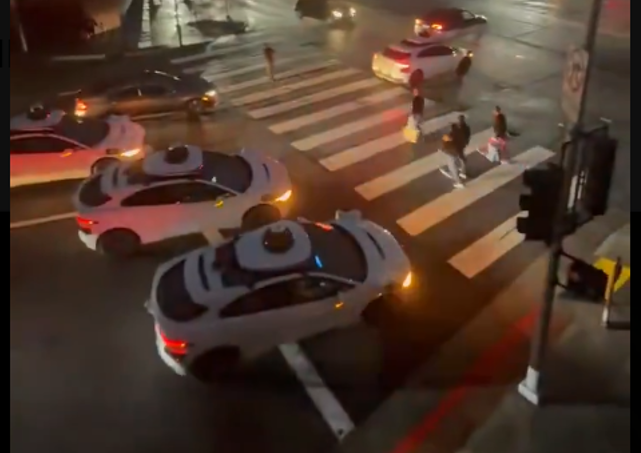
San Francisco, the epicenter of Big Tech, faced an interesting new crisis this weekend.
Waymo temporarily halted its robotaxi service in San Francisco this Saturday evening after a large blackout left many of its autonomous vehicles stalled in traffic lanes and intersections, causing gridlock across parts of the city.
San Francisco plunged into darkness when nearly 30 percent of the city was struck by a power outage, which brought vital transportation, such as self-driving cars, to a grinding halt on Saturday night.
Over 130,000 houses and businesses were left in the dark, largely in the northwest part of San Francisco, including the Richmond, Sunset, Presidio, and Golden Gate Park sections, officials said on Saturday.
As of early Sunday morning, more than 29,000 people were still without power, according to PowerOutageUS.
The “citywide” outages forced Waymo to halt its driverless car service, stranding the autonomous vehicles in the middle of the streets, SF Gate reported.
Currently, Waymo has not explained why its vehicles stalled. It is theorized these units effectively “froze” because the blackout knocked out traffic signals and may have disrupted the connectivity and remote support they rely on, leaving them in a conservative fail‑safe state where they simply stopped rather than proceed through dark intersections.
A Waymo spokesperson said the company paused operations to prioritize rider safety and ensure that emergency responders could move freely through affected areas, the San Francisco Standard reported.
The company didn’t specify why the blackout disrupted its vehicles, though the outage may have interfered with traffic signals or wireless data feeds that Waymo’s cars rely on to navigate safely, prompting them to stop as a precaution.
The episode highlighted how dependent autonomous vehicle fleets are on external infrastructure. While Waymo frequently emphasizes that its vehicles outperform human drivers on safety metrics, the incident underscored their vulnerability to failures beyond the company’s control, such as disruptions to the power grid.
Power went out in San Francisco yesterday, and all the self-driving Waymo cars didn't know what to do when the street lights went dark. 😁
Brought traffic to a halt in many intersections.
Looks like they need to re-read page 34 of the CA Driver's Manual! pic.twitter.com/pXNnijdB4l
— Brad Cooper (@mvhacking) December 21, 2025
The cause of the blackout is being reported as a fire inside San Francisco’s Eighth and Mission substation, which caused “significant and extensive” damage. As of this report, over 20,000 area residents are still without power.
PG&E said on social media that the remaining 21,000 without power on Sunday morning are concentrated in Golden Gate Park, the Presidio, the Richmond District and small areas downtown. The company said it could not offer a precise time frame for full restoration but would continue to provide updates.
“The damage from the fire in our substation was significant and extensive and the repairs and safe restoration will be complex,” PG&E posted Sunday morning on X. “We have mobilized additional engineers and electricians.”
On the eve of the longest night of 2025, many parts of San Francisco lost power. Traffic lights were out. Fleets of Waymo were stuck and confused. pic.twitter.com/uespcBhijt
— Ann (@AnnTrades) December 21, 2025
Interestingly, the Tesla services in the city continued despite the blackout.
Unlike Waymo, Tesla does not operate a driverless robotaxi service in San Francisco.
Tesla’s local ride-hailing service uses vehicles equipped with “FSD (Supervised),” a premium driver assistance system. The service requires a human driver behind the wheel at all times.
According to state regulators — including the California Department of Motor Vehicles and California Public Utilities Commission — Tesla has not obtained permits to conduct driverless testing or services in the state without human safety supervisors behind the wheel, ready to steer or brake at any time.
Tesla is vying to become a robotaxi titan, but does not yet operate commercial, driverless services. Tesla’s Robotaxi app allows users to hail a ride; however, its vehicles currently have human safety supervisors or drivers on board, even in states where the company has obtained permits for driverless operations.
🇺🇸 SAN FRAN BLACKOUT – WAYMO FROZE, TESLA DROVE
Waymo’s robotaxis got a little too real last night – by completely shutting down when San Francisco’s power outage knocked out traffic lights.
Meanwhile, Teslas on FSD? Kept rolling. No drama, no headlines – just handling chaos… pic.twitter.com/8FinYpAOcB
— Mario Nawfal (@MarioNawfal) December 21, 2025
In retrospect, Waymo’s stoppage during the San Francisco blackout, the slow restoration of power, and PG&E’s description of “significant and extensive” damage at a single substation rightly fuel broader questions about whether California’s energy system is resilient enough to handle both routine stresses and extreme events. Legal Insurrection has covered several other troubling incidents featuring the state’s grid, including EV-pushing regulators begging citizens not to charge their vehicles during a heatwave.
Darkened neighborhoods, failed traffic signals, and stranded autonomous vehicles are not the result of bad luck, but the predictable result of years of under‑investment in hard infrastructure (i.e., transformers, substations, and transmission lines) because political and regulatory priorities have pushed utilities into promoting “sustainable” energy at the expense of basic care of the systems that have reliably worked for decades but are beginning to age.
This event is another example of cascading failure, attributable to delusional decisions made in Sacramento based on pseudoscience and vibes. I predict that there will be even more Golden State energy-based dramas playing out in 2026.
Donations tax deductible
to the full extent allowed by law.




Comments
Back to the coding board.
Seems to me are a reasonably foreseeable circumstance, especially in California.
Funny that Waymo did not think to program their vehicles for the possibility of a power blackout.
One fail Safe might be to have the vehicles pull over and park instead of just blocking the road.
Couldn’t have happened to a more deserving city.
But at least Newscum has been able to enjoy funding for his phantom supertrain.
Because they’re NOT intelligent.
David Codrea points out that not only are Waymo vehicles unmistakably distinctive from a distance, but Waymo’s terms of service forbid riders from riding armed. Once enough thugs become aware of this, it will be open season on Waymo patrons during any future power outages — and there will be future power outages.
It’s a fail-safe design, not a fail-convenient design.
Like railroad crossing gate controllers. If they detect that the system isn’t working, e.g. they can’t detect the distant shunts put there for that purpose, then they close the gates.
Rather, they just select who it fails convenient FOR.
It’s very convenient for the trains.
The fundamental flaw of so-called artificial intelligence is that it is NOT intelligent. It can’t improvise when things don’t go to plan..
Teslas have no trouble at intersections having no signals. The law says treat it like a four-way stop, and FSD does that.
Waymo knows that there are lights at that intersection but for some reason it’s not getting any signal. You could jump software-wise to 4-way stop rules, or you could play it safe and say it’s just as likely that something’s wrong with the system and stop.
Traffic lights are not safety devices. They’re traffic-flow efficiency devices. If it’s green, you don’t have to slow and check the crossing traffic might try to cross in front of you.
You assume but do not know that crossing traffic doesn’t have a green too, or some other failure like burnt out red. In that way traffic lights actually make it more dangerous.
Stop signs are the same – if you don’t have a stop sign, you can go. But the sign might fall down.
The universal safe rule is 4-way stop but it’s inefficient.
My city had a major transformer blow, and it took a week and a half to replace. When traffic lights are out, intersections become four-way stops. Tesla knows that, and Waymo apparently doesn’t.
But the overriding rule, that covers every possible situation, is, you are required to avoid collisions when possible, even if you have the right of way. This covers four way stops where people are not yielding.
Ask your favorite AI for synonyms of “artificial” and you will never trust AI with anything important.
I would rather they stopped than just run through intersections. I don’t think it ever occurred to Waymo that there would be such a large scale power outage like this or the consequences.
Reminds me of one of my favorite stories as a child: Lazy Tommy Pumpkinhead…
Has the possibility of sabotage of the substation been explored?
I’m not worried about robotaxis stopping in darkness.
I’m worried about what happens when terrorists figure out how to spoof green lights.
Does anyone in “leadership” realize what else is going to happen? Especially in places like CA? More EV’s means more drain on the electric grids. CA is already WAY behind in power production, as well many other blue states, so they beg power from other grids/states, and affects the whole USA. What happens when one or more of these grids are attacked/compromised? Also, is it fair for ALL Americans to help foot the bill for electricity to be available to 2-3% population? Last bite – also EVs need to pay their fair share of road usage, too.
Of course they know. It’s not supposed to work. You’re supposed to have an electric car but no electricity to drive it.
Stalling and snarling traffic beats running amuck!
Someone who lives in the area pointed out online that some of the stalled Waymos were actually impeding evacuation routes.
Why weren’t they towed to the impound yard? Pretty sure if John Q Public abandoned his vehicle in the roadway his vehicle wouldn’t be given much slack.
This is a reason why I don’t completely trust the “promise” of AI or other advanced technologies. To err is human, but to fail is machine.
SF has never has been the epicenter of tech industry. The epicenter of Silicon Valley is located 35 miles south down by san jose in upper santa clara county. SF benefits from the spill over from Silicon Valley. When office space gets filled up in silicon valley, then SF becomes the branch office. SF does have Saleforce headquarters now, the city’s one claim to being real player, but there are multiple floors available for sublease.
Beyond that issue, punks in the street will spray paint over the robo taxi sensors, when they are stopped at red lights, stalling them out. The entire concept is flawed.
Robo taxis have dragged homeless junkies up and down hilly streets of SF for blocks without realizing it.