


New Study Suggests Raccoons are Showing First Signs of Domestication
Meanwhile, a racoon drinks its way through a Virgina liquor store and passes out in the bathroom.
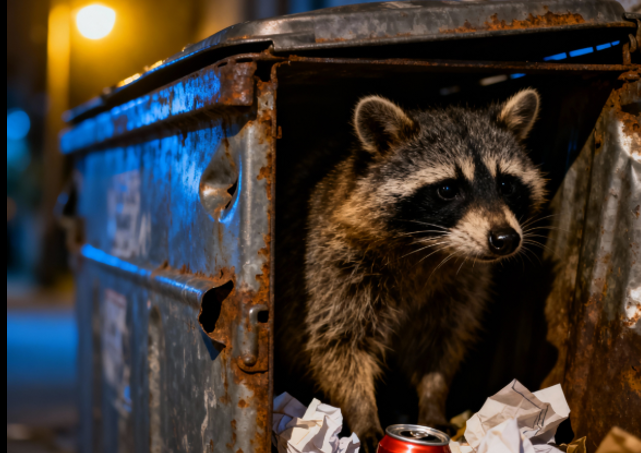
A new study suggests that raccoons living in cities and suburbs are undergoing very early, subtle changes in both body shape and behavior that match those seen in the first stages of domestication in other species, mainly driven by easy access to human food and reduced fear of people.
Researchers stress that “trash pandas” are not yet domesticated pets, but urban populations are showing traits that suggest the domestication process may be beginning. And, apparently, trash may be at the root of this development.
The study lays out the case that the domestication process is often wrongly thought of as initiated by humans—with people capturing and selectively breeding wild animals. But the study authors claim that the process begins much earlier, when animals become habituated to human environments.
“One thing about us humans is that, wherever we go, we produce a lot of trash,” says the study’s co-author and University of Arkansas at Little Rock biologist Raffaela Lesch. Piles of human scraps offer a bottomless buffet to wildlife, and to access that bounty, animals need to be bold enough to rummage through human rubbish but not so bold as to become a threat to people. “If you have an animal that lives close to humans, you have to be well-behaved enough,” Lesch says. “That selection pressure is quite intense.”
Proto-dogs, for example, would have dug through human trash heaps, and cats were attracted to the mice that gathered around refuse. Over time, individual animals that had a reduced fight-or-flight response could feed more successfully around humans and pass their nonreactive behavior on to their offspring.
The researchers reported observing a notable level of snout shortening among urban raccoons. This finding fits into a broader pattern called “domestication syndrome,” a cluster of traits such as shorter faces, smaller brains or teeth, floppy ears, white patches, and calmer behavior that tends to appear when animals adapt to life around humans.
The leading hypothesis is that selection for tameness alters early embryonic development of neural crest cells, which indirectly produces these visible and behavioral changes across multiple body systems, including the size of the nose.
She [Raffaela Lesch, an assistant professor at the University of Arkansas at Little Rock] and 11 undergraduate and five graduate students from her fall 2024 biometry class combed through more than 19,000 photos of raccoons on iNaturalist, an online database of wildlife observations submitted by hobbyists and citizen scientists around the country. They found 249 images that showed the animals in perfect profile.
Then, the researchers used a computer imaging program to measure the length of the specimens’ snouts, from the tip of the nose to the tear duct, and total head length, from the tip of the nose to where the ear attaches to the head. When Lesch and her students mapped the counties where each picture was taken, a clear pattern emerged: Urban raccoons’ snouts were 3.6% shorter than those of raccoons in rural areas.
“That doesn’t sound like a lot, and in a sense, it is not a lot, but if you think about these animals potentially only being at the very early beginning stages of domestication, that is still a fairly clear signal,” Lesch said. She was lead author of a study published October 2 in the journal Frontiers in Zoology.
Apparently, trash isn’t the only thing raccoons find appealing in the urban environment, either!
A small, furry “suspect” reportedly broke into a Hanover ABC store and ransacked several shelves over the weekend, after which he was found passed out on the bathroom floor.
According to a social media post by Hanover County Animal Protection and Shelter, on the morning of Saturday, Nov. 29, Officer Martin responded to an “unusual call” at the ABC store in the town of Ashland.
When the officer arrived, she found that a raccoon had broken into the store, ransacked several shelves, become intoxicated, and then passed out in the bathroom.
NEW: Raccoon gets drunk at an ABC liquor store in Ashland, Virginia, and passes out in the bathroom.
Hanover County Animal Protection says the raccoon "ransacked" the store before passing out next to the toilet.
"Officer Martin safely secured our masked bandit and transported… pic.twitter.com/PqDl23pymp
— Collin Rugg (@CollinRugg) December 2, 2025
File this story under “Wild America”.
Do you think Raccoons look through peoples windows to see cats and dogs and wonder why they aren’t good enough? pic.twitter.com/CSxbQjpI0m
— Nature is Amazing ☘️ (@AMAZlNGNATURE) December 5, 2025
Image by perplexity.ai
Donations tax deductible
to the full extent allowed by law.







Comments
https://youtu.be/qqA4ZiQaGtU?si=Aj_gZ9fFWOEbnSJr
Rabies, if not treated within the first few weeks of exposure, is 100 percent fatal.
oh I know a guy who got racoon scratched and had to do the rabies protocol. he brought a broom to chase it from beating the hell out of his dog… he should have brought the carbine.
I once opened a can of sardines to get my cat in the house, and a racoon came up on the porch in front of the cat. I shooed the coon away with a broom so the cat could come in and then locked the door. Then I remembered the cat door was still open, so I rushed down to the basement and slammed the window shut in front of the cat door and seconds later the racoon had stuck his head through and was banging it on the window. Stopped that coon in the nick of time!
You know how to handle them coons.
Becoming an alcoholic is a sign of domestication…
OK… Right… Got it.. 🙂
Now do Groot…
https://nypost.com/2025/12/07/us-news/virginia-liquor-store-trashed-by-drunk-raccoon-introduces-new-cocktails-inspired-by-viral-tipsy-critter/
What I want to know is did the racoon actually unscrew any of the bottle caps, or did he just drink from bottles that smashed on the floor?
If you thought cats hated you, wait until you wake up one morning and find your cute new raccoon pet eating your feet.
I had one as a semi-pet when I was young and delighted to give him sugar cubes which he would promptly wash and the cube would disappear! He would look at his little hands and wonder where the sugar went. They are very interesting animals and much smarter than dogs.
My guess is they’ll vote democrat after the democrats sign them up to vote.
Reminds me of this gem:
https://youtu.be/A993UA4hgG0?si=pRhw-QFR0_VIHn67
“shorter faces, smaller brains or teeth, floppy ears, white patches, and calmer behavior”
ahhh, yes. The cuteness camouflage.
Too bad about the rabies. Most racoons are carriers.
I don’t know about other states but in Florida it is automatically assumed they carry rabies and if you are bit or scratched by one you will go through the treatment for rabies.
In my neck of the woods, skunks are the primary rabies reservoir and prairie dogs are the reservoir for plague. We had a prairie dog colony on a vacant lot across from my office until the plague wiped it out about 5 years ago.
NM?
“Piles of human scraps offer a bottomless buffet to wildlife,”
Well that is certainly alarming. Though good news for your local serial killer.
Wait until the C.H.U.D.s come pouring out of their underground lair riding their domesticated giant racoon as trained, fighting steed.
it’s only a matter of time until we see them on planes as therapy animals.
Rabies isn’t the only problem with raccoons.
“While human infections are rare, severe disease can occur if the young (larval) forms of the worm travel to the spinal cord, brain, and eyes.”
http://publichealth.lacounty.gov/vet/raccoonroundworm/
In Orlando, we have had raccoons living in the top of one of our palm trees, and in our attic.
New study with 249 profile PICTURES showed a small, and certainly within the limits of error, decrease in snout size? Evidence of selection you say? Sample size way, way too small and evidence could just be grouping of family unit in such a small sample. Even classic examples such as the change from white to black moths during the smoggy industrialization of England have been proven to not(!) be evidence of selection. I call selection bias – and B.S. of course.
Back in the 1970s, I owned a pair of kinkajous. They were semi–domesticated. I had friends that also had kinkajous, also semi-domesticated.
Having said that, I believe that skunks are also semi-domesticated, considering that many people have skunks as pets.
Since skunks, racoons, and kinkajous are members of the same family, it would stand to reason that their level of, or ability for, domestication would be similar.