


Ford Zaps Production of Big EV Trucks, Taking $19.5 Billion Hit
The F-150 Lightning is returning to what it was originally: A gas-powered workhorse.
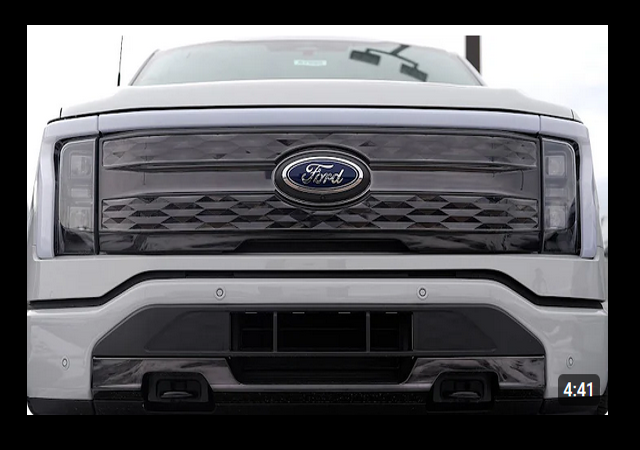
Ford Motor Company has zapped production of its EV truck, the F-150 Lightning, as it takes a $19.5 billion hit and ends production of several electric-vehicle models, as the auto industry’s retreat from battery-powered models continues in response to the Trump administration’s policies and weakening EV demand.
The Dearborn, Michigan-based company said it will replace the fully electric F-150 Lightning with a new extended-range electric model that uses a gas-powered engine to recharge the battery. The company is also scrapping a next-generation electric truck, codenamed the T3, as well as planned electric commercial vans.
“When the market really changed over the last couple of months, that was really the impetus for us to make the call,” Ford CEO Jim Farley told Reuters in an interview.
Ford said it will pivot hard into gas and hybrid models, and eventually hire thousands of workers, even though there will be some layoffs at a jointly owned Kentucky battery plant in the near term. The company expects its global mix of hybrids, extended-range EVs and pure EVs to reach 50% by 2030, from 17% today.
The car company will spread out the writedown, taken primarily in the fourth quarter and continuing through next year and into 2027, the company said. About $8.5 billion is related to cancelling planned EV models. Around $6 billion is tied to the dissolution of a battery joint venture with South Korea’s SK On, and $5 billion on what Ford called “program-related expenses.”
I reported earlier this month that President Donald Trump had essentially gutted Biden’s Green New Deal and significantly reduced fuel-economy standards. The move, paired with the Trump team’s emphasis on increasing American fossil fuel production and the elimination of the EV tax break, was a contributing factor in a business decision that has since been replicated throughout the automotive industry.
The announcement amounted to an admission by Ford that it had overestimated demand for battery-powered vehicles and underestimated the staying power of vehicles powered by gasoline and diesel.
Other big automakers, including General Motors and Stellantis, have also recently changed their plans and placed a far greater emphasis on combustion engine vehicles and hybrids.
The U.S. auto industry’s move away from electric vehicles is also a result of a reversal in government policies since President Trump took office in January. His administration has slashed government incentives for electric vehicles while promoting fossil fuels.
This month, the administration announced plans to significantly weaken fuel economy standards, which would reduce automakers’ incentive to make electric cars.
The F-150 Lightning is returning to what it was originally: A gas-powered workhorse.
The Lightning’s design evolved from what was once a gas-powered truck. And now it will come full circle; an upcoming plug-in hybrid version of the truck will once again have a gasoline engine, in the form of a generator that will allow the vehicle to keep driving even if the battery runs out of juice. The all-electric Lightning is dead; the extended-range Lightning is on its way.
The all-electric F-150 Lightning was a big deal to Ford. It was announced in 2021 with great fanfare and an appealingly low price of just $40,000. But once it actually hit production lines, Ford was never able to sell it for anything close to the promised price tag; the 2025 model started at around $55,000.
The truck was designed to appeal to mainstream truck enthusiasts, with no quirky EV styling. It came festooned with outlets everywhere, leveraging the onboard battery so drivers could run tools at a worksite, power appliances at a tailgate party and even run their house on it, using it like a generator during a power outage.
It must be noted that the company still plans to produce mid-sized EV trucks at a price point more appealing to the public.
For its future EV lineup, the company is shifting focus to more affordable EV models, conceived by a so-called skunkworks team in California.
Ford plans to price the first model from that team at about $30,000 US and begin sales in 2027. Ford is building this midsize EV truck at its Louisville plant.
“Rather than spending billions more on large EVs that now have no path to profitability, we are allocating that money into higher-returning areas,” said Andrew Frick, head of Ford’s gas and electric-vehicle operations.
Donations tax deductible
to the full extent allowed by law.







Comments
“The Dearborn, Michigan-based company said it will replace the fully electric F-150 Lightning with a new extended-range electric model that uses a gas-powered engine to recharge the battery”
Was the original author paid on word count? They couldn’t bring themselves to just say “hybrid”?
I think they got that from the ford press release itself.
I think a certain demographic of truck owners are allergic to the word “hybrid” frankly. Sounds like a pussified child wagon.
I’m skeptical of the hauling capacity of a hybrid. The more batteries you put in, the heavier the truck and the reduced payload. I can haul 12,500 with my F250 Superduty. Why would I drop that to, idk, 8000lbs and incur the extra expense of battery replacement? I bought it to tow an RV so I’d have to upgrade to an F350. Doesn’t make much sense to me.
I tow an RV with my f250.
Hybrids dont have a lot of batteries. In the ford F150 hybid, the battery is about 200lbs, while the weight of all the gear for adaptive cruise control (like the controllers in the front wheel wells) is about 500lbs+. The Ford F150 hybrid specs (horsepower, payload, torque) are all better than the gas.
On the road, hauling, you are not using the batteries. Hybrids are more efficient mainly because they keep the engine at its most efficient RPM in stop-and-go traffic (this is very similar to a Continuously Variable Transmission, and why 10-speed tranny is better than a 6 or 8-speed).
You don’t need a heavy battery to keep the engine in optimal range, and you won’t ever be towing with it.
Fun fact: big diesel freight trains are actually diesel-electric: a diesel engine powers a generator that runs electric motors that power the wheels. A hybrid is just a version of this. The Toyota Tacoma hybrid dispenses with the battery.
Diesels are more efficient than gas… so an F250 with a diesel and *No DEF* equipment would be a beast,
“The Toyota Tacoma hybrid dispenses with the battery. ” What I meant was it dispenses with expensive lithium and just uses nickel metal hydride.
That’s not exactly how a diesel locomotive works. It’s not a true hybrid as we think about it. As for the F150 hybrids, they do not have a good longevity or reliability record and are all V6’s. No one would buy one for serious hauling.
Your right about the no def thing. I remember when it was first introduced. International came out with a no Def option on their engines to meet particulate standards and it was dropped. We had no end to troubles with them. Def at this point isn’t a big deal as you can get it right at the pump beside the gas or in a 5gal jug most places.
I’m looking forward to a non lithium battery option as those seem to have a tendency to burn up for some reason.
which proves YOU are smarter than the average exec at Dearborn
“Was the original author paid on word count? They couldn’t bring themselves to just say “hybrid”?”
Ford already makes a hybrid F-150. It features a 400+ HP ICE engine, and a 60 HP electric engine. The electric supplements the conventional engine and powertrain.
By contrast, the proposed vehicle here will not have a conventional powertrain, and instead will rely on electric motors (as does the EV). What is new is the addition of gasoline powered generator that can supplement the range of the battery. Realistically, one could make a 50 HP motor, finely tuned to work at a constant, efficient speed to run the generator for extended range, and to cover the power consumption of running a vehicle at speed for an extended period. This form of vehicle could have a much, much bigger market than current EV.
No conventional powertrain? This is how large diesel electric freight trains work, and a lot of other large machines. But I have to wonder why this idea never took root with gasoline powered cars.
I don’t think this quite fits a “hybrid” definition, as the gas engine is a tiny thing with an alternator just enough to recharge the batteries, not to propel the vehicle. I think it would be better defined as an “onboard recharging system?
Ford already makes a hybrid f150, its the best half ton ton on the market. Great horsepower, torque, and payload even fully loaded. Easier at the pump. The only reason I didnt buy the hybrid F150 is that I needed the payload of a 250. Bring on the hybrid F250, ill buy the shit out of it. It will have better horsepower, more torque, higher payload, with the same mpg as the f150 ecoboost.
and unreliable plus expensive to fix. There is a reason no one buys them anymore than the 2.7 Ecoboost they were trying to foist on us.
Stupid is its own reward.
Lightning doesn’t strike twice in the same place….
….except in the case Ford Trucks—which strikes multiple times with less effect each time until finally it just fizzles like a dime store sparkler and disappears from sight or morphs into something else.
Ford should junk all and evey EV line in production. The process of making the batteries and components of EVs comes with a lot of pollution. In addition, EVs simply move the production of motive power from the vehicle to the power plant which for the foreseeable future will use fossil fuels. Finally, EVs put a strain on the grid which is currently already strained from Brandon’s war on fossil fuels, the fetish some states have with ruinables and the introduction of AI centers.
Ford should give it one last chance by offering it in pink.
This is what the leftist obsession with renewables costs. $19.5 billion flushed down the sewer, and not one shred of guilt from any DC mastermind for having mandated it.
Biden autopen + EPA = Economic demise
so they made another bad decision
we shouldnt have to pay for that via tax schemes
socialism doesnt work..its evil
This was a very bad vehicle for what it was intended. Youtube is rife with video’s showing the towing capacity wasn’t there and the range was not even close to promised to the point the truck was useless when towing or hauling anything. Will it work as a true hybrid? I don’t know, maybe but no one demanded one in the first place. This was all driven by the government and what the government gives it can take away. Without subsidies no one wanted one.
The real land filling capability of the truck is the canary in the coal mine, so to speak. A Canadian drove the vehicle of the edge of the road and damaged the front wheel and rim, and possibly the rotor. While there was essentially no significant damage to the battery armoring or battery system, the Canadian insurance collective decided to total the vehicle since the actual value (somewhere around $45k was less than the cost (around $65k). He could find no one that would check out the barrier/circuity issue and repair what if anything was broken. There is no secondary repair path since the tech is so new and the secondary EV model repair market is very small. I suspect this follows the same path for EVs and hybrid – you are connected to the manufacturer and their whims.
Who knew that selling overpriced products that nobody wants to buy would be a bad business decision?
When I see a vehicle speeding, tailgating, and weaving, half the time it’s a pickup truck.
Why?
“Yee-haaa!”
That’s what I thought.
I’m not sure about the trucks you’re seeing on the road, but I know the truck I learned to drive in was a ragged out old Ford F-100 that had been in a delivery fleet for many years… it was BEAT UP and WORN OUT. My dad let us drive it around our property, and later we would sneak it out and drive the county roads. That thing had such a loose steering wheel that you’d need to turn it about a quarter of a turn to get the truck to actually start to turn at all. Steering-wise, driving that thing felt a lot like driving a boat. And then there was the clutch… sometimes the clutch pedal would just fall off. To this day, my sister and I still have lots of laughs about that old truck.
And I will bet that some dude gave $50 to buy it, and i still driving it.
Old rigs like that never really die. At last, some o those parts are carrying on yet, having been graphted in to some othe slightly less derelict truck.
But a new hybrid truck takes a minor bump and is totalled?
Nah. Gimme an OLD truck.
My daily drivev is a 1985 D 50 turbodiesel. Previous owners gave up cuz hey didn’t underand diesel systems. Could NOT keep it running. I spent about $30 on new lines, hi cap philter, and have run it about 35K miles since. I’ve got >$500 in it, have paid more to the State o Washinon to bribe them to “allow” me to sully their pweshus oads with it. than I have in the whole truck. I;ve hauled well over a on wth it multiple times, and it returns 37 mpg on the cheapest diesel I can buy. Cruises easily a 75 mph. That’s above any posted limit in the Western states.
They will have to come up wuth one amazing awesome wonderphull ig to get me to shell out a small portion o the list prices I am seeing. My total out o pocket, not counting the State’s greedy paws, is about $4000 over $32,000 miles including the diesel, repairs, maintenance, tyres, original purchase……..
We saw the lefts true devotion to electric vehicles and ‘saving the planet’ this spring when they labeled the coolest maker of the coolest electric car a Nazi for working with President Trump and started a terrorist campaign of torching his Tesla dealerships and cars.
Nice people. True devotion.
‘the last couple of months’? EV trucks were stupid from the getgo.
Ford followed Biden’s lead on this one and is now paying the price. Any time politicians tell me I have to buy an electric car by a certain date, smacks of Communism.
What the Biden admin did with their Nude Green Eel was one of the financial hallmarks of Fascism, which made it all the more hilarious to see the TDS deranged morons squeeeling about Trump being Hitler.