


Alina Habba Resigns as New Jersey U.S. Attorney
Last week, a judge disqualified Habba from the role
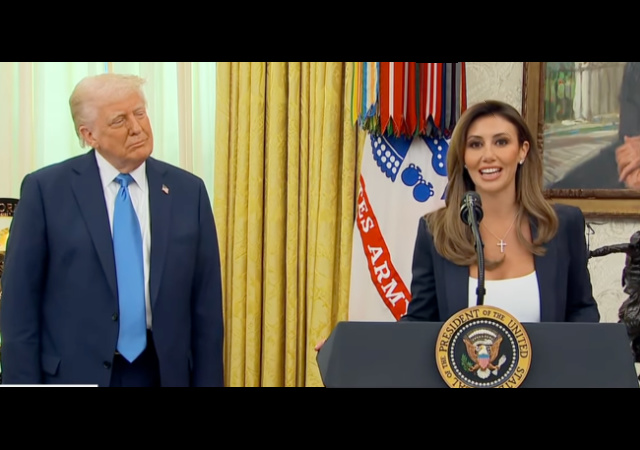
Alina Habba has stepped down as New Jersey U.S. Attorney.
Last week, Judge D. Michael Fisher of the U.S. Court of Appeals for the Third Circuit disqualified Habba from the role. He cited the Federal Vacancies Act (FVRA), which allows the president “to designate someone to perform the duties of specified offices in an acting or interim capacity.”
“As a result of the Third Circuit’s ruling, and to protect the stability and integrity of the office which I love, I have decided to step down in my role as the U.S. Attorney for the District of New Jersey,” Habba wrote in a statement.
— Alina Habba (@AlinaHabba) December 8, 2025
New Jersey U.S. Attorney Phillip Sellinger resigned on January 8. Attorney General Pam Bondi appointed John Giordano on March 3, but he resigned after three weeks.
Bondi then appointed Habba, who was sworn in on March 28.
Remember, the interim appointment only lasts 120 days.
President Donald Trump nominated Habba for the position in June, but the Senate has not acted on the nomination. This is known as the PAS process.
The administration took action when the deadline approached.
A district court disqualified Habba.
The administration appealed.
Donations tax deductible
to the full extent allowed by law.







Comments
The Congressional GOP hasn’t been worth spit.
They never are.
Why all the resignations?
RINOs…
others being offered better positions
money etc…
The did this to Trump in his first term to give the house to Democrats.
The judge’s interpretation of the Federal Vacancies Act (FVRA) is wacked. In that theory, all that would be needed was the Senate refusing to approve any US Attorneys and 120 days (or so) later, the Article III courts could appoint, anoint, and approve whoever they want as Article II US Attorneys, from 4 months into a President’s term to the end, 8 years later.
The law should be that the Senate has 120 days to confirm or deny the appointment. If the Senate fails to act within that period, the appointment is automatically confirmed and the Senate can go pound sand.
If you think so, feel free to propose a constitutional amendment. But your idea flies in the face of the current constitution. Congress can’t do what you want, even if it wanted to.
It is not. On the contrary, it is the most natural reading, and it was always a huge stretch to read it any other way.
That’s right. And the way you want to read it the President could keep making 120-day appointments for 8 years. This is what Congress wanted, and it’s the law. The constitution specifically authorizes Congress to make such provisions, and to vest appointment power in the courts if it likes.
How can she resign from an office to which she never had held title? Maybe this entitles her to a pension. Or a parking spot.
Dragging their feet to gum up the administration.
Thanks useless Senate.
“In remarks at the White House, Trump blamed Habba’s resignation on the Senate blue slip tradition, which allows senators to block certain nominees in their home state. Habba has complained that the state’s Democratic senators would not meet with her.”
https://www.nbcnews.com/politics/justice-department/ex-trump-lawyer-alina-habba-announces-stepping-us-attorney-nj-rcna248070
Where are “blue slips” mentioned in the Constitution?
They’re not. They’re a senate custom. The constitution authorizes the senate to run its affairs as it pleases, including such customs as blue slips and filibusters.
Nothing in the Constitution says that Congress has to approve or disapprove anything in the Executive Branch. This was a law added later by Congress. I understand why President Trump is mad as to get one of his US Attorneys approved they have to go to the Senate, but the Senate will let the Senators of the State that the Attorney will represent decide if the Attorney is okay. This means no Dem controlled state will allow any Trump choice to pass. this is more Deep State BS.
That is not true at all. The constitution explicitly requires that the president appoint all officers with the senate’s consent.
It then gives Congress the option of exempting inferior officers from this, and vesting their appointment “in the president alone, in the courts of law, or in the heads of departments”, as it chooses. But it can’t make such provisions for superior officers, such as US Attorneys, even if it wants to. They must be appointed by the president, with the senate’s consent, and there’s no way around that.