


EPP Presses Education Department to Expose Hidden DEI and Discriminatory Aid Programs
EPP asked the Department to include additional objective characteristics in the proposed survey to identify institutions that have a high-risk of noncompliance with Title VI through DEI rebranding efforts.
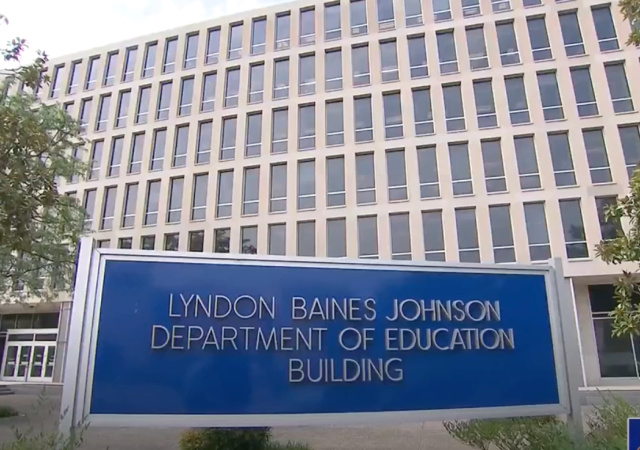
Earlier this week, the Equal Protection Project (EPP) submitted a comment to the United States Department of Education concerning a newly proposed rule that could help tamp down on continuing efforts to introduce DEI programs on college campuses.
As a refresher for those lucky enough to have skipped law school:
Most lawmaking in the United States doesn’t actually happen when legislative bodies like Congress approve a new statute.
Instead, most lawmaking occurs through what is commonly known as “notice and comment” rulemaking.
The way it works is that administrative agencies tasked with enforcing legislation, like the Department of Education, are empowered to enact “rules,” which have the force and effect of law, to help them further their missions.
But before they can do so, they have to put out a notice to the public asking for comments they should take into consideration before deciding on the final rule (if you ever want to submit a comment of your own, just follow along here).
Agencies at the federal and state levels enact thousands of these kinds of rules per year (so many that we aren’t even sure how many are in the books).
No matter what your views on the process, participating in and submitting public comments on proposed rules can be a powerful way to influence the law.
That’s exactly what EPP did here.
The Department of Education asked for public input on a newly proposed rule designed to reduce DEI programs in higher education even further.
In 2023, the Supreme Court ruled in Students for Fair Admissions that discrimination based on race in admissions violates the Equal Protection Clause of the Fourteenth Amendment and Title VI of the Civil Rights Act of 1964.
Nevertheless, unlawful practices persist because DEI continues to be used as a pretext to advance racial discrimination.
Now the colleges are just doing a better job of keeping it hidden.
The federal government does not currently collect racial data on admissions and scholarships and has limited tools to ensure widespread compliance with Title VI.
Therefore, the new rule proposes to add new data categories to already existing college surveys collected by the Department to assess whether colleges are admitting students based on their merit or based on the color of their skin or sex.
EPP offered the Department two additional considerations for how the final rule should work, based on our experience and expertise.
First, in our work investigating and filing civil rights complaints with the Department, EPP has identified several ways, based on a manipulation of language, that educational institutions attempt to evade scrutiny for race-based programs.
For example, in a 2024 report titled “How Higher Ed is Rebranding DEI Departments,” one of EPP’s partner projects, CriticalRace.org, documented campus efforts to hide their DEI efforts through rebranding and other tactics:
Out of the twenty-six universities the report evaluated in states where anti-DEI laws have been passed, ten claim to have eliminated their DEI offices (and related activities), but have replaced them with new offices that have similar programming and/or personnel.
New offices such as the “Office of Access and Engagement” and the “Division of Access, Opportunity, and Diversity” have simply replaced former DEI offices, but continue DEI initiatives and programming.
A common sentiment on campuses is the statement of a University of Texas Tyler employee who said, “No, you can still do it. You just have to be creative,” regarding DEI practices at the school.
Second, while open-access institutions, like community colleges, have minimal or no risk for civil rights noncompliance in admissions because they admit all (or the vast majority of) students who apply, these institutions still present a risk of noncompliance in awarding scholarships and other benefits.
For example, on September 18, 2025, EPP filed a civil rights complaint with your Department’s Office for Civil Rights against Craven Community College “for discrimination in five (5) scholarships and programs based on race, color, or national origin, in violation of Title VI, and based on sex, in violation of Title IX.”
The complaint uses Craven’s own websites to demonstrate the discriminatory nature of the programs.
These discriminatory programs include:
- Herbert Lee and Rosa Bell Perry Memorial Scholarship (blacks only).
- Scott and Lisa Ralls Leadership Endowment (females or black males only).
- Coastal Women’s Forum Scholarship (females only).
- New Bern Woman’s Club Educational Scholarship (females only).
- E.O. Program for Continuing Education Scholarship (females only).
The scholarships identified above violate either Title VI, by discriminating based on race, skin color, or national origin, or Title IX, by discriminating on the basis of sex, or both.
Furthermore, because Craven is a public institution, such discrimination also violates the Equal Protection Clause of the Fourteenth Amendment.
Based on these examples, EPP asked the Department to include additional objective characteristics in the proposed survey to identify institutions that have a high risk of noncompliance with Title VI through DEI rebranding efforts, and to expand the scope of institutions required to complete the survey to include open-enrollment institutions, which are at risk of noncompliance with respect to scholarship awarding practices.
The Department of Education should take our advice.
Donations tax deductible
to the full extent allowed by law.






Comments
“most lawmaking occurs through what is commonly known as “notice and comment” rulemaking.”
As if the Constitution didn’t even exist.
Elite politicians grew the government to such an unconstitutional size that lazy Congress can no longer do its job, so they delegate it outside their branch. The syndrome was recognized so long ago that our own state constitution, written over 100 years ago, explicitly forbids any branch from exercising the powers of any other.
It’s not only colleges and universities. High schools, secondary schools and even elementary schools do it too. And, of course, law firms and other employers.