


Scientists Making Plans to Nuke Asteroid Targeting Moon, Slated for 2032 Impact
A lunar impact could generate debris that damages key satellites, the ISS…and potentially any lunar installations that had been constructed as part of the new space race.
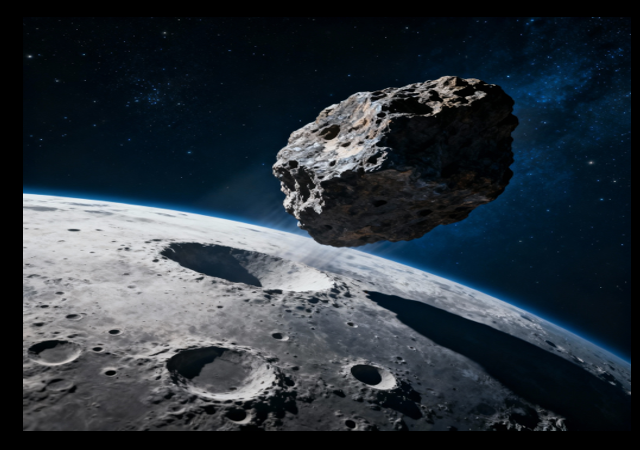
Asteroid 2024 YR4 is a near-Earth object approximately 53–67 meters wide that was discovered in December 2024.
While initial models suggested a small chance of Earth impact, refined tracking now indicates that there is no risk to Earth, but about a 4% probability that it will strike the Moon on December 22, 2032.
Earlier this year, asteroid 2024 YR4 drew global attention when its estimated chance of striking Earth in 2032 reached 3%. Although further observations have since ruled out any risk to our planet, interest in the asteroid has not faded.
As the asteroid moved out of range of even the most advanced telescopes, calculations left a remaining 4% probability that it could impact the Moon on December 22, 2032.
This impact risk is expected to stay unchanged until the asteroid becomes visible again in mid-2028.
The Moon lacks an atmosphere to burn up incoming objects, so even a modest-sized asteroid such as 2024 YR4 can make a direct impact. A lunar strike from this object has the potential to generate enough debris to threaten satellites and the International Space Station (ISS).
Scientists are considering several options to address this possibility. Legal Insurrection readers may recall NASA’s Double Asteroid Redirection Test (DART) mission, which successfully altered the trajectory of an asteroid.
However, this approach has been deemed impractical for the 2024 YR4. So a “nuclear option” is being considered.
Nuclear explosives presented a better option as these “are generally capable of handling larger asteroids and/or shorter warning times than other methods, all else being equal,” Brent Barbee, one of the researcher’s behind the paper, told Newsweek.
The team suggested the deployment of two nuclear explosive devices—one just “in case it was needed”—each five to eight times stronger than the bombs dropped on Hiroshima and Nagasaki, according to Futurism.
These would be launched toward the asteroid in an attempt to disrupt it before it reaches the moon.
The plan, according to the study, is more feasible than attempting a precision deflection mission that could inadvertently redirect the asteroid toward Earth.
Yes, keeping a “city killer” away from Earth would be an essential part of the plan. And, I would like to note that for the “climate crisis” minded that impacts of asteroids in this size range have the potential to inject large amounts of dust and aerosols into the atmosphere, resulting in global temperature reductions of several degrees, reduced sunlight, lower precipitation, and severe ozone depletion for a few years. This would be a real example of a “climate crisis”.
But I digress.
Nuke it in orbit. It's the only solution. https://t.co/i01oJ0i0lV
— Phineas Fahrquar (@irishspy) September 24, 2025
Meanwhile, the object will continue to be monitored closely.
They want to redirect missions like Psyche or OSIRIS-APEX to gather crucial data on the asteroid during its close Earth-Moon flyby in 2028, as it will help them nail down the asteroid’s path and risk.
The researchers have proposed a “kinetic disruption mission” to blow up the space rock with “nuclear explosive devices”. According to a report by Futurism, the team proposed sending two 100-kilotonne nuclear devices to the asteroid. The device will detonate with a force roughly five to eight times more powerful than the atomic bombs dropped on Nagasaki and Hiroshima in 1945.
In short, scientists want to replicate what we saw in the Hollywood sci-fi thriller Armageddon to tackle the asteroid 2024 YR4.
And, who knows…perhaps there will be lunar installations present in 2032 that could be hit. Artemis II, the crewed fly-by of the Moon, is now slated for 2026.
NASA officials have said that the Artemis II mission will launch no later than April 2026, taking the four astronauts on a 10-day trip circumnavigating – but not landing on – the moon.
In an update at a press conference Sept. 23, officials confirmed that not only is the mission on track for launch by April, but could potentially be moved up to February.
While no moon landing is in store for the Artemis II astronauts, the mission serves a vital role in testing the systems and hardware on the spacecraft needed for future expeditions to the lunar surface.
The first of those could happen no earlier than 2027 with the much more ambitious Artemis III mission, which will return astronauts to the surface of the moon for the first time in more than half a century.
Integrity.
That's what the Artemis II astronauts have decided to name their Orion spacecraft, which will take them from @NASAKennedy on their journey around the Moon and return them safely back to Earth. pic.twitter.com/EDwyOYkOeK
— NASA (@NASA) September 24, 2025
Donations tax deductible
to the full extent allowed by law.






Comments
A 100Kt nuclear strike in space. What could possibly go wrong? (sarc)
Those exact words were my first thoughts as I read the story.
I am prepared to sell all of you out and kneel before Zod.
Thank goodness we have NASA. It’s not look the moon has ever been struck by space debris in its billion year history.
Frankly I’d rather have the ability to edit comments here to correct spell check typos. Can we get NASA working on that?
It’s a shame that Bruce Willis isn’t available to make the trip.
Damn, beat me to it…
Of all the stupid ideas…
Do people realize that the reason the moon looks like a teenager’s pimply face is due to…
Asteroids?
I have precisely zero faith that this could be pulled off, let alone pulled off with zero risk to we earthlings.
We come from stardust; we’ll return to stardust. The only uncertainty is when. If it’s 2032, there’s nothing I’m willing to do about it.
I guess if we didn’t have orbits full of spacecraft, they wouldn’t care so much.
Me, I’m disappointed — last news I heard was that the rock was going to strike the moon, and we would be all be treated to an extra fun meteor shower, which I was looking forward to.
on stargate sg-1 they used hyperdrive to make an asteroid skip hitting earth. seems earth is more important than the moon, make it happen NASA.
Great TV Show!!!!!
I suppose my question is, with a 3% impact risk, what is their metric for success? We’ve already shown we can play space tag with impact missions. Are they going to also launch an array of sensors to monitor what happens to any debris from detonation?
“Sacrificial sensors.” Would make an OK short story title.
What about the treaty prohibiting nuclear weapons in space [Outer Space Treaty 1967]?
Nuclear weapon release authority is rather restricted – this effort would probably test the limits of the existing authorization structure? Is Presidential authority required to launch? Do ‘scientists’ have access to 100 KT weapons?
Nuclear weapons on missiles (e.g. Minuteman) are tested/qualified for safety – how to rapidly qualify a nuke + launch system for this? Launch safety, enroute safety, and so forth. Arm/fuzing/firing system?
Hollywood often skips past all the inconvenient realities involved with nuclear weapons – this project will encounter those.
Maybe – just maybe – we are on the dinosaur trajectory.
It’s a mostly peaceful 100 KT blast.
There’s a pallet on the street corner with lots more asteroids.
Out of curiosity, where do these scientists plan on finding the nuclear weapons needed? Or did I miss the Second Amendment case to end all Second Amendment cases?
Iran will volunteer theres.
Somebody has seen too many movies. The moon is a dead body and has been hit trillions of times.
in other words…
hopefully we’ll have the israeli laser/nuclear beam to destroy this as a test case for our own weapon
Where will the debris from this shattered asteroid go and why is it not similarly a threat to orbiting satellites and any potential moon stations? An impact may produce more debris (by weight) than the mass of the asteroid itself, so the amount of debris from the blasted asteroid will be less likely to cause damage because there will be less debris?
It’s not going to ‘blow it up’ like a Hollywood movie, the point of a nuke would not be to destroy it, but produce enough force in a single direction to deflect the trajectory so it never hits the moon at all. It wouldn’t impact until 2032. You could intercept it with the nuke a full a year out, and the force from the nuke detonating on the side would deflect it more than enough it never impacts the moon.
The reason the asteroid impact might threaten satellites around Earth is that an impact would kick up a LARGE amount of debris, and the moon doesn’t have enough gravity to hold them, so some amount of that debris would be pulled into Earth orbit, and at the speeds satellites travel around the Earth it only takes a very small particle to destroy a satellite. NASA has a huge project where they track every piece of space debris possible specifically to try and prevent any satellite hits.
Why don’t we plan to blow it up as it passes by in 2028? This will let the debris disperse before reaching us in 2032. If we wait until 2032 to blow it up as it approaches, we’ll be in the debris path.
Transforming a large slug into a cloud of large shot, the center of gravity of which will be following the same trajectory – still going to be a mess wherever it hits. But less dangerous than the big slug.
True, as far as it goes. The CG will change since a few tons of rock/nickel-iron converted into energetic plasma will give the rock a different shape, and if we can hit it on an edge, maybe a different spin. I’m more concerned about EMP. Blowing up nukes in distant Earth orbit has not been done before, but (checks internet) Starfish Prime and some other experiments blew them up in near-Earth orbits, and caused quite a bit of orbital and surface damage from the electromagnetic effect and energetic ions.
Does NASA and the scientific community not realize that nuclear explosion that large in space may end up frying the electronics of all the satellites? Who comes up with these dumb ideas. A 4% chance is statistically a zero % chance. By the way is coming for the front or back of the moon? Front the ejecta may take out a satellite or two. Start building the new ones now. His the back, who cares the ejecta is sent away from earth.
Design of a suitable bomb is easy. Read the works of Teller, Feynman, VonNeumann, Dirac, Einstein and Shannon. In fact, while reading through the comments I designed a 100KT devices that I could build here at home. If only I had the U235, high explosives, timers, detonators and plutonium booster disk. Total mass around 2000 kg when ready for launch.
Remember, this is all 1940s metalworking technology. The first test at Los Alamos was the plutonium spherical shell bomb. They did not even bother to test the U235 “gun tube” bomb because it was obvious that it would work. Use this same design method: super high reliability delayed mechanical interlock, but make it symmetric. Add a Pt booster for a bit more boom. Total active parts count: 4 pieces of metal, of which only two must move. No high explosive lenses, no collapsing spherical shell with density-enhanced liquid plutonium.
Launch the detonation shell and one piece of sub-critical metal. Then launch the other sub-critical parts on another flight. Assemble in space. The sub-critical nuclear parts are less than 1 cubic foot each. Arm remotely after sending it on its way as a one-way ballistic payload.
Now that the design is done, feel free to send me that $3.2 billion fee.
The second part is a joke, but the first part is not. The bomb design for this task is easy.
Requires a Pinball Wizard or perhaps a Snooker Champ. Once deflected into a different orbit, what lies down range?
The massive damage we see from nuclear bombs is mainly from the shockwave through the atmosphere. But there is no atmosphere in space, hence no shockwave.
A nuclear explosion in space would produce an instantaneous pulse of massive radiation, which would vaporize the surface of an object, which would create a pushing force, deflecting the object. This would be highly unlikely to fracture a large stony object, unless the object were a loose agglomeration of objects.
If the asteroid did hit the moon and kick debris into the Earth’s atmosphere it would at least momentarily delay the global warming catastrophe.
Let’s just take the W, okay?
Kidding, I think.
Pretty good Neal Stephenson novel about just this sort of thing: Seveneves. The political dimension of the novel alone makes not well worth reading.