


CDC’s Vaccine Advisory Panel Votes to Amend MMRV Vaccine Recommendations for Children
The Advisory Committee on Immunization Practices indefinitely postpones decision on Hepatitis B vaccination for newborns, citing lack of preparedness to reach a verdict.
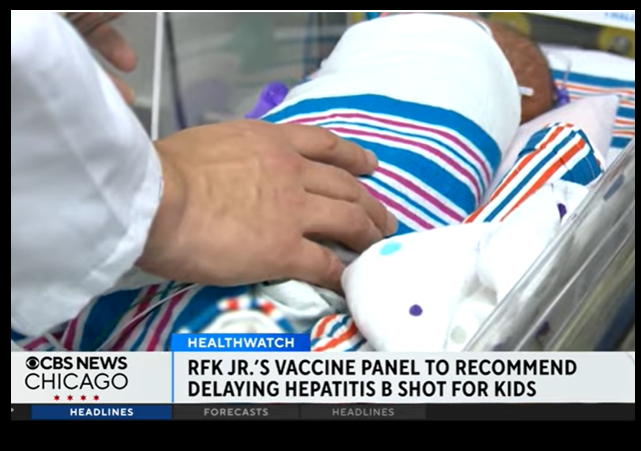
As many Americans supporting the “Make America Healthy Again” agenda had hoped, a vaccine advisory panel appointed by the Department of Health and Human Services Secretary Robert F. Kennedy, Jr., has begun reviewing childhood vaccine recommendations.
This week, the Centers for Disease Control and Prevention (CDC) Advisory Committee on Immunization Practices (ACIP) voted 8-3 against recommending the combined measles, mumps, rubella, and varicella (MMRV) vaccine for children under age 4, advising instead that children in this age group receive separate shots for MMR and varicella (chickenpox).
The decision is driven, in part, to avoid injecting children with several different vaccines all at the same time.
The new guidance from the Centers for Disease Control and Prevention’s Advisory Committee on Immunization Practices (ACIP) suggests the vaccine, called MMRV, shouldn’t be recommended for children under age 4 because of a small risk for febrile seizures in that age group. The seizures can be prompted by fevers associated with viruses or, sometimes, vaccines. They usually last for a few minutes and, while they are scary for parents to witness, are generally harmless, doctors say.
The panelists voted 8-3 in favor of the change. One member, Dr. Robert Malone, abstained because of a conflict of interest.
Doctors have known about the increased risk of febrile seizures in young children for years. It’s why the CDC already suggests that younger kids get the varicella vaccine separately, unless a parent or a caregiver prefers the MMRV shot.
The combination shot was developed to cut down on the number of vaccines babies receive at age 1 and to increase the chances kids will get all of their vaccinations. But about 85% of parents opt to give their children the stand-alone measles, mumps and rubella vaccine and a separate varicella shot, according to data presented at Thursday’s meeting.
The panel also indefinitely postponed a vote on a Hepatitis B vaccine they had already deferred once. Hepatitis B (HBV) is a bloodborne pathogen that can be transmitted sexually or if there is contact with infected bodily fluids via needles, surfaces, or other contaminated items.
And the panelists said they felt unready to decide whether to limit the use of a vaccine for hepatitis B that is typically given to all newborns. Some said they still had questions about the vaccine’s safety, while others seemed relieved that the panel did not make what they saw as a rash decision that might harm children.
“We are more prudent when we are cautious,” Dr. Joseph Hibbeln, a neuroscientist formerly at the National Institutes of Health, said as he voted to table the vote.
It must be noted that 90% of newborns who acquire hepatitis B (usually from infected mothers at birth) will become chronically infected if not given immediate prophylaxis (i.e., the vaccine). This means those children have immune systems that will not be able to kill the virus, but will eventually have adverse effects on their liver.
How many children does this impact? In the U.S., about 17,800 infants were born to hepatitis B-positive mothers in 2021, representing nearly 0.5% of all births.
I would simply argue that parents of infants should be fully informed of the risks and health consequences of Hepatitis B, then they can decide if the vaccine is appropriate for their child. There should be no mandate for this particular shot.
However, a few of the experts on the panel argued otherwise.
Public health experts acknowledge that a baby’s risk of contracting hepatitis B is low if the mother is negative for the virus. But they say the broad recommendation should be maintained because of the original reason it was put in place: Many babies slipped through the cracks.
The ACIP originally recommended the vaccine be given only to infants of mothers who tested positive. But when uptake of the vaccine remained low due to a lack of prenatal testing, the panel broadened the recommendation to include any infant within 24 hours of birth. About 12 to 16 percent of pregnant women do not receive prenatal screening for the infection, according to the CDC.
“The birth dose is the safety net that catches a baby who would otherwise fall ill,” said Kelly Moore, president of Immunize.org, a vaccine advocacy organization, and a former ACIP member who voted for the recommendation.
Vaccine Panel Postpones One Vote and Reverses Another Amid Confusion https://t.co/oQHIsevE8D
— Catherine Lucey (@catherine_lucey) September 19, 2025
Again, I would argue that a one-size-fits-all approach to healthcare is senseless. Ensure the parents have all the information they need, including risks and outcomes, and allow them to select the schedule appropriate for their child.
Donations tax deductible
to the full extent allowed by law.







Comments
Indecisive panel
Not always bad but doesn’t give ringing confidence
“We are more prudent when we are cautious,” Dr. Joseph Hibbeln, a neuroscientist formerly at the National Institutes of Health, said as he voted to table the vote.”
Rashness was perfectly fine when they put the vaccine ON the list, but when it comes time to take it off, well… prudence and procrastination is the order of the day!
How are medications in general, and vaccines in particular really tested? Digging deeply into this subject provides unexpected results. A relatively new book: “Turtles All The Way Down: ‘Vaccine Science and Myth.” reveals some of the inside details. The Israeli authors are anonymous which is a feature, not a bug. Everything is referenced to the mainstream medical literature. The authors backup all their assertions with references, some 1,200 of them. Some excerpts.
“The last option available to the company wishing to hide their product’s undesirable side effects is to design a trial in which the reported rate of adverse events in the control group would likely be very similar to that of the trial group. As described previously, the RCT’s control group represents the baseline rate to which the trial group is compared. A similar proportion between the two groups would indicate that the adverse events reported in the trial group were the result of “background noise” only and not caused by the experimental drug. This technique has three distinct advantages: (1) It is 100% legal, (2) it is very effective, and, as it turns out, (3) it has the full approval of licensing authorities around the world. As we shall shortly see, this method is exactly the one vaccine manufacturers employ to deliberately obscure the real incidence of vaccine adverse events. The entire vaccine program is founded upon this deception.”
“Vaccine trials in general, and childhood vaccine trials specifically, are purposely designed to obscure the true incidence of adverse events of the vaccine being tested.”
“A new pediatric vaccine is never tested during its formal approval process against a neutral solution (placebo).”
That last sentence is true and the solution that is generally used is another “safe” vaccine, thereby ensuring that the results will not have a significant difference in outcomes.
And, of course, the other part of that equation is that the entire approved lot of vaccines has never been tested against non-vaccinated – officially. This lack of clarity by the science is why there should be no mandates. Let a family and their doctor (if they can find one who can read) decide what is appropriate. I am sorry for the immuno-compromised children that don’t get vaccines, but that shouldn’t make mine get them if that is not what I want for them.
My other bugaboo is the doctors (pediatricians mostly) who refuse to keep a patient that does not do the approved schedule on time.
Prevnar 20, PCV-20 (Pfizer): licensed for babies based on trials with no placebo control (Prevnar 13 used as the control), up to 6 months of safety review after injection, and that showed high rates of serious events (this time broken up into two categories – “serious adverse events” and “newly diagnosed chronic medical conditions”) in both vaccine groups (experimental and control) but deemed “safe” because “no notable patterns or imbalances between vaccine groups.” Meaning, PCV-20 was licensed based on a clinical in which PCV-15 was the control, PCV15 was licensed based on a clinical trial in which PCV-13 was the control, PCV-13 was licensed based on a clinical trial in which PCV-7 was the control, and PCV-7 was licensed based on a clinical trial in which another experimental, unlicensed vaccine was the control, and in each of these trials the serious adverse events in both the control and experimental groups were similar which was sufficient for a finding of “safe” for licensure by the FDA.
From the written testimony of attorney Aaron Siri of Siri & Glimstad, on May 19, 2025
Re: Hearing Regarding the Corruption of Science and Federal Health Agencies: How Health Officials Downplayed and Hid Myocarditis and Other Adverse Events Associated with the Covid-19 Vaccines
Explain to me why it doesn’t make more sense to mandate Hep B testing for mothers, rather than injecting millions of babies to help a handful. The chances of a baby NOT born to an infected mother are ZERO, not “low”.
This wholesale vaxxing makes sense only if you buy into “safe and effective” mantra, which is only possible if you deliberately close your eyes to all the published negative effects of vaccines.
The medical and pharma establishments would love it if we continue to believe there are no adverse effects and just purely amazing benefits to vaccines (it is, after all, what we’ve been told for decades) but with education people are discovering that neither premise is true.
Read and research for yourself; stop simply accepting the company line. You will be amazed and appalled at the true record of vaccines.
It does make more sense to test the mothers. Anything else is just obsessive,
Because the argument is that Hep B test can give a false negative result and it’s better to vaccinate a newborn “just in case” the mother’s test result was a false negative. Not sure why they can’t simply repeat the test and compare the two results but there you go. Guess it’s easier to give the newborn the jab then it would be to make sure your test was accurate.
Which also leads to the obvious question: if the test isn’t accurate, and returns a significant amount of false negatives, how can we tell if the shot works or not?
“The ACIP originally recommended the vaccine be given only to infants of mothers who tested positive. But when uptake of the vaccine remained low due to a lack of prenatal testing, the panel broadened the recommendation to include any infant within 24 hours of birth.”
As a physician myself, my response is the traditional one — better education of physicians, health care workers, and patients. We could make the EHR work to inform us when a pregnant woman is HBV+ and thereby arrange to treat the newborns.
The previous recommendation was a shotgun approach; the last two generations of medicine have tried to get away from precisely that.
Nothing says gov’t efficiency like the ‘one size fits all’ mindset. I don’t understand the reasoning to oppose having Physicians evaluate the needs of each Child and work with the Parents to decide and apply the best fit for that particular Child. Factory style medical practices, centralized billing, Pharma lobbying, loss of independent Physician Practices would probably explain it.
“…I would argue that a one-size-fits-all approach to healthcare is senseless.”
Every injection or administration of even an approved drug or vaccine is an experiment in how the individual receiving the dose will react.
Prescription drug commercials now warn “Don’t take drug XYZ if you’re allergic to drug XYZ.” How does one find that out? By having an allergic reaction to drug XYZ, that’s how.
It seems to me the obvious solution is to make it standard protocol for all newborns except where the mother has tested negative. That catches the ones where she wasn’t tested. And it saves the minuscule risk for those whose mothers did test negative.
Leaving it to the parents ignores the fact that a Hep B+ mother who has not been tested throughout her pregnancy is probably an irresponsible person who is not in a position to judge her child’s best interests, and the baby is at significant risk.