


Ash from 1980 Mount St. Helens Eruption Still Swirls Around Iconic Volcano
The most recent in a series of unusual activities occurring with the Pacific Northwest volcanoes.
The volcanoes of the Pacific Northwest have certainly been active in interesting ways this year.
Slumbering Mt. Adams experienced an unusual round of seismic activity that lasted into the beginning of this year.
Subsequently, two of the area’s Congressional representatives sent a letter to the United States Geological Survey (USGS) requesting additional studies of the region. Additionally, emergency plans for the Pacific Northwest were being reviewed and updated.
An underwater volcano off the coast of Oregon appears poised to erupt.
In July, swarms of hundreds of small earthquakes were recorded around the Cascade Range’s iconic Mt. Rainier.
Fortunately, seismic activity at Mount Rainier has returned to normal background levels following this swarm, which resulted in thousands of small quakes and was the most energetic ever recorded at the volcano. However, all evidence indicates the activity was related to the volcano’s hydrothermal system and not magma movement. So the current volcano alert level remains “Normal” with no signs of imminent eruption.
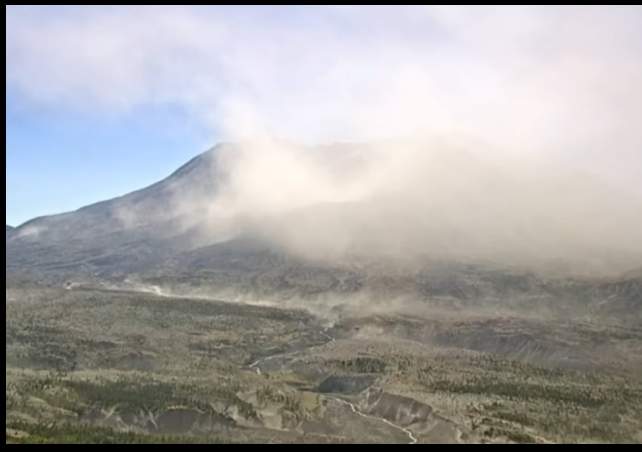
This week, Oregon residents became concerned when the infamous Mt. St. Helens (which erupted spectacularly in 1980) was obscured by a cloud of ash.
It turns out, it wasn’t an eruption. Rather, strong wind currents kicked up the ash left 45 years ago.
Some Pacific Northwesterners woke Tuesday to an unusual sight: A smoky haze shrouded Mount St. Helens, the large, active stratovolcano in Washington state that erupted catastrophically in 1980. But a new eruption was not to blame for the foggy scene this week, scientists said. Instead, ash from the blast that occurred 45 years ago had suddenly begun to swirl around the mountain.
Strong winds in the area caused the decades-old debris to circulate, according to the United States Geological Survey and forecasters in Portland, which is about 50 miles away from the summit of Mount St. Helens across the Oregon border.
“Mt. Saint Helens is NOT erupting,” Portland’s National Weather Service office assured in a social media post Tuesday. “Volcanic Ash from the 1980s is being lofted back into the air from the strong east winds.”
MOUNT ST. HELENS Strong easterly–southeasterly winds in the vicinity of Mount St. Helens have picked up loose volcanic ash deposited during the 1980 eruptions.
— USGS Volcanoes🌋 (@USGSVolcanoes) September 16, 2025
Airline pilots report that ash was blown as high as 10,000 feet into the atmosphere. While dramatic, clouds of resuspended ash are not unusual; however, the magnitude of this particular event was remarkable.
Resuspended volcanic ash isn’t unusual at Mount St. Helens. The massive 1980 eruption blasted a column of ash and gas more than 15 miles into the atmosphere and triggered a devastating landslide, killing 57 people in what was the most destructive eruption in modern US history.
Pockets of that fine, powdery rock still linger today on the volcano’s flanks and inside the crater. When conditions line up — dry surfaces, no snow cover and strong winds — the deposits can be lofted again.
That’s exactly what happened Tuesday when a stubborn ridge of high pressure over the Pacific Northwest not only brought record September temperatures to Washington and Oregon, where large parts are experiencing a severe drought, but also set off dry, gusty east winds barreling across Mount St. Helens.
The ash cloud will dissipate when the winds die down. Hopefully, this will be the only spectacular ash event in the Pacific Northwest for some time to come.
Donations tax deductible
to the full extent allowed by law.







Comments
The Cascade range can have any one of these individual Strata Volcanoes erupt. The bigger issue is the Cascadia subduction zone. That can be the single most catastrophic earthquake and Tsunami to ever hit the developed Northwest area. Seattle, Vancouver, Portland all heavily damaged/destroyed.
Don’t worry about the tsunami. Everyone will die instantly from the plate moving a few miles in 2 seconds.
They tell us we will have 15 minutes from zone movement to tsunami hitting us. Plenty of time to grab the kids/cats, find the car keys and phone, and head out onto a road already jammed tight with other residents fleeing to higher ground.
So, in a tsunami trigged by movement in the CSZ, we’re all sure to die in our cars.
If only they still made the old VW Bugs….I still remember the car commercial with the Bug floating on water…. 😛
Even better was National Lampoon’s parody ad satirizing Ted “Swimmer” Kennedy:
https://www.theretrosite.com/national-lampoon-ted-kennedy-vw-ad/
Here’s hoping the entire costal area goes the way of Atlantis along with their toxic citizens.
Portland State University has a really good seismic reader down in the basement. Dunno if its still set up like this, but they had the ticker tape running in a view window in the hallway, so you could watch the geologic action for the past X window of time- which was super cool if a small earthquake happened to hit.
The geology dept there used to be pretty good. At the time one of their lead instructors was an incredibly smart local who really made the lectures pretty compelling. He had said if the Helens had blown the way it was geologically set up to do, PDX would have been buried.
Have they tried Clearasil?
If you fly over the top of Mount St. Helens you can see the lava dome that has grown in size over the many years.
Remobilized ash is not uncommon. Kodiak and the Alaska Peninsula gets remobilized ash from the 1912 Katmai / Novarupta eruption from time to time, and that was 110 years ago. Only way to stop that is to grow vegetation on the deposits, which takes a while. Cheers –
John Forbes Kerry, the haughty French looking Massachusetts Democrat, who by the way served in Vietnam, and MAN-BEAR-PIG announced this was caused by global warming.
He’s flown over the area in his private plane and tossed someone else’s Vietnam War medals into the volcano several times so he ought to know.