


Gordon Klein v. UCLA Trial Update – The Defense Rests
Closing arguments on September 5
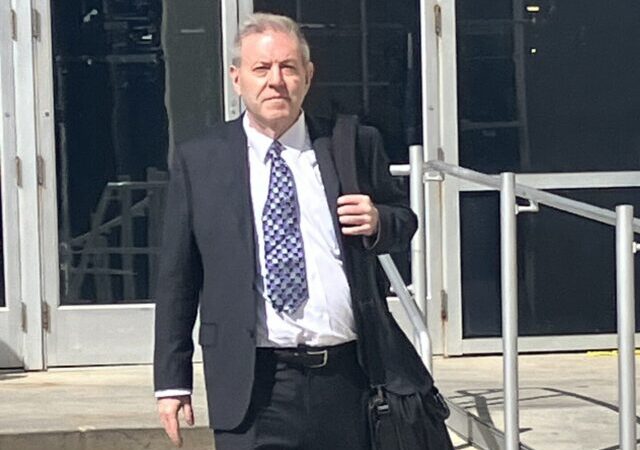
The trial continued in the case of Prof. Gordon Klein versus the UC Regents and UCLA business school Dean Antonio Bernardo, with the defense completing its case.
Legal Insurrection has been following the dispute since inception. Our prior trial reports are here:
- Trial Starts In Suit Against UCLA By Prof. Gordon Klein, Targeted and Smeared For Refusing Exam “Leniency” For Black Students
- Gordon Klein v. UCLA Trial Update – Expert and Student Take The Stand
- Gordon Klein v. UCLA Trial Update – Cross of Prof. Klein Wraps Up, Dean Bernardo Takes The Stand
- Gordon Klein v. UCLA Trial Update – Dean’s Cross-Examination Continues, Supervisor Testifies
- Gordon Klein v. UCLA Trial Update – Plaintiff’s Expert Values Damages At Over $13 Million
- Gordon Klein v. UCLA Trial Update – Dean Bernardo’s Testimony Wraps Up
- Gordon Klein v. UCLA Trial Update – Plaintiff Rests His Case, Defense Motion For Directed Verdict Denied
- Gordon Klein v. UCLA Trial Update – The Defense Puts On Its Case
We are catching up on our summaries of testimony on the defense case for trial dates I was not able to attend in person, based on my review of trial transcripts.
August 11, 2025
Asmara Carbado (Former UCLA Discrimination Prevention Office Investigator)
The defense began its case with Asmara Carbado, a former investigator in UCLA’s Discrimination Prevention Office (DPO). A Harvard Law graduate and former attorney with the Federal Public Defender’s Office, Carbado outlined her work at UCLA, where she reviewed discrimination and harassment complaints involving faculty.
She explained that complaints were first subject to a preliminary assessment to determine whether a full investigation was necessary. At that stage, faculty members were not contacted. The “respondent is only obligated to respond if there’s actually a formal investigation,” she said, clarifying why Klein himself was never interviewed during her review.
Carbado testified that she was assigned to review Klein’s June 2020 email to student Leslie Giovanny, who had requested accommodations for black students. She interviewed the student, analyzed the correspondence, and drafted reports for her supervisors. Her conclusion was that there was not enough evidence to justify a formal investigation. Still, she wrote that Klein’s remarks showed “poor judgment” and were “racially insensitive,” particularly his references to “special treatment” and comments suggesting students prove their racial identity. These, she said, reflected “a gross lack of empathy.”
When questioned by the plaintiff’s attorney, Carbado was pressed on earlier deposition testimony where she acknowledged being assigned to initiate a formal investigation but later recommended closure. Burg highlighted her draft email, in which she wrote: “I don’t see a basis to go forward with an investigation.” He also noted a mistaken reference in her draft report that misgendered the student, which Carbado conceded was an error.
Later, when asked again by the defense, Carbado stressed that investigators had the independence to reach their own findings regardless of initial instructions. She reaffirmed that while Klein’s tone was troubling, it did not rise to a policy violation. The DPO closed the matter in July 2020 with only a recommendation that Klein attend training.
Brian Bergmark (Forensic Accountant/Business Valuation Specialist)
The defense also presented Brian Bergmark, a forensic accountant and business valuation specialist, who testified as an expert on damages in the case. Bergmark, now with Stout but previously at Torrey Partners, told the jury his work focuses on economic damages and lost earnings analyses.
He began by critiquing the approach of plaintiff’s expert, Eric Madsen, who had calculated Klein’s projected “but-for” consulting income and compared it against actual income after June 2020. Bergmark said Madsen’s method attributed the entire difference to the defendants, without accounting for other factors. “There’s no allocation to all of the other factors,” he explained, pointing to the COVID-19 pandemic, the volatility of Klein’s one-off consulting engagements, and broader market conditions that could affect revenues.
Bergmark examined the underlying data as well. He noted that the file contained invoices and some 1099 forms, but no tax returns that would provide comprehensive totals. As a result, Madsen’s calculations rested mainly on invoices. While acknowledging gaps in the 1099s, Bergmark cautioned this could be explained by benign reasons—such as foreign clients—and said he had “no reason to doubt” Klein’s stated collection rate.
The expert conceded that Klein’s consulting revenues did drop sharply after June 2020 and that the incident at UCLA contributed “to some degree.” Still, he resisted attributing all the decline to the defendants, emphasizing the need to separate out pandemic effects and normal business fluctuations.
Bergmark also walked through alternative modeling. Using government tables, he pointed to a life expectancy of 17.5 years and a work-life expectancy of 7.34 years from the date of the incident. As a reference point, he cited Klein’s 2019 consulting income of about $1.3 million. However, he did not prepare full revenue projections under this alternative model.
The court allowed Bergmark to use his draft summary of opinions as a demonstrative exhibit but made clear that the summary itself was not admitted into evidence. Only his sworn testimony would stand as part of the record.
August 15th, 2025
Heather Caruso (Associate Dean for Equity, Diversity, and Inclusion, UCLA Anderson)
Heather Caruso, the Associate Dean for Equity, Diversity, and Inclusion at UCLA Anderson, appeared in court on August 15th as one of the key administrators involved in the early university response to the June 2020 email controversy. Her testimony reflected both urgency and emotional awareness. She explained that upon learning of Professor Gordon Klein’s email — which had denied a request for special accommodations following the George Floyd protests — she immediately sensed what she called a “heightened” level of emotional harm among students, especially Black students. “There was a general sense of emotional harm that many Black students had expressed experiencing,” she testified.
Caruso did not contact Professor Klein or seek clarification about his email. Instead, she forwarded the complaints to senior leadership. Caruso emphasized that while she did not formally recommend any disciplinary action, she believed it was vital that the administration show “visible responsiveness.” She explained, “The situation was escalating quickly, and students needed to see responsiveness from the institution.”
Under cross-examination, Caruso confirmed that her role was not investigative. She did not attempt to verify the claims against Klein or seek his perspective before helping to initiate internal communications. “I was not in a role to investigate,” she said, reiterating that her priority was student wellbeing. When asked directly whether the university provided Klein an opportunity to respond before he was placed on leave, Caruso acknowledged that no such process occurred.
She stated that her primary concern was supporting students during a time of national trauma, not evaluating the merits of the email itself. “It wasn’t about the technical language,” she said. “It was about the impact on the students.” Her involvement, she added, was “consistent with [her] role and the expectations of it,” though she admitted to having limited information about the full scope of the issue.
Video Witnesses
Adoria Lim and Ashish Pradhan provided video depositions that were to be furthered reviewed by the judge at a later time
Closing arguments will take place on September 5.
======================
Jadon Soriano is a recent UCLA graduate with a Bachelors of Arts in Economics.
Donations tax deductible
to the full extent allowed by law.







Comments
Enough already. The time has come to call a spade a spade.
There’s a Klein-Gordon equation which is fairly famous.
“There was a general sense of emotional harm that many Black students had expressed experiencing,” she testified.
She explained, “The situation was escalating quickly, and students needed to see responsiveness from the institution.”
The proper response of the university to the students seeking favored treatment because of their skin color and when they didn’t get it throwing a hissy fit and lodging unfounded allegations against the Professor would have been “grow the hell up and if you can’t then you are not ready to attend our university so go elsewhere”.
That would have been my response also.