


Gordon Klein v. UCLA Trial Update – The Defense Puts On Its Case
UCLA’s expert witnesses attacked Klein’s damage calculation and disputed his loss of business from UCLA’s actions.
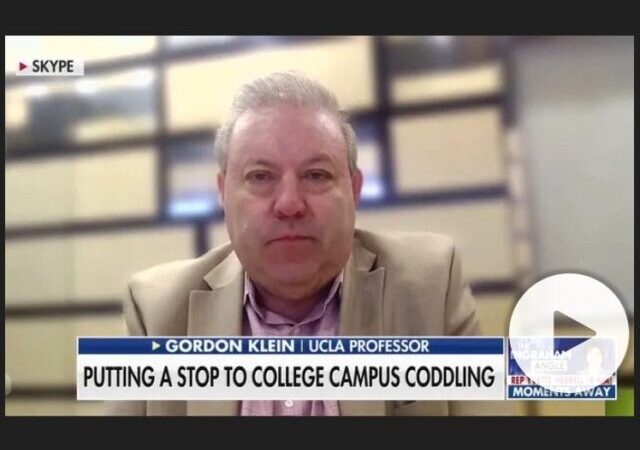
The trial continued in the case of Prof. Gordon Klein versus the UC Regents and UCLA business school Dean Antonio Bernardo.
Legal Insurrection has been following the dispute since inception. Our prior trial reports are here:
- Trial Starts In Suit Against UCLA By Prof. Gordon Klein, Targeted and Smeared For Refusing Exam “Leniency” For Black Students
- Gordon Klein v. UCLA Trial Update – Expert and Student Take The Stand
- Gordon Klein v. UCLA Trial Update – Cross of Prof. Klein Wraps Up, Dean Bernardo Takes The Stand
- Gordon Klein v. UCLA Trial Update – Dean’s Cross-Examination Continues, Supervisor Testifies
- Gordon Klein v. UCLA Trial Update – Plaintiff’s Expert Values Damages At Over $13 Million
- Gordon Klein v. UCLA Trial Update – Dean Bernardo’s Testimony Wraps Up
- Gordon Klein v. UCLA Trial Update – Plaintiff Rests His Case, Defense Motion For Directed Verdict Denied
Last week saw a full schedule of witnesses as the defense put on its case.
Here are summaries of some of the defense witnesses, with more summaries to follow in the next post.
Mohammed Cato (UCLA Title IX Director)
Mohammed Cato, UCLA’s Title IX Director since September 2017, began by detailing his background, including a joint JD/Urban Planning degree from UCLA and prior work at Western Washington University. As Title IX Director, he explained, his duties included training, compliance, and consulting on matters involving dating violence, retaliation, and gender-based discrimination. He also clarified the role of the Discrimination Prevention Office (DPO), which handles complaints based on race, age, disability, and other protected categories outside of Title IX’s scope.
Cato confirmed that he first became aware of concerns involving Professor Klein in June 2020, when an “equity advisor” forwarded concerns to the Title IX office as a responsible employee. An initial email by Klein to students, calling them “favorites” and questioning if grade adjustments were needed, triggered the inquiry.
Cato emphasized that the Title IX office doesn’t investigate motives or intent: “We’re only concerned about the conduct,” he explained, reiterating that the office evaluates whether behavior is “severe, pervasive, or persistent.”
Cato’s colleague reached out to five potential complainants multiple times. Of those, three responded, and only one engaged in any meaningful way, offering detailed information. The student never agreed to reveal her identity, and no formal investigation was opened.
When questioned about whether this constituted a closed case, Cato clarified, “There was never an investigation that took place.” He stressed that student reluctance and timing—finals season, summer break—often delay proceedings: “It only takes one” complainant to pursue a case, which is why cases may remain open.
Cato eventually met with Klein on August 27, 2020, not to investigate but to “make the respondent aware of concerns brought to the office” and to discuss policy and best practices. He said Klein appeared engaged and wanted to ensure the matter didn’t involve any sexual allegations.
When cross-examined by plaintiff’s counsel, Cato was pressed about the identities of the five complainants. He believed they included the female student and her four sorority sisters, but was not definitive. Questions arose about whether one of the complainants was an Anderson staffer. Cato admitted uncertainty, noting that records often contain phone calls not documented in writing.
Cato testified that Title IX does not publicize administrative leave decisions. He was not sure which department made Klein’s leave public. When asked if respondent motives affect how Title IX responds, he said, “It has no effect. We prioritize student safety.”
Justine Farrell (Defense Marketing Expert)
Justine Farrell, a marketing professor and department chair at the University of San Diego, testified as a social media and email marketing expert. Her primary finding was that UCLA’s official actions had minimal media impact compared to Klein’s own activities and public appearances.
Farrell reviewed engagement data from four UCLA emails provided by a UCLA marketing analyst. For example, Dean Bernardo’s June 4 email was opened by 1,906 out of 3,000 recipients, with only 20 clicking or interacting. Similarly, a June 21 email had a slightly better open rate but similarly low engagement.
In contrast, Klein’s appearance on Fox News in October 2022 reached 22 million impressions, with 172,000 unique users. Non-UCLA media content consistently performed orders of magnitude better, sometimes reaching hundreds of millions. Farrell attributed this to the limited reach of UCLA’s email lists and social platforms.
She also noted recurring spikes in media interaction well after the initial controversy, often triggered by Klein’s blogs or renewed media interest. Klein’s posts on Reddit received many upvotes, indicating public desire to keep the discussion alive.
Under cross-examination, plaintiff’s counsel highlighted inconsistencies in Farrell’s prior deposition, where she stated she had not worked with anyone on her analysis. She admitted to receiving documents from UCLA’s legal team and from “Eva.”
Importantly, Farrell had “no opinion” on whether Bernardo’s emails caused harm to Klein’s business or reputation. When asked whether the social media firestorm harmed Klein, she said that question was outside her scope of work.
John Charles Meyers (Defense Damages Expert)
Vocational rehabilitation counselor John Charles Meyers provided a critical analysis of Gordon Klein’s damages claims. As an expert frequently appointed under Section 730 in California courts, Meyers has evaluated earnings in family law, probate, and employment law cases.
Meyers used IBISWorld software and Scogg work-life tables to estimate Klein’s professional future. He disagreed with opposing expert Madsen’s methods, which used general labor participation rates. Meyers calculated that Klein had about 7 and a half years left in the workforce, through June 2028.
He criticized Madsen’s approach for lacking peer review and standard error calculations. Meyers believed Klein could have mitigated damages by reaching out to law firms directly rather than relying on three firms (Brattle, Compass Lexecon, Cornerstone).
Meyers also dismissed the idea that Klein could work indefinitely, referencing the physical and mental demands of expert consulting. Though Klein held roles (professor, forensic economist) where individuals may work late into life, Meyers asserted this doesn’t apply universally.
He described a sharp drop in demand for expert witnesses between March 2020 and January 2021 due to court closures during COVID-19. But since 2021, he noted an “explosive” resurgence in demand and fees.
Despite media coverage and Klein’s public controversy, Meyers stated that these effects were difficult to quantify. Still, he agreed that publicized administrative leave would reasonably impact Klein’s ability to attract clients: “Common sense tells you anything negative about you will have a negative effect on your ability to get work.”
Vilma Ortiz (UCLA Prof., Member Privilege & Tenure Committee)
Vilma Ortiz, a sociology professor with 37 years at UCLA and former chair of the Privilege & Tenure (P&T) Committee, detailed the grievance process for faculty. The P&T Committee hears grievances involving rights violations, including academic freedom, but not those involving employment status for lecturers like Klein unless tied to academic freedom or involuntary leave.
Ortiz confirmed that Klein filed a grievance claiming his academic freedom was violated by Bernardo’s public statements and the school’s response to his email. The P&T Committee reviewed submissions from both sides but made no attempt to resolve the issue informally.
Ultimately, the committee split evenly. Because of the tie, Klein’s grievance did not proceed to a full evidentiary hearing. Ortiz emphasized that a formal hearing resembles a court trial, with attorneys, evidence, and a final ruling by the chancellor.
Some committee members believed Klein’s response to the student was outside his expertise and showed poor judgment. Ortiz herself echoed this, describing it as a “lapse of judgment” and noting, “Had Mr. Klein thought more about his response and what was unfolding around us, he might have handled the situation differently.”
During cross, Ortiz struggled with details of the student request, appearing unaware that Giovanny (a student who testified during the trial) had requested special accommodations for Black students. She admitted this misunderstanding may have affected her assessment of the grievance.
She confirmed that labor relations handled step one of Klein’s grievance before forwarding it to the P&T Committee. When the committee split, the process ended.
Ortiz was also questioned about statements from some committee members that suggested Bernardo’s actions may have harmed Klein. She said, “I would not disagree with every sentence and phrase in the group 1 part of the letter,” indicating some agreement with concerns raised about Bernardo’s conduct.
Ortiz concluded by acknowledging that Klein’s case was the only academic freedom grievance she encountered during her time on the committee.
We will have more coverage of the completed testimony in the next post.
======================
Jadon Soriano is a recent UCLA graduate with a Bachelors of Arts in Economics.
Donations tax deductible
to the full extent allowed by law.





Comments
I thought the following blurb in the article from Mohammad Cato illuminates the bankrupt morality of the title IX mentality at least at UCLA and probably at most other universities.
Cato emphasized that the Title IX office doesn’t investigate motives or intent: “We’re only concerned about the conduct,” he explained, reiterating that the office evaluates whether behavior is “severe, pervasive, or persistent.””
By this logic there would be no difference between killing a man in cold blood compared with killing him in self defense or as the result of an accident. That is not how these cases are perceived in the US. Motivation or intent is very important to the Western sense of justice. It turns out that many non-Western cultures view motivation or intent as irrelevant to evaluating an infraction or crime. So it seems that UCLA is departing from Western civilization when they should be bastions of it. .
I can’t understand UCLAs reasoning for letting this BS get to this point. Doesn’t anyone there especially in the schools insurance agency, see the folly in what they’re doing?
There has to be an adult SOMEWHERE at that school, doesnt there?
fwiw – In my line of work as a CPA, I frequently deal with valuations. What is common in litigation is that expert prepared valuations skew heavily in either direction depending on which side has hired the expert. An excellent example is the Oberman / Gibson case where the defense understated the value at near zero while the plaintiff valuation was a few million.
UCLA’s expert made the following statement about the plaintiff’s expert – “He criticized Madsen’s approach for lacking peer review and standard error calculations”
I can state from personal experience, I have never seen an expert valuation report having been peer reviewed.
Judging from the photo, any diminution of the lost income amount can be more than compensated by the resultant increase in the booze budget.