


Court Throws Out Trump Lawsuit Against Maryland Judges
The court gave the administration blunt advice when it comes to a decision it does not like: “It should appeal.”
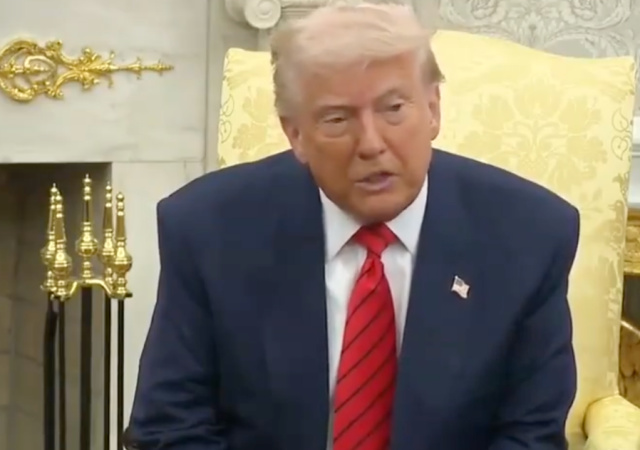
The U.S. District Court in Maryland tossed out President Donald Trump’s administration’s lawsuit against Maryland’s judges.
The administration named Chief Judge George Russell as the main defendant, but also added “every other active and senior (i.e., semi-retired) judge in the district (15 in total), the Clerk of Court, and the court itself.”
The court found:
(A) the Executive lacks standing to bring its claim for injunctive relief, but even disregarding that critical flaw, its entire complaint is subject to dismissal because (B) Defendants are immune from suit and, (C) alternatively, the Executive fails to identify a legitimate cause of action that allows it to bring this lawsuit. Because these irreconcilable defects mandate dismissal of the entire suit, the court does not reach the merits question of whether the standing orders are a proper exercise of judicial power.
The situation started in May when the court’s Chief Judge George Russell “issued two standing orders prohibiting federal immigration officials, for just two business days, from removing or altering the legal status of any alien detainee who had filed a petition for a writ of habeas corpus.”
Trump’s administration described Russell’s standing orders as “a direct insult” to the Executive Branch’s authority to handle immigration laws.
Judge Thomas Cullen, who authored the ruling, wrote out the administration’s grievances with the order.
“Fair enough, as far as it goes,” Cullen responded. “If these arguments were made in the proper forum, they might well get some traction. And under normal circumstances, it would not be surprising if the Executive raised these concerns through the channels Congress prescribed—that is, by challenging the orders as applied to a particular habeas proceeding through a direct appeal to the Fourth Circuit or, as expressly authorized by federal statute, by petitioning the Judicial Council of the Fourth Circuit, which has the authority to rescind or modify local court rules.”
Cullen then said we do not live in “normal times.” The administration’s decision to sue the court did not surprise him.
Cullen gave the administration blunt advice: “It should appeal.”
The judge had a point when he wrote, “the executive branch is not the sole sovereign” of America. The three branches, legislative, executive, and judiciary, are the sovereign branches in America.
Cullen admitted it’s serious when one branch accuses another branch of encroaching on its constitutional duties. He also acknowledged that the judiciary is not above the rules.
“But those disputes, weighty as they may be, must be resolved within the constitutional structure and with due respect for the Judiciary’s co-equal standing with the executive branch,” explained Cullen. “The Constitution does not give courts ‘general oversight’ of other branches; rather, it permits courts to adjudicate only cases and controversies to the extent Congress allows.”
In other words…appeal Russell’s standing order.
Look, I am tired of activist judges. But Cullen has a point. We have a process, so use it.
“Much as the Executive fights the characterization, a lawsuit by the executive branch of government against the judicial branch for the exercise of judicial power is not ordinary,” concluded Cullen. “The Executive’s lawsuit will be dismissed, and its motion for preliminary injunction denied as moot. Whatever the merits of its grievance with the judges of the United States District Court for the District of Maryland, the Executive must find a proper way to raise those concerns.”
Donations tax deductible
to the full extent allowed by law.







Comments
As expected. This is a brush-back pitch. It was expected to be tossed. Moving the Overton Window, etc…
Andrew Branca articulated a way to remove them via a simple majority.
Article III authorizes these judges ‘during good behavior’
Certainly doubling down after being rebuked by SCOTUS is BAD BEHAVIOR
It seems pretty stupid to open that door since the dems would abuse it to easily remove plenty of conservative judges.
Judicial independence requires that “behavior” can’t include a judge’s decisions. Congress can’t sit in judgment of a judge’s decisions, because it is exclusively the judicial branch’s role to decide what the law is, and not Congress’s role; so Congress can’t know whether a decision is right or wrong. It can only remove a judge for bad acts.
“Congress can’t sit in judgement of a judge’s decisions, because it is exclusively the judicial branch’s role to decide what the law is.”
Crapola!
The legislative branch creates the law. Its opinion of what the law is, is equally valid as the judicial branch’s opinion. The power grab of Marbury continues to skew the separate but equal balance of the three branches of government.
No, it is not. The constitution explicitly puts the judicial power, which is the power to say what the law is, in the hands of the judicial branch. The legislature is not entitled to an opinion on the matter. It can make new laws if it likes, or it can amend existing laws, but it can never say what a law means.
Do you listen to what you say? If Congress makes a law, it is explicitly saying what the law means. Don’t be obtuse.
But SCOTUS can rule that decision is wrong. And it has, several times.
And if it has to do that enough, then bad behavior starts attaching.
Well, Trump tried putting the judiciary in its proper place by using the judiciary’s own processes. Fat wonder it got him nowhere.
Now he needs to try putting the judiciary in its proper place by using the executive power, and the legislative power assuming he can swing that. Levers over which the judiciary has no control. Then we’ll see if they can learn some humility and cooperation.
It seems to me the court is correct. The administration should appeal the decision. However the concept of co-equal government branches gives rise to the concept of the administration ignoring the courts orders and tell the courts that it is the courts that need to appeal the decision of the administration. Why is it I get the impression that unelected judges believe they are more equal than those elected?