


Box Tree Moth Invades Virginia: 10th U.S. State Confirms Pest Presence
This destructive insect came into the country by way of Canada.
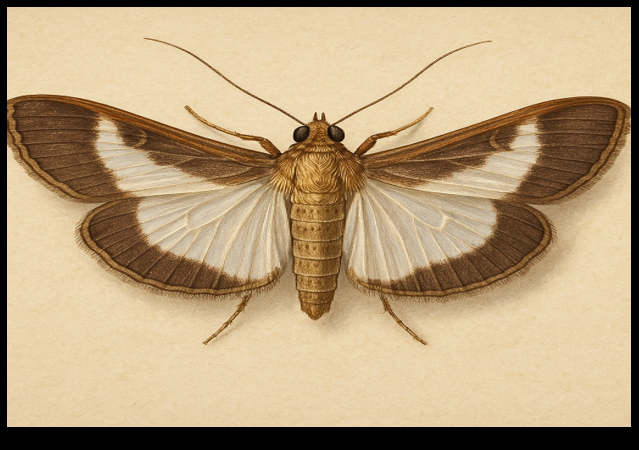
An invasive moth species has been making its way through the U.S., and Virginia has now become the tenth state to confirm the presence of the pest.
The Virginia Department of Agriculture and Consumer Services (VDACS) has confirmed the detection of a new invasive insect in the Commonwealth: the box tree moth.
Inspectors discovered the pest, Cydalima perspectalis, at four locations in Clarke and Loudoun counties. This marks the first time the species has been found in Virginia, though it has been detected in several other states.
The box tree moth poses a serious threat to boxwood plants (Buxus species), a popular ornamental shrub in Virginia landscapes, officials said. The caterpillars are known for their voracious appetites and can quickly strip boxwood of its foliage. If infestations are left untreated, the damage can lead to plant death.
VDACS officials said they will treat affected boxwood plants if the moth is confirmed on the property.
The moth’s name is a reference to its destructive impact on boxwood plants (Buxus species), which are widely used as ornamental shrubs in this country’s residential, commercial, and public landscapes. It turns out, until these moths arrived, boxwoods had no predators, and deer didn’t like to eat them. Hence, their popularity.
The pest’s larvae are voracious feeders that can completely defoliate infested plants. After consuming all the leaves, the caterpillars then feed on the bark, leading to the death of the plant if infestations are left unchecked.
Currently, the box tree moth has also been detected in New York, Delaware, Massachusetts, Michigan, Ohio, Pennsylvania, West Virginia, Maryland, and Connecticut. Michigan enacted a very aggressive quarantine policy to address its box moth invasion problem.
The quarantine means that every boxwood plant coming to the nurseries in these counties must comply with insecticide treatments and inspections from the Department.
Michigan State University Extension has been closely tracking the spread of the box tree moth.
“What homeowners should be doing is making sure that if they are pulling out plants that have been heavily infested, they’re double bagging those plants and putting them in the municipal waste, not the yard waste,” said Caitlin Splawski, a greenhouse and floriculture educator.
Unfortunately for homeowners, landscapers, and those in real estate, modeling studies predict that nearly the entire country (except for Alaska, high elevations in the Rockies, and hot, dry southern regions) is suitable for the establishment of box tree moth populations, so further spread is likely if uncontained. And the history of its spread points to the bug being a Canadian import, entering New York in 2021.
The paper, “Modelling potential distribution of the invasive box tree moth across Asia, Europe and North America,” published in the journal PLOS ONE, shows how the ecoclimatic CLIMEX model predicts that most of North America should be climatically suitable for the establishment of the moth which feeds on boxwood (Buxus spp.).
However, the model suggests that Alaska and the northern territories of Canada, as well as higher elevations in the Rocky Mountains and southern hot and dry areas, will be out of reach for the box tree moth which is native throughout eastern Asia.
Box tree moth became invasive in Europe in 2007 and rapidly spread across Europe and the Caucasus—causing damage to both ornamental and wild Buxus. In 2018, the box tree moth was found in Toronto and has since spread south into the U.S.
Boxwoods dying? If so good chance you have box tree moth! Good news it can be controlled – if you catch it quick! Be on the lookout! #gardentip #boxwwods #boxtreemoth pic.twitter.com/tB0lnknPUg
— Frankie Flowers (@FrankFerragine) June 10, 2025
Image by perplexity.ai
Donations tax deductible
to the full extent allowed by law.







Comments
Sounds like a good reason to bring back incandescent lightbulbs for outdoor use. Light to draw in the moths, and some nice excess heat to fry them. String them among the trees.
Also, maybe we need to conquer Canada to stop this invasion.
Blame Canada!
They’re not even a real country anyway!
Boxwood moths came from Asia, via Toronto. I find boxwoods boring myself, but these moths will switch to holly trees if no boxwoods are available.
Frankly, not a fan of Boxwood at least the variety grown in lawns.
notice its left wing is way more damaged
“nearly the entire country (except for Alaska, high elevations in the Rockies, and hot, dry southern regions)”
I did a search for boxwoods in Arizona, expecting I might find some range in the higher, cooler northern half. Not at all — apparently they are quite popular as a drought-resistant shrub sold all over the Phoenix Valley! Uh-oh!
Please note: Scientific names are always italicized.
Cydalima perspectalis
Correctly, as it is in the article, the genus is always capitalized and the specific epithet is always lower case.
Interesting trivia about boxwood, relevant to the perennial arguments about what color Jesus was. The Mishneh, compiled in the Galilee approximately 100 years after Jesus, says that while Germans have white skin and Africans black, Jews have skin the color of boxwood.
https://www.wood-database.com/boxwood/ light to medium tan.
Or if we are going with the leaves, sort of dark green.
That can’t be easy.