


Battle of Midway: 83 Years Ago, U.S. Wins Decisive Naval Engagement against Japan
“The Japanese lost or left behind a naval air force that had been the terror of the Pacific.”
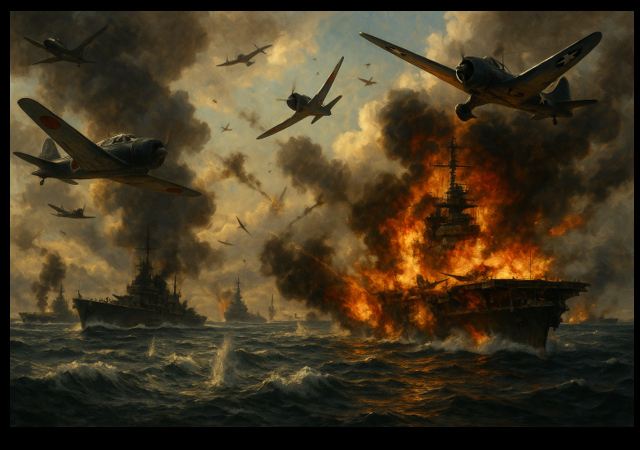
My colleague Mary Chastain wrote a magnificent post about D-Day, which is truly a must-read.
As I spent the day nursing a cold and rewatching the movie “Midway”, I thought I might take this opportunity to review the naval engagement that occurred 83 years ago to pair with the piece.
The Battle of Midway was fought from June 4 to June 7, 1942, and is widely regarded as a World War II turning point. However, I feel the battle doesn’t quite get the attention it deserves, so I thought I would hit the highlights and share a few videos that I found quite interesting.
The battle took place near Midway Atoll, a strategic U.S. outpost, and was initiated by the Japanese in hopes of eliminating the U.S. Pacific Fleet’s aircraft carriers and securing dominance in the Pacific.
On June 4, Japanese aircraft from four carriers bombed Midway Island, intending to draw out and destroy the U.S. fleet. However, U.S. cryptanalysts had broken Japanese codes, allowing Admiral Chester Nimitz to set an ambush with three American carriers (Enterprise, Hornet, and Yorktown) positioned northeast of Midway.
The importance of this code-breaking can not be stressed enough. U.S. Navy intelligence, particularly the cryptanalysts at Station HYPO, led by Commander Joseph Rochefort, played a pivotal role in uncovering Japanese plans for the offensive. The Japanese referred to their intended target only as “AF” in their encrypted communications. While some U.S. analysts speculated that “AF” could be locations like Samoa or Hawaii, Rochefort’s team suspected it was Midway Island.
To confirm their hypothesis, Rochefort and his team devised a ruse: The U.S. garrison on Midway was instructed to send an uncoded radio message stating that their water purification system had failed and they were running short of fresh water. Shortly after this message was sent, U.S. intercepts picked up a Japanese encrypted transmission reporting that “AF” was experiencing a water shortage. This conclusively identified “AF” as Midway.
By the time Midway was identified as the Japanese target, Nimitz had only 2 weeks to set up the ambush.
Interestingly, some Japanese naval officers had foreseen just such a strategy during a war game just a month before the battle.
Japanese officers assigned to play the American (Red) forces adopted a strategy that closely mirrored what the U.S. Navy would actually employ: They had American carriers arrive at Midway earlier than the Japanese expected and launch a surprise attack on the Japanese carrier force while it was engaged in bombing Midway. In this scenario, the American side managed to inflict heavy damage on the Japanese carriers, sinking two of them (the Akagi and Kaga).
However, the outcome of this war game was not accepted by the Japanese command staff. Rear Admiral Ugaki, acting as the chief umpire, considered the result “ludicrous” and overruled the umpires’ decision. He did not believe the Americans would be so aggressive or that their bombers would be so effective. Ugaki reduced the result from two carriers sunk to only three hits scored, leaving Akagi afloat and minimizing the impact of the American attack.
At first glance, Ugaki’s decision appears to be a perfect example of a senior officer insisting that a plan will work while ignoring all evidence to the contrary. After all, American aircraft did indeed catch the Kido Butai by surprise and destroyed Kaga, Akagi, and Soryu on the first day of the battle. Had Ugaki accepted the game results and taken its lessons to heart, he might have taken the American air threat more seriously and acted accordingly.
The combination of intelligence, American bravery, and the Divine contributed to the victory at Midway.
If you doubt the hand of divine providence in the affairs of men and particularly in protecting and guiding the United States of America, you need only reflect upon the Miracle of Midway: 6 minutes and one 1,000 lbs bomb turned the tide in the Pacific and changed the course of…
— Barry Jacobsen (@Barry4the44th) June 6, 2025
As Japanese planes attacked Midway, U.S. carrier-based aircraft launched counterstrikes. In a series of attacks, American dive-bombers fatally damaged three Japanese carriers (Akagi, Kaga, and Soryu) in quick succession during the morning of June 4. Later that day, the fourth Japanese carrier, Hiryu, managed to launch strikes that heavily damaged the USS Yorktown, but was sunk by U.S. aircraft by evening.
There was so much that could have gone wrong for the U.S. over 80 years ago, but the victory began to turn the tide in America’s favor.
Finally, as my mentor Gordon W. Prange told me, one must consider the intangibles. What might have happened had the Japanese destroyed the three U.S. carriers and won at Midway is very debatable and open to speculation, but Australia and perhaps Hawaii would have been the next Japanese targets. With virtually all of the Pacific Fleet’s aerial striking power out of the picture, there would have been little to stop Japan. It would have been open season on U.S. forces, and the Japanese would have been in total command of the Pacific, including possibly the waters around the U.S. West Coast. Fortunately, this did not happen.
Captain Edwin T. Layton, an excellent intelligence officer and authority on Pearl Harbor, pointed out to Prange that “at Midway the Japanese lost or left behind a naval air force that had been the terror of the Pacific—an elite force, an overwhelming force that would never again come back and spread destruction and fear as it had over the first six months of the war.” This is the meaning of Midway.
I highly recommend a viewing of the 2019 version of “Midway” (which I prefer over the more drama-laden 1976 version).
One last note: There are so many heroes involved in this American victory that we have an abundance of good name options for our Navy’s ships that are better than the woke picks we have endured recently.
Image by perplexity.ai.
Donations tax deductible
to the full extent allowed by law.






Comments
I liked both versions of Midway for different reasons, though 2019 is more accurate. 1976 does include actual gun footage (highly controversial at the time to include).
John Ford was filming on Midway whey the attack began; I don’t know if any of his footage was used in the film
The CGI in the 2019 Midway is so amazingly bad that it’s unwatchable.
Airplanes in formation, seen from the formation, do not wiggle. They drift in one direction or another but point the same direction all the time. The movie has them wiggling but not moving, just the opposite.
It shouts “I am not real and we won’t bother asking anybody who knows what it really looks like.”
An imperceptible pointing change results in visible drift because of the high speed, is the reason. All you ever see is drift.
Inaccuracies aside, the 2019 film is fine. 76 version ueed newsreel footage, but most of it is late war and uses the wrong aircraft. And the love story subplot was excruciating.
I’m not a CGI expert, but in the 2019 movie the point at which the Dauntless dive bombers nose over and begin their attack, flying through a veritable wall of flak, had me saying, “no, no, not this boy, Mama White’s boy has more sense than to fly through all that!!”
But those pilots did, and thank God.
The Japanese loss of all their highly trained pilots was the killer. It resulted in huge losses in subsequent encounters that never stopped. No fuel to train replacements at anywhere near their level.
If I could go back in time and participate in the battle, I would want to be one of the dive bomber pilots who caught the Japanese carriers with their pants down. I can only imagine the sweet, sweet taste of revenge taking out those who killed my shipmates at Pearl just a few months before.
Then again, as a Navy cryptologist, Joe Rochefort is my hero. I would want to have been the cryppie who got the traffic in which the Japanese confirmed AF as Midway.
The Douglas SBD Dauntless (Knick name “Slow But Deadly”) was indeed the most accurate Dive Bomber we had at the time – but you really really wouldn’t have wanted to be one of those pilots. Incredible bravery shown – the pilots knew going in the math of trading several bombers for a carrier was a “good” trade. As I recall at Midway out of 19 Dauntless dive bombers only 6 survived – out of 41 TBD Devastator torpedo bombers also only 6 survived.
The TBD Devastators – although not a single torpedo scored a hit on a Japanese ship – our torpedos were still crap at the time – arguably were responsible for the success of the SDB Dauntless’s. Both were slow enuf targets to make them easy targets for Zeros but the Devastators drew off the Japanese fighters to low altitude leaving the path relatively clear for the dive bombers whose weaponry actually worked.
The Devastators prevent the Japanese from forming up per their doctrine. The loss was not in vein.
Oh, I know about those losses and would definitely still want the chance to exact revenge on those ships and pilots, No doubt in my military mind.
as a retired navy cryptologist
in the 1976 we were shown the
movie in A school.. showing the
importance of our job
motto
in GOD we Trust.. all others we monitor, we would monitor GOD if we had HIS frequency .
also
if you communicate we will hear you, we will find you, we will destroy you.
Joseph John Rochefort was the major cryptanalyst for Midway and was unfairly treated, in part for being more successful than the D.C. group. Unconventional, he was never given the credit he deserved until too late. The Imperial Japanese Navy always wanted the big all at once battle. They always had plans too complicated and when holding all the cards, never pushed their advantage. The Americans were better at going all in. Midway and Guadalcanal were the turning points.
This is the best account. https://www.amazon.com/Shattered-Sword-Untold-Battle-Midway/dp/1574889230/ref=mp_s_a_1_1?adgrpid=176765511495&dib=eyJ2IjoiMSJ9.M3WN5QjiE8oQN7WgNa330K9_jHI9_9Dr4VGiYlrpScUnr2HSRY69wXBD2IpRCgd59ZabyyRDftKdHhsYMX7aUPuMzo2m3dYYXOkjnHzh0tXbYpVzFVmFg2UiRe46TsPa8KH-3yXHE_4zZ-16lsJvYRT9bSVjn3ZSF2Up_GLHTvzuAZ-OlSWycZ_wG_mIZESBSu4fhLfdT9bv25hEZ7gPdg.BVWvYNd-V3wcqX40rLz9C53NbMcC5co3wX-IipljTZw&dib_tag=se&hvadid=739084454153&hvdev=m&hvexpln=68&hvlocphy=9008193&hvnetw=g&hvocijid=12495499785524297134–&hvqmt=e&hvrand=12495499785524297134&hvtargid=kwd-298222650670&hydadcr=15179_13754915&keywords=shattered+sword&mcid=1d98eca6e51a3a9ab09ff9d7fc595150&qid=1749344427&sr=8-1
One of the authors of that book, John Parshall was a lecturer when I was at Naval War College. He’s written several other excellent books focusing on the Pacific Theater since that was published.
Can’t forget the great Sabaton song, “Midway”.
https://www.youtube.com/watch?v=oCOc7Z95eF0
The Brit group Iron Maiden did the Battle of Britain salute “Aces High”, but a bunch of Swedes did the salute to Midway instead of Americans.
I wonder what school kids are taught about it nowadays. Probably that the evil imperialist Yankees committed a war crime against the Japanese victims of colonialism, and we bear the guilt to this day.
There are a number of good breakdowns of Midway including a very good one from the Japanese perspective. They had an idea that their cover was blown and then what a disaster the battle was for their war effort.
A month before Midway, the battle of Coral Sea took place with neither navy having sight of the other but used aircraft to do the fighting. America won that battle as well and set is up nicely for the big one at Midway.
great article
now lets draw a parallel :
However, the outcome of this war game was not accepted by the Japanese command staff. Rear Admiral Ugaki, acting as the chief umpire, considered the result “ludicrous” and overruled the umpires’ decision. He did not believe the Americans would be so aggressive or that their bombers would be so effective. Ugaki reduced the result from two carriers sunk to only three hits scored, leaving Akagi afloat and minimizing the impact of the American attack.
the gop acting alongside their lefty partners dismissed any thoughts/common sense that stated:
bringing in millions of non educated people with a welfare system to keep them afloat was going to lead to americas submission to people named omar etc
and turn american cities into powerful anti american encampments where the left could further control the good people with the fears of crime and violence
Amen to your comment about an abundance of good ship names. I served in the early ’60’s on the USS Eugene A. Greene DDR-711. At the time I served it was a radar picket destroyer. We participated in the Cuban Missile Crisis. Ensign Greene was a young pilot who took off from his carrier during the Battle of Midway knowing he might not return. He dropped his ordnance on the Japanese carriers and ran out of fuel on his way back, never to be seen again. His young widow christened the Greene when it was launched later in the war. After it was decommissioned in, I think, the ’70’s, it was sold to the Spanish Navy. Perhaps we should have another Eugene A. Greene warship.