


LIVE: Israel Election Results — Exit Polls Point to No Clear Majority Bloc
Netanyahu-led bloc secures 50 seats, falls short of 21-seat mark.
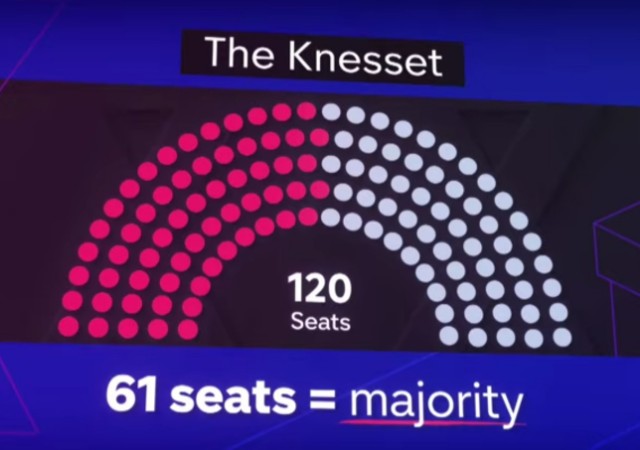
Update: Early official results show the bloc led by Prime Minister Netanyahu inching closer to a majority. With nearly 40 percent of the votes counted by Wednesday morning, his coalition partners are projected to win 57 seats, just four short of the 61-seat mark needed to form a government.
Prime Minister Netanyahu welcomed the initial results, highlighting his party’s strong electoral showing. “The Likud is the largest party in Israel,” he told his supporters on Tuesday night. He called on other right-wing parties to join his coalition. “We must establish a strong, right-wing, national government,” Netanyahu urged. “The Jewish and Zionist majority must unite.”
The Israel National News reported:
According to the partial official results updated at 5:49 a.m., with approximately 37.4% of the votes counted, the current coalition holds 57 seats, the change bloc 47, and the Arab parties 16.
Likud receives 28 seats, followed by Yashar with 21 and the Joint List with 12. Togther receives 11 seats, United Torah Judaism and Yisrael Beytenu eight each, while the Democrats, Otzma Yehudit, Shas, and the joint Religious Zionist-Zehut list each receive seven. Ra’am remains above the electoral threshold with 3.81% of the vote, giving it four seats.
🔴 Netanyahu says right-wing bloc has a 'decisive majority,' 'Zionist Jewish majority must join forces' pic.twitter.com/HfebKR2OzI
— i24NEWS English (@i24NEWS_EN) October 28, 2026
As polling stations close across Israel, early projections show all political blocs falling short of a parliamentary majority. Neither Prime Minister Benjamin Netanyahu’s Likud-led bloc nor Gadi Eisenkot’s centrist opposition alliance won the 61 seats needed to control the 120-seat Knesset.
Prime Minister Netanyahu’s Likud party is allied with six other right-wing, nationalist, and Zionist factions. He faces a challenge from a center-left opposition bloc headed by former military chief Eisenkot.
“Prime Minister Benjamin Netanyahu’s Likud party has won the highest share of votes in Tuesday’s election, but neither of Israel’s two political camps has a clear path to forming a government,” the Times of Israel reported.
In its updated exit poll, the Kan public broadcaster lowers Naftali Bennett’s B’Yachad from 14 to 13 seats, with the Joint List gaining from 10 to 11,” the news website added. “This means that Kan, Channel 12 and Channel 13 now all project the pro-Netanyahu bloc to win 50 seats, the anti-Netanyahu bloc to get 52, and the Arab parties to win a whopping 18.”
Israel’s Channel 14 is showing Prime Minister Netanyahu’s bloc closer to victory with 60 seats, one short of a majority:
Netanyahu-led right-wing bloc: 60
Eisenkot-led left-wing bloc: 43
Arab parties: 17 https://t.co/wdXC4dKfbe pic.twitter.com/jWGVFDBIfx— C14 News | EN (@c14english) October 27, 2026
A clearer picture is expected to emerge later tonight. “Exit polls are projections rather than official results, and the political picture may change as votes are counted and verified throughout the night,” the Jerusalem Post noted.
Israel’s initial exit polls, side by side. Six channels, six projections. All put Netanyahu-aligned parties below 61 seats. These are exit polls, not official results.https://t.co/8uK9vQPpA7 pic.twitter.com/Quy2KFc6iO
— Zvika Klein צביקה קליין (@ZvikaKlein) October 27, 2026
Prime Minister Netanyahu’s Likud remains the biggest party in the new parliament, projected to win between 25 and 27 seats.
A 'happy' attmosphere at the Likud HQ in Jerusalem after exit polls suggest Netanyahu's party is to remain the biggest in Israel, reports @BaligSladeen @Nicole_Zedeck pic.twitter.com/thqv7eZzit
— i24NEWS English (@i24NEWS_EN) October 27, 2026
Prime Minister Netanyahu, Israel’s longest-serving head of government, is seeking a record seventh term. He navigated Israel through a series of wars and counter-terrorism operations since the October 7 massacre, overseeing military campaigns against Hamas, Hezbollah, and Iran.
Donations tax deductible
to the full extent allowed by law.






Comments
Time for both sides to start throwing money at likely defectors. That’s what happens here when Republicans have too comfortable majority of anything
The Muslim red/green is trying to steal votes
What a surprise
if they just had an obamaaaaa…
Wasn’t there an election, a few years ago, that resulted in no one being able to form a majority coalition in the Knesset?
So they had to hold another election and try again.
They had elections on April 9, 2019, September 17, 2019, and March 2, 2020, and March 23, 2021, and November 3, 2022.
Who do they think they are? Italy?!?
Israeli politics is quite confusing 😂 Anyone know who the opposition is and their stance on dealing with Palestinians? Are they like Democrats, wouldn’t hesitate to give you up to terrorists as ,ont as they are in power? 🤔
Consusing is right.
We are pikers over here.
The election is the first step, then it moves into party consolidation.
It takes a while.
The winner of the first round gets to seek Presidential approval to take the first shot at consolidation, if that fails, the next guy gets a turn.
If consolidation is not possible, the incumbent stays on until the next election can be held.
Months later.
That is a very short summation.. and maybe not quite the best.
Confusing…
Meant to be
Most of the opposition parties are on the right or center, but they’re open to coalition with the left, and even with the Arabs. The only real left party left is the “Democrats”, which is about as bad as ours, and to their left are the Arabs, who are almost openly treasonous.
Things are quite uncertain, in Israel and elsewhere. As for the election there, it is interesting for those people that claim Israeli Apartheid that nearly 20 Knesset seats went to Palestinians. Did South Africa under Apartheid EVER have a black office holder, let alone in many areas. Ignorance abounds.
Anyone who says that is an out and out racist.
The people who say things like this would have been right there in October 7 getting their fair share of murdering and raping.
Muslims will procreate the Jews out of Israel
“Netanyahu-led bloc secures 50 seats, falls short of 21-seat mark.”
They secured 60 seats and the “mark” they needed to reach was 61.
It’s not clear yet how many they’ve secured. The exit polls are always wrong, and there are 5 or 6 of them to choose from. The actual counting continues for at least another day or two. The ballots from remote voting sites (military bases, embassies, hospitals, prisons, etc.) have not yet even been opened, and those usually change the results by one or two seats.
A point that is so obvious that no one mentions it, which means that outsiders who don’t know it never hear about it, is that the reason the system is so unstable, and it’s so difficult to form a government after an election is the elephant in the room: the Arab parties. To form a government, a coalition must have a majority of the Knesset, i.e. 61 votes. But there are two Arab parties with approximately 17 seats between them, and for most of Israel’s history all major parties refused to include them in a coalition, which means that one must assemble those 61 seats out of a pool of only 103. Which means one needs 60% of the available members.
After the 2021 election Netanyahu made noises about including an Arab party in his coalition, or making a deal with it to support his coalition without being included, but none of them were interested. However, after the president finally gave up on him and asked whether someone else could put a government together, Naftali Bennett did manage to form a coalition that included an Arab party, and he became PM for about a year.
Many people were outraged over this, especially because Bennett is a member of the right. Netanyahu pretended to be shocked, forgetting that he had sought to do the same thing, it’s just that the Arabs turned him down. But it was pretty much a disaster waiting to happen, because the Arab parties are inherently hostile to the state, and any concession to them endangers the state. Eventually they extract concessions that no one can live with. So the government collapsed and the 2022 elections gave Netanyahu and his allies a bare majority.
If this election leaves that group with less than 61, he has to try to peel away at least one of the opposition parties to work with him. But they all have a much tougher job, because if he’s starting with 58 or 59 or 60, they’re starting with 45 or so! Without bringing the Arabs on board it’s impossible for them to form a government. All they can do is deny him one.
That must be the genocide that we hear so much about. Genocided into an election bloc so large it prevents a government being formed.
It could be worse. Arab population is Israel is 21% although I wouldn’t be surprised if its skewed to the young side. That’s 25 delegates they could have if demographics held instead of the 17 you mention.
How accurate are projections with 38% of the vote counted?
Wait….there are Arab parties in the Knesset? They’re not doing that genocide thing very well.
“Exit polls are projections rather than official results, and the political picture may change as votes are counted and verified throughout the night.”
A preview of our election results.
Leave a Comment