


Bates College Racial-Balancing STEM Program Challenged By Equal Protection Project
“White students or students of European ancestry are not included in Bates’ list of students targeted for the STEM Scholars Program.”
Since its launch in February 2023, the Equal Protection Project (EqualProtect.org) has challenged over 850 discriminatory programs and scholarships at more than 290 colleges and universities. While most of our claims have been at the Department of Education Office for Civil Rights, increasingly we have filed at the Departments of Health and Human Services, Department of Justice, the Department of Housing and Urban Development (HUD).
The nature of the discrimination varies – sometimes open and defiant, sometimes with attempted linguistic workarounds and proxy terms. Our latest filing addressed a twist – a program designed for racial balancing in the sciences at Bates College, an elite liberal arts school in Maine.
On October 21, 2026, EPP filed a Civil Rights Complaint with the Office for Civil Rights of the U.S. Department of Education regarding the Bates Stem Scholars Program:
We bring this civil rights complaint and request for investigation regarding Bates College’s (“Bates”) STEM Scholars Program (“STEM Scholars” or “the program”) which appears to racially discriminate in violation of Title VI warranting OCR investigation.
The Bates STEM Scholars Program at issue in this complaint is part of a larger racial balancing effort at Bates under the banner of Diversity, Equity, and Inclusion (DEI).2 Yet as demonstrated below, such DEI efforts embodied in the STEM Scholars Program can cross the line into possible civil rights violations through race-focused promotion and signaling.
The STEM Scholars Program is focused on encouraging the retention and success in STEM fields among students from groups traditionally “underrepresented” in the sciences, including African American, Asian American, Hispanic/Latino, Native Alaskan, Native American, Native Pacific Islander, and first-generation to college students as well as students from under-resourced high schools in Maine.3 White students or students of European ancestry are not included in Bates’ list of students targeted for the STEM Scholars Program. As described by Bates itself, the STEM Scholars Program focuses in significant part on balancing the racial makeup of those in the Bates STEM disciplines.
The primary purpose of the STEM Scholars Program openly targets students based in part on race and ethnicity. Bates promotes the program as intended for certain races and ethnicities whereas other races and ethnicities need to show an additional factor, such as first generation status. Such a race-based two-tiered system reasonably would deter at least some students from non-preferenced races and ethnicities from applying. As discussed in the legal section below, the inclusion of some non-racial preferential groups (such as first generation) does not negate the legal implications of the program’s unlawful purpose to give preference to students of particular races or ethnicities for the purpose of achieving racial balance within Bates’ STEM courses.
After describing the considerable financial and educational benefits of the program, we addressed clear racial balancing goal of the program:
The STEM Scholars Program’s emphasis, description, and promotion to specific racial and ethnic groups reinforces a message that participation is intended for those identified groups. As discussed in the legal section below, the listing of targeted demographic groups functions as race-based signaling.6 Such messaging is likely to deter at least some students who do not fall within the identified racial categories from applying to the STEM Scholars Program.
Moreover, what is obvious from the information provided by Bates through its website and social media is that the purpose of the STEM Scholars Program is to provide a racial balancing of the students who participate in STEM coursework and degrees. For instance, when soliciting donations to the college, Bates openly states that the program’s purpose is to assist certain racial and ethnic groups:
“Ensuring Equity and Excellence in the Sciences THE MISSION — The STEM Scholars program is a four-year, cohort-based mentoring initiative designed to ensure that every student interested in Science, Technology, Engineering, and Math has the support to succeed and graduate. By focusing on students from groups traditionally underrepresented in the sciences — including first-generation students and those from rural Maine — Bates is redefining who can excel in STEM”.7 [Emphasis added.]
Bates further boasts that the program “has successfully transformed the Bates STEM landscape from one viewed as competitive and uninviting to a culture of inclusive excellence, and that race, ethnicity and socioeconomic status are no longer predictors of graduation in the STEM disciplines at Bates.” [Empasis added] [image omitted]
It appears that this desire to achieve racial balance within the STEM disciplines at Bates hasbeen successful. In a report by the college in 2022, titled “Inclusive Excellence in STEM at Bates, A progress report of STEM and STEM adjacent academic units,” Bates heralded the success of the racial rebalancing through the STEM Scholars Program:
“All of the students in STEM Scholars come from populations or identities that have been historically and/or contemporarily minoritized in STEM (i.e., students who identify as first-generation to college, Black, Hispanic/Latinx, Asian/Asian American/Pacific Islander/Native Hawaiian, Native American/Alaska Native, two or more races, Pell eligible or low financial capacity, students from rural Maine, or women in math, computing and physics)”8.
We emphasized that because Bates is a private college, information relevant to its acceptance practices with regard to the program were not publicly available – highlighting the need for an OCR investigation:
Demographic data specific to the STEM Scholars Program does not appear to be publicly available, but would be available in an OCR investigation, highlighting the need for OCR to open this case for investigation. Photos on the Bates website and related Instagram photos, however, further reinforce the success of this discriminatory purpose to racially balance the STEM disciplines at Bates, reinforcing the racial signaling. The photos feature almost exclusively non-white students.
In conclusion, we urged OCR to open a formal investigation, which is the first big step in OCR cases, particularly since after the Supreme Court released its affirmative action decision in 2023, the Bates administration issued a defiant rebuke to SCOTUS:
Bates’ STEM Scholars Program appears to violate Title VI by discriminating on the basis of race, color, or national origin.9 The program states that it is intended to serve “historically underserved students,” which include African American, Asian American, Hispanic/Latino, Native Alaskan, Native American, Native Pacific Islander, those who are first generation college or from an under resourced Maine high school. These eligibility requirements automatically confer preference for students from the identified races, while those students who do not belong to the identified racial or ethnic groups have to show they are first-generation to college or graduated from an under resourced high school. Such differential treatment based on race and ethnicity is impermissible discrimination….
Bates has publicly defined the goals of the STEM Scholars Program— to “Close the Gap” so that “race, ethnicity and socioeconomic status are no longer predictors of graduation in the STEM disciplines at Bates.12 Programs that seek to achieve racial balance are discriminatory. “[O]utright racial balancing is “patently unconstitutional.” Students for Fair Admissions, Inc. v. President & Fellows of Harvard College, 600 U.S. 181, 223 (2023)….
Importantly, Bates’ administration is aware of the limitations on use of race, as evidenced by its written statement on the U.S. Supreme Court’s decision in Students for Fair Admissions, supra. Then President and President-elect of Bates asserted in a defiant public statement that “[w]e are deeply disappointed by today’s decision by the Supreme Court, a ruling that turns back the clock on 45 years of established constitutional principle and significantly restricts the admissions practices used at many colleges and universities, including Bates.”13 The statement continued that “the Court fails to acknowledge the role of race in American history and contemporary social structures… We will not allow the Court’s decision to diminish our commitment to our current students or the students we will continue to seek out.” Id.
Bates’ defiant continuation of the racial rebalancing through its Bates Scholars Program even after the Supreme Court ruling demonstrates the need for OCR action and investigation. Based on the evidence on Bates’ own website, there certainly is a need for OCR to investigate whether the STEM Scholars Program violates Title VI.
We will continue to challenge the racial discrimination that permeates higher education and elsewhere.
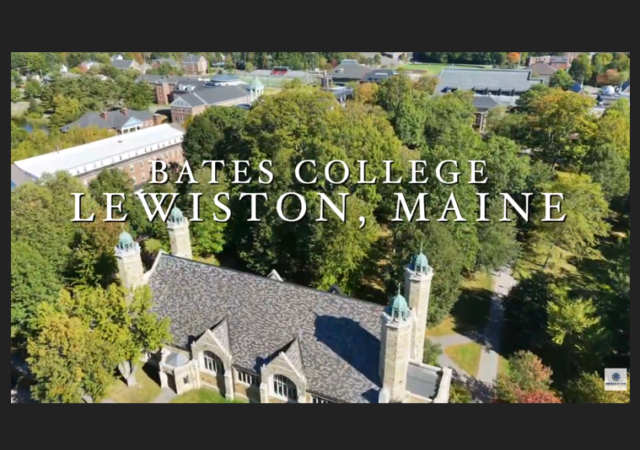
[Featured Image: Bates College at Lewiston, Maine Aerial: New England by Air]
Reminder: we are a small organization going up against powerful and wealthy government and private institutions devoted to DEI discrimination. Donations are greatly needed and appreciated.
=========================
Donations tax deductible
to the full extent allowed by law.





Comments
Such efforts don’t cross the line. They start already on the other side of it. Not only the means of achieving “racial balancing” are illegitimate, so is the very goal.
So is the notion of “underrepresentation”, which requires one first to determine what an “ideal representation” would look like, when in fact there is no basis for any such determination. Whatever numbers you say there “ought” to be are inherently made up, based entirely on your own irrational prejudices, because there’s no other way to do it. It’s like deciding how many STEM students “ought” to be called Melissa, or how many “ought” to wear green coats.
Hit them where it hurts. Go after the basketball team.
I’d rather spend a night at the Bates Motel than a semester at Bates College.
Thank you for all you do, Professor.
Tyler Austin Harper, a black professor, wrote about the dismal DEI and outright racism going on at Bates this summer after he took a job there and then left in disgust. It’s quite the read.
https://www.theatlantic.com/magazine/2026/09/elite-academia-leadership-hypocrisy/687969/
You beat me to it.