

Feds Target North Korean Laptop Farms Allegedly Funding Nuclear, Missile Programs
U.S. Treasury estimated that more than $800 million was sent to North Korea in fiscal year 2024.
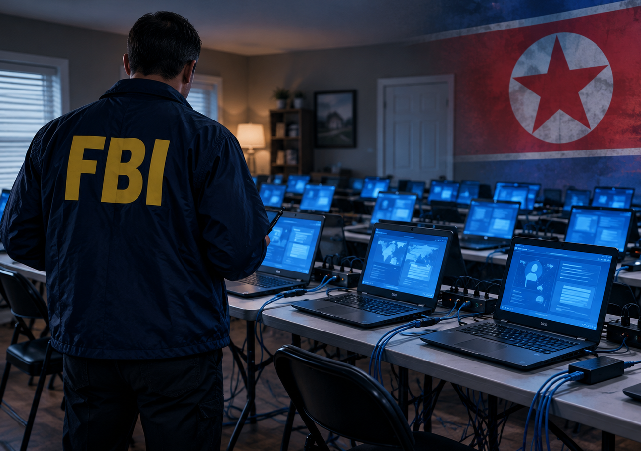
How wonderful to see the FBI focusing on alleged North Korean spies and fraudsters, which is truly a welcome change from the bureau’s controversial scrutiny of traditional Catholics and concerned parents at school-board meetings during the Biden era.
The new focus has proven results.
Federal agents raided 40 North Texas locations and seized more than 180 laptops allegedly used to let North Korean operatives pose as American remote workers, funneling earnings to a regime whose nuclear and missile programs hardly qualify as worthy charitable causes.
Federal authorities have raided farms in 40 locations across North Texas — but the farms targeted by Operation Lone Star Roundup weren’t harvesting food or raising livestock.
They are called laptop farms that authorities say are controlled remotely in North Korea and used to steal U.S. jobs and money.
Officials said indictments are coming after they seized more than 180 laptops they claim were part of a widespread operation supporting the North Korean government, something officials say threatens national security.
During a Tuesday morning press conference with the U.S. Attorney’s Office for the Northern District of Texas, U.S. Attorney Ryan Raybould said the Democratic People’s Republic of Korea (DPRK) uses information technology (IT) workers to earn wages from American companies, funneling that money to the North Korean government. Raybould said that money funds the DPRK’s nuclear and ballistic weapons programs.
North Korea is NOT going to use American companies as ATMs to bankroll its regime.
12 indictments. Nearly 190 devices seized. 40+ suspected laptop farms targeted across Texas.
The @FBI and @TheJusticeDept are dismantling these networks and holding those responsible accountable.… https://t.co/l8UayN4BhX
— FBI Director Kash Patel (@FBIDirectorKash) October 14, 2026
The laptop farms started when North Korean IT workers used falsified identification to get remote work contracts with U.S. companies.
Because these workers actually live in North Korea, they rely on U.S. facilitators to receive company-issued laptops and host them in their homes.
The U.S. facilitators install remote access software, allowing operatives in North Korea to log in and appear as though they are working from within the United States.
The workers then funnel an estimated 85% to 90% of their earnings directly to the North Korean government.
Raybould said the U.S. Treasury estimated that more than $800 million was sent to North Korea in fiscal year 2024.
Federal authorities seized more than 187 devices from 40 residences in Texas as part of a crackdown on so-called "laptop farms" allegedly used by North Korean operatives to pose as American IT workers and funnel wages to North Korea.
FBI Cyber Division Assistant Director Brett… pic.twitter.com/3f2kl0Y7g8
— CBS News (@CBSNews) October 14, 2026
The Department of Justice also indicated that announced that Michael James Bostelle of Pennsylvania and Juan Cecilio Pena Carrillo of Texas were arrested on charges of wire fraud, money laundering, and identity theft in connection with the alleged scheme. Additionally, prosecutors indicted several Chinese nationals for their participation in the scheme.
The fraud scheme affected more than 70 U.S. companies, compromised the identities of 25 Americans, and led to the submission of false information to multiple federal agencies.
Exposing this alleged North Korean operation is welcome news, but it raises an uncomfortable question: Might investigators have uncovered it sooner had Washington kept its attention on genuine national-security threats?
With federal prosecutors promising indictments for those involved in the laptop farms, I hope Washington rediscovers that protecting Americans from hostile foreign operations is a better use of federal resources than treating church socials and school-board disputes as national-security territory.
Donations tax deductible
to the full extent allowed by law.




Comments
It raises more than one uncomfortable question.
“used by North Korean operatives to pose as American IT workers”
So if 100 Norks are remote-working at US companies, are they using 100 fictitious but bulletproof American identities?
Or are the employers exploiting “loopholes” in employment law?
From Grok:
Commons and Muslims all in Texas
Wide open spaces
Geez
“The workers then funnel an estimated 85% to 90% of their earnings directly to the North Korean government.”
Here’s where a motivated prosecutor can go after the hiring corporations for employing slave labor.
There were a few articles on this about a month ago, Its not just the NORKs doing it.