


Margaret Hamilton, Pioneering Software Engineer Behind Apollo’s Success, Dies at 90
The best memorial is a renewed commitment to the competence, testing, and engineering discipline that made her work consequential.
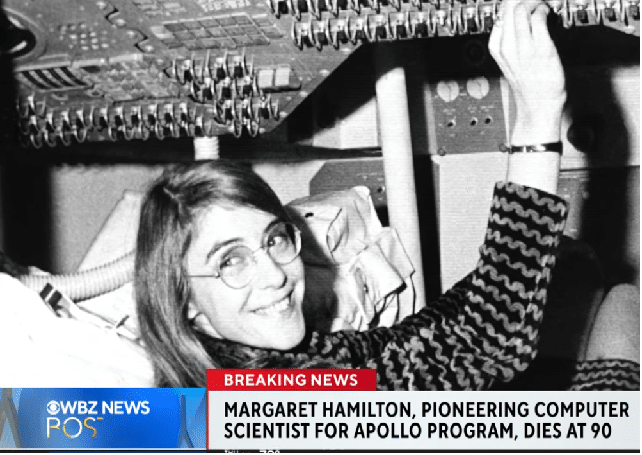
America has lost another pioneer whose ingenuity helped launch this nation’s successful lunar exploration missions.
Margaret Hamilton, who led the team that developed onboard flight software for NASA’s Apollo missions, died September 30 in Cambridge, Massachusetts. She was 90. Her daughter, Lauren, confirmed her death to The New York Times.
Neil Armstrong and Buzz Aldrin became household names when they walked on the Moon. Hamilton’s work helped ensure they could get there safely. Her legacy reminds us that spectacular achievements depend on people who anticipate problems long before the countdown begins.
Hamilton worked at MIT’s Instrumentation Laboratory, where she rose to lead the software engineering effort for Apollo. Her team developed programs for the computers aboard both the command module and lunar module, equipment that would navigate astronauts through the unforgiving environment of space.
Her approach wasn’t simply to write software that worked under ideal conditions. It was to build software that could keep working when something went wrong. That distinction became critical during Apollo 11’s descent in July 1969.
Hamilton’s most famous contribution to the Apollo program came during the pivotal Apollo 11 mission to land on the moon in July of 1969. Moments before the Eagle module was set to land on the lunar surface, the onboard computer raised the alarm. It had detected a 1202 error: The computer was overloaded due to a fault in a hardware switch, and it was possible the system would not be able to handle the complex landing procedure.
But Hamilton and her team had engineered priority-driven software, able to shut down unnecessary background tasks in order to prioritize mission-critical tasks. Houston trusted Hamilton’s software and allowed the mission to proceed, and two men walked on the moon for the first time.
The system did what it had been designed to do: Protect the mission’s most important functions. Mission Control recognized that the computer could continue supporting the descent and allowed the landing to proceed.
“To say Margaret Hamilton was a pioneer — to say she was ahead of her time — would be a dramatic understatement,” Olivier de Weck, the Apollo program professor at the Massachusetts Institute of Technology and interim head of its aeronautics and astronautics department, told MIT News, a publication of the university’s communications office.
“She was a software engineer at a time when that field was in its infancy,” de Weck continued, “and she not only developed advanced code herself but also led a team in using that nascent technology to develop one of the most complex systems humanity had ever achieved.”
This was an outstanding example of disciplined engineering by a team whose leader understood that anticipating failure was part of achieving success.
Many readers will recognize the 1969 photograph of Hamilton standing beside a towering stack of printed Apollo computer code. The image captures the enormous intellectual labor behind a mission remembered primarily through rockets, spacesuits, and footprints.
A 1969 photograph of the 5-foot-4 Ms. Hamilton standing beside a head-high stack of printed code developed for the moon landing has been widely shared on social media in recent years.
Primary navigation for the Apollo flights was guided from Houston on mainframe IBM computers. But the onboard Apollo Guidance Computer that the M.I.T. lab created was a crucial cog.
Developing its software was a major lift in an era when computers had limited memory. The onboard computers contained only 72 kilobytes of storage memory (an iPhone 16, by comparison, can have more than seven million times as much storage).
As Apollo 11’s lunar module, Eagle, touched down on the moon on July 20, 1969, Ms. Hamilton, then 32, was patched into Mission Control in Houston from M.I.T.
Margaret Hamilton, the pioneering software engineer whose work helped make the Apollo 11 moon landing possible, died Sept. 30 at age 90, MIT confirmed Thursday.
Hamilton led the team that developed flight software for NASA's Apollo missions and is famously pictured standing… pic.twitter.com/9URMtps80k
— CBS News (@CBSNews) October 9, 2026
In 2016, President Barack Obama awarded her the Presidential Medal of Freedom for contributions that helped establish modern, highly reliable software engineering.
Her achievement deserves recognition on its own terms: Technical excellence, leadership, and responsibility for systems upon which human lives depended.
Hamilton’s passing follows another loss previously covered at Legal Insurrection: Apollo 13 commander Jim Lovell, who died in 2025 at 97. They served in different roles within the same extraordinary enterprise—one leading astronauts in flight, the other leading the development of the software they relied on.
Together, their stories underscore why Apollo remains more than an exercise in nostalgia. Its enduring lesson is that space exploration requires preparation, technical judgment, and the ability to respond when reality refuses to cooperate.
That lesson remains relevant to Artemis. As covered here in April, Artemis II completed its crewed lunar flyby and returned safely with a splashdown off San Diego’s coast. Sending astronauts outward is only part of the assignment; bringing them home safely is also a requirement.
Earlier coverage of the current NASA Administrator Jared Isaacman’s “NASA Force” initiative examined efforts to recruit engineers and technologists for mission-critical work and rebuild the agency’s core capabilities. Hamilton’s career illustrates the value of precisely that kind of expertise.
The best memorial to Margaret Hamilton is not merely another celebration of the famous photograph. It is a renewed commitment to the competence, testing, and engineering discipline that made her work consequential.
America’s next generation of lunar explorers will benefit from following her exceptional example.
Donations tax deductible
to the full extent allowed by law.






Comments
Thanks for this post Leslie. My dad was an aerospace engineer who worked on Titan, Skylab, and the Viking lander. He would have loved this.
“Houston, Tranquility Base here. The Eagle has landed.”
Thank you, Margaret.
She learned and earned her achievements. No DIE here. Wonderful!
And given the totally male dominated society at the time we ABSOLUTELY know she earned her position by hard word, commitment, dedication and perseverance!
She did great in The Wizard of Oz as well.
Being serious: a remarkable scientist and a brilliant mind.
She earned her place in space history. She lived and worked in world that used 1’s and 0’s to write code. Think about that! No hexa decimal, no machine code, nothing but Fortran for main frames and ones and zeros for limited memory on board computers. Salute to Margaret Hamilton. A truly important cog in the machinery that was the Apollo program.
“One of these days, Margaret, straight to the moon!”
“Her approach wasn’t simply to write software that worked under ideal conditions. It was to build software that could keep working when something went wrong.”
This seems so obvious but (at least in the 1990’s) it was rare in practice. My company built a 1.8 million sq ft distribution center with 18 miles of automated conveyor, and a (supposedly) sophisticated inventory management system. The documentation seemed impressive until we tried to start using it. Of course we had a least 100 different people entering data into the system, and all of them new at the task. Here’s the problem we found: The documentation told the user the next step assuming each prior step was correct. However: if an entry error was made, it was gone…somewhere. Even if you knew you’d made an error there was no way to reverse it, and no way to see what impact your error had made. An inventory count error was bad enough (1,000 units vs. 1999 units) but an action command? What fresh hell had you unleashed? You might not know for days. After six weeks, we had to shut down and wipe all the data, and then do a manual inventory count and reorganization. It cost us millions.
So Margaret ….May God always bless your soul. You were right.
Women were the computer nerds then, those that developed outstanding competence. They started by being the ones assigned to do computations for engineers and that survived into computers. Some of them got very good at writing compact and efficient code for the then-small computers.
It turned into a focused hobby that they (and corresponding men) were devoted to.
Mildred Knabbe was the corresponding woman at Bell Labs. Not in charge but the one who worked out the local problem and was left to do it.
“Presidential Medal of Freedom for contributions that helped establish modern, highly reliable software engineering.”
It took Management, Marketing, and HR, and to destroy it.
what a life she lived–from an era when the pursuit of excellence was a worthy endeavour in itself–not granted, passed along, dishonestly bestowed but earned–from a time when american capability and ingenuity were the standards for the world–the best of the best–what an example she must have set for everyone around her–focused, diligent, persistent, committed– have only encountered a few of those in this life myself–an inspiration and a privelege to work with them
thank you, m’am and rest in peace