


Report: Trump Admin Proposing $5 Billion to Rebuild Gulf Energy Sites
“Some Middle East officials said the initiative appeared to be Washington’s attempt to cast the Strait of Hormuz as a less consequential energy route and show the U.S. and its allies as united in confronting Iran.”
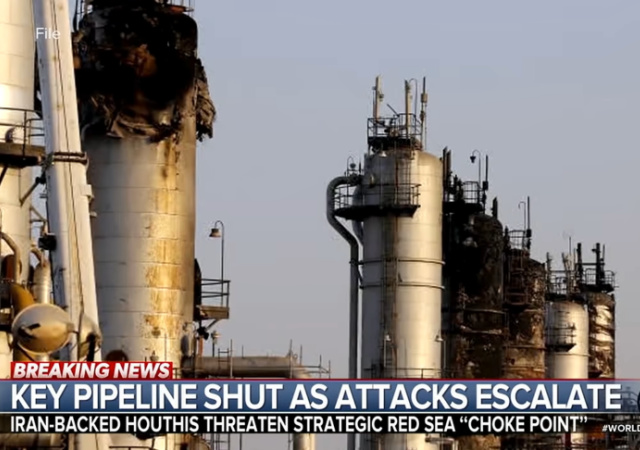
The Wall Street Journal reported that President Donald Trump’s administration wants to invest $5 billion in a new fund to help rebuild energy sites in the Middle East that were destroyed or damaged in the Iran War.
From the report:
Under Trump’s plan, the U.S. would seek a matching contribution from eight Middle Eastern partners—Saudi Arabia, the United Arab Emirates, Qatar, Bahrain, Kuwait, Oman, Iraq and Jordan—with the goal of generating a $10 billion investment fund. The investment would be called the Partnership for Allied Trust and Construction, or Pact.
Discussions on the fund are under way, and the terms of the arrangement could change, U.S. officials said. It is unclear when, or even if, other countries will sign on.
Some Middle East officials said the initiative appeared to be Washington’s attempt to cast the Strait of Hormuz as a less consequential energy route and show the U.S. and its allies as united in confronting Iran. They added that creating a fund to rebuild destroyed energy sites without a peace deal with Tehran would be premature, as the regime could target fresh infrastructure with drones and missiles.
—-
Under the U.S. proposal, the fund would be managed by the Development Finance Corporation, a federal agency that works with the private sector to support U.S. national-security policy. Its programs historically have targeted projects in developing countries, not wealthy Gulf monarchies.
Energy Now listed the oil refineries, gas facilities, oil fields, nuclear plants, and ports attacked during the war, which started in February.
Here are the oil refineries:
- Ruwais, UAE: One of the biggest refineries in the world was shut as a precautionary measure after a drone strike caused a fire in the industrial area where it’s located.
- Ras Tanura, Saudi Arabia: Saudi Aramco temporarily halted operations at the kingdom’s largest crude processing plant — with 550,000 barrels a day of capacity — after a drone attack in the first few days of the war. The facility has since been restarted.
- Samref, Saudi Arabia: A drone fell on refinery that’s half owned by Exxon Mobil Corp.
- Bapco Energies, Bahrain: The 400,000 barrel-a-day plant was damaged in an attack and declared force majeure on operations that had been impacted.
- Mina Al-Ahmadi, Kuwait: The refinery suffered another attack Friday that shut down some units, a day after the facility was targeted in a wave of strikes.
- Mina Abdullah, Kuwait: A fire at the plant was extinguished following a March 19 attack. One of the country’s two refineries was already shut in, after Kuwait’s oil output was cut by at least half.
- Lanaz, Iraq: Operations were suspended at the plant in the northern city of Erbil after a fire caused by a drone strike, Reuters reported, citing unidentified provincial officials.
In April, Rystad Energy estimated that the war damaged at least $58 billion of energy infrastructure in two months.
I have not found a recent damage estimate.
Donations tax deductible
to the full extent allowed by law.






Comments
More money we don’t have.
That ship sailed along time ago.
“What difference at this point does it make”
Shrillery Clinton.
“How did you go bankrupt?” Bill asked.
“Two ways,” Mike said. “Gradually and then suddenly.”
We’re well down the path…
In fairness $5 billion is not much in the context of our current $7 trillion a year Federal budget or even within the $2 trillion a year we’re spending above revenue. If it assists in getting alternate routes for world oil supply established to lessen the importance of the Strait of Hormuz to mitigate Iranian ability to threaten oil flow then sure. Though I’d like to see the Nations which purchase the ME oil/gas paying the freight.
This is insane
They are literally driving around in cars of the very very rich. Skyscrapers Beyond the clouds
Palaces of endless beauty
And WE should pay 5 billion to repair and rebuild their refineries?
This comes out right before the election?
We are so screwed
Why don’t we instead invest more in our own energy infrastructure here at home instead? Expand production here, and that includes expanding refining capacity, so that we are less reliant on foreign sources for fuel and energy.
The acronym is actually PATC, not PACT. That’s patsy, i.e. the USA, if it subsidies these oil rich kingdoms for not defending themselves against their true enemy, Iran.
A billion here, a billion there, pretty soon we’re talking a $40 trillion dollar debt.
NO, Sending money to wealthy countries is insane. They probably have enough money to rebuild themselves 10 times over. If they want money for rebuilding then can get it in the form of reparations from Iran,
That ‘no sending US $ to wealthy countries’ prohibition would also apply to Israel which has a higher per capita GDP than all of the 8 Nations listed in the article except Qatar.
Well Israeli population is only 10M so getting a higher GDP might be easy. Basically I have no problem with stopping aid to Israel (as long as all aid to all arab countries is stopped too) and neither does Bibi it seems.
If you can’t help yourself to spend 5B, how about using it to add more state of the art refineries in the US?
Nah, if you’re going to spend that money spend it on upgrading our refineries here. Let them bomb the s*** out of Iran and get the money from them.