


Carnegie Mellon Tightens Fence Rules After Repeated Antisemitic Messages
”We want the Fence to remain a safe and welcoming part of our campus community”
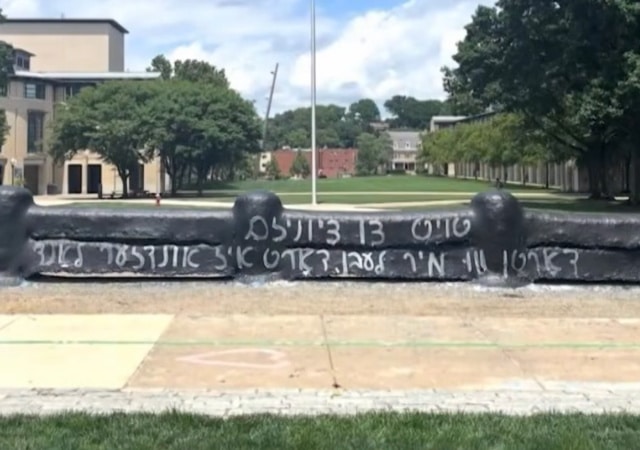
The ‘Free Palestine!’ mob thinks nothing of scrawling their hatred for all to see.
Campus Reform reports:
Carnegie Mellon cracks down on Fence vandalism following anti-Israel messages
Carnegie Mellon University (CMU) in Pittsburgh, Pennsylvania, has increased enforcement of rules regarding its iconic campus Fence after multiple incidents of messages the university deemed threatening were painted, including repeated displays of the phrase “Death to Zionism.”
Painting the Fence is one of CMU’s oldest traditions, in which students can hand-paint messages overnight. University rules limit painting exclusively to CMU students between the hours of midnight and sunrise. The rules require at least two students to continuously guard the Fence while painting.
University officials said that the recent incidents also involved non-students painting the Fence, prompting campus police to begin checking the identification of students painting the landmark during overnight hours to ensure university rules are adhered to.
In a statement, the university said it had received “multiple reports of vandalism and reports of non-CMU students and individuals unaffiliated with the university participating in painting the Fence.”
The increased enforcement follows several incidents involving anti-Israel messages.
CMU President Farnam Jahanian reported that the phrase “death to Zionism” was painted on the Fence multiple times, including once in Yiddish. Jahanian said the university determined that the message “incites or implies violence or reasonably can be viewed as threatening to members of our community.”
An earlier Fence message included the phrase “Free Palestine” followed by small text that reads “by any means necessary.” Jahanian said anonymous messages that incite or imply violence are “categorically unacceptable.”
”We want the Fence to remain a safe and welcoming part of our campus community,” Vice President of Operations Daryl Weinert said.
Donations tax deductible
to the full extent allowed by law.






Comments
“University officials said that the recent incidents also involved non-students painting the Fence”
Leftists are why we can’t have nice things.
I don’t remember enough Hebrew to read what’s written, but it’s mostly Hebrew, and I don’t see a word for Palestine on the fence. Anyone else able to read it?
It’s not Hebrew, it’s Yiddish. It says, “Death to zionism; wherever we live, there is our home.”
This is actually not a violent message. It calls for the death of an ideology, not of people. And it’s not antisemitic.
This is an old Yiddishist sentiment. The classical Yiddishist movement (which has pretty much died out and is maintained today only by young socialists, many or most of whom are not even Jewish) was anti-zionist, not because it was against Jews or even Jewish nationalism, but because it rejected the idea that Israel is the Jews’ homeland, and that we should return there, or even aspire ever to do so.
It rejected religion, and maintained that nowadays being Jewish means maintaining European Jewish culture, such as speaking Yiddish, eating traditional Jewish foods (in addition to all sorts of treife foods), telling stories of a certain style, etc., and promoting socialism wherever we are. As the slogan says, Israel is not our home, our home is wherever we happen to live. Russia, Poland, Hungary.
In this aspect it was similar to the Reform Jewish movement, which also rejected any aspiration to return to Israel or to rebuild the Temple, let alone to restore the sacrifices there, and cut all references to that return from the prayerbook, which made it a lot shorter. Classical Reform’s motto was that “Berlin is our Jerusalem, and the synagogue is our Temple”. That’s why Reform synagogues are called “temples”.
So in context this is neither a violent nor an antisemitic message. But it rejects everything that Judaism stands for.