


Bessent Enlists Banks in Trump Immigration Crackdown
“We do not ask bankers to assume the burdens of border enforcement. But we depend on banks to do what you do best: know your customers.”
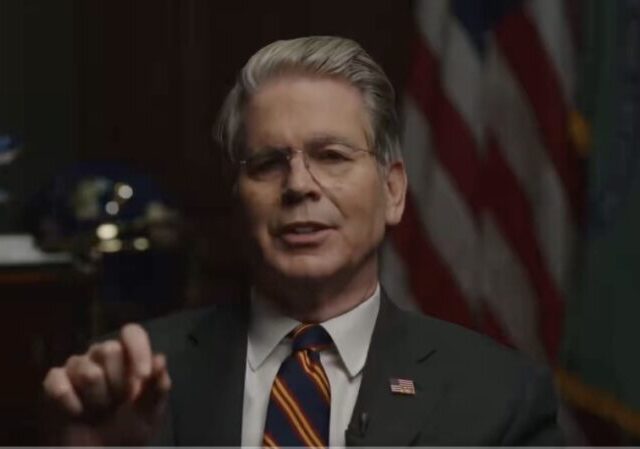
The same community banks that Washington spent fifteen years strangling with regulation are now being asked to help expose the financial networks propping up illegal immigration, and the Trump administration is making the case that the two goals are inseparable.
Treasury Secretary Scott Bessent brought that argument to Phoenix Thursday, appearing alongside Comptroller of the Currency Jonathan Gould at an Arizona Bankers Association roundtable, pairing a pitch for deregulation with a blunt warning about the criminal financial networks tied to the border.
Bessent was direct about who created the problem Arizona now faces.
“President Trump has taken historic action to seal our southern border. Still, Arizona remains uniquely exposed to the aftershocks of Biden’s border crisis, including cartels and criminal organizations that seek to conceal illicit proceeds within legitimate channels.”
The administration’s effort stems from President Donald Trump’s May executive order directing federal banking regulators to address financial risks associated with immigrants who lack authorization to work in the United States. Treasury’s Financial Crimes Enforcement Network (FinCEN) and other banking regulators followed with advisories and guidance in June.
FinCEN’s advisory was aimed at helping financial institutions spot schemes involving unlawful employment, labor brokers, shell companies, payroll tax evasion, identity theft and financial exploitation. The Office of the Comptroller of the Currency (OCC) has also instructed banks to account for the credit risks involved when lending to borrowers who are not legally authorized to work in the country.
Bessent made clear that the administration is not asking bank employees to become immigration agents.
“We do not ask bankers to assume the burdens of border enforcement. But we depend on banks to do what you do best: know your customers, identify risks as they arise, and report suspicious patterns before they metastasize into criminal schemes. “
That could make community banks particularly useful. According to Bessent, community banks hold only 15 percent of banking industry assets and deposits but account for 40 percent of small-business loans. Their local presence, he argued, gives them a better chance of recognizing transactions that do not fit the normal course of business in their communities.
Gould similarly described banks as part of the effort to protect the financial system from the consequences of illegal immigration and criminal activity.
As Secretary Bessent has said, economic security is national security. Banks have an important role to play. They need to know their customers, understand the risks they face, and make sound decisions based on the facts of each relationship.
Not everyone in the banking industry is fully on board. The Independent Community Bankers of America (ICBA) and 34 state banking associations urged FinCEN last month to ensure the order doesn’t pile new compliance costs onto smaller institutions. ICBA has argued that community banks already run extensive Bank Secrecy Act programs, and notably, it pushed back hard enough that the final order stopped short of requiring banks to collect citizenship information from customers. That was a significant win for smaller institutions.
Bessent paired the administration’s request for greater vigilance with a promise to continue rolling back regulations on community banks. He said half of America’s community and small banks have disappeared since the financial crisis while the regulatory system still failed to prevent three of the largest bank failures in U.S. history in 2023.
Dodd-Frank was supposed to end “too big to fail.” Instead, it created “too small to succeed.”
The OCC said its current approach is to focus supervision on material financial risks rather than requirements that do little to improve bank safety and soundness. Gould argued that a broader Main Street recovery depends on strengthening the country’s smaller banks.
The broader argument Bessent is making is that deregulation and border security aren’t separate agendas; they’re two sides of the same coin. Washington spent fifteen years weakening the community banks that know their customers best, while the open-border policies of the Biden era allowed criminal networks to embed themselves in legitimate financial channels. Fixing one without the other doesn’t work. The Trump administration is now trying to do both at once.
Donations tax deductible
to the full extent allowed by law.





Comments
Take a page from the Democrats and Trudeau in Canada and debank the sanctuary cities and states, Also debank the anti-ICE groups NGOs and any individuals convicted of anti-ICE activities, The banks would have to do this but the federal government could request it. It’s constitutional isn’t it? If not then why not.
Let’s start with the obvious question: What NGOs have been “convicted of anti-ICE activities”?
That’s not what he said.
I say forbid any FDIC covered bank from opening any account of any kind for any person not legally residing in the USA. No savings, checking, credit cards, mortgages or car loans. None. Make it as difficult to live in the USA illegally as possible.
I like that approach. Of course I’d need someone more educated than I am to tell me whether that would require an act of congress or could be done through regulatory authority of the FDIC.
Milhouse? Anybody?
Bank of America’s been catering to illegals for years now.
This.
When we first moved to Arizona, we opened accounts at the local BoA, as our old bank didn’t exist outside New England, The manager pointed out that I had neglected to fill in the SSN field on the application. I informed him that there was no legal requirement to provide one. He said this was the first time anyone had made this claim to him so he would check it out. He checked it out, the next day said I was right, he didn’t need it, and opened our account.
A few years later, due to new law (probably the Patriot Act), he called asking for our SSNs. Since we already were aware of that change, we provided them.
Then a few years after that, BoA is suddenly running ads: “If you don’t have an SSN, you don’t need one to open an account with us!” At the same time, they were denying services to gunsmiths, trainers, and dealers. It was clear what side of the street they had chosen. DW and I decided FTS, and we pulled our accounts from the bastards. We never regretted our decision. Five years later, the BoA presence in our working cowboy town had devolved to an unattended ATM in the shopping center across the street, where the “anchor store” is a CVS. (Or a Goodwill, hegemonic claims vary.)
Fun fact — did you know that the original name of Bank of America was… Bank of Italy? It’s true.
That’s ridiculous. Foreigners often have US bank accounts, just as USAns often have foreign bank accounts. It’s how international commerce works.
Read the fine print: “not legally residing in the US”
Yes, foreigners don’t legally (or illegally) reside in the USA.
I have no problem with foreigners who are in this country legally that have bank accounts. What I have a problem with is the banks that turn a blind-eye to the issue and establish checking/savings accounts and other banking services for those illegally in the country. That’s a problem that needs to be addressed. That’s the problem that needs to be solved.
EoT
No, I’m not talking about lawful US residents who are not citizens. I’m talking about actual foreigners, living in foreign countries, who find it convenient to establish accounts with US banks, just as many USAns, living here, find it convenient to establish accounts with foreign banks. This is a major avenue of international commerce, and your proposal would choke it off.
No absolute need for a foreign National residing in a foreign Nation to have a domestic US bank account. The system of correspondent banking worked well for a very long time. Would it be more convenient, efficient and less of a pain to hold a domestic US account instead? Sure, but the absence of that account doesn’t foreclose ‘International commerce’.
I think you must have meant “illegally residing” instead of “not legally residing.”
We can use that definition.
The banking lobby owns too many Congressmen. Good luck passing that one…
It’ll be interesting to see if the banks are as enthusiastic about combatting illegal immigration as they were in attacking manufacturers and merchants of constitutionally authorized firearms.
I doubt it. There are many more illegal aliens who need banking services than there are firearms manufacturers & retailers who need banking services. Sacrificing a few businesses to keep progressive administrations off of their back was probably a sound business decision.
Not sure how collecting Citizenship info to open and/or maintain an account would be a ‘burden’. Customers already gotta provide ID (often two) as part of ‘know your customer rules’ and if we made a Federal requirement that each DL/State ID must display citizenship status to qualify for Real ID acceptance for ‘Federal purposes’ (TSA, banks, entry to military bases) that seems really simple. The Bank just sends a notice to the customer to come in and verify and the bank notes customer X is/is not a US Citizen. Heck make it voluntary for customer …but remove FDIC protection on any unverified account and institute holds on transfers/withdrawal over $1K or any series of those under the threshold (structuring).
Funny, the USA has forced every bank everywhere in the world to ascertain whether any new customer is a US citizen, and if so to report their account details to the USA. But apparently not in the USA itself.
I don’t think banks in places like Vanuatu feel compelled to obey US regulations.
They do. They have to, or they’re effectively banned from participating in the US financial system.
“Know Your Customer” has turned banks into government snoops on all of us. The USSR would have been proud.
And the Stasi envious.
Weird. I have it in good authority from the US treasury dept. that under section 326 of the Patriot Act (2001, etc), I am required to provide state ID, social security number, proof of residency, submit to a credit check – and other intrusions, if requested – in order to open a simple personal bank account.
I also have on good authority that no illegal alien can honestly provide this documentation in order to open a bank account.
So, how on earth does any illegal alien have a bank account??
This is not true. To open a bank account you do not even have to be a US resident at all.
The information required is a form of identification, which can be a foreign government issued document, showing name, photo, nationality, date of birth.
Those who don’t have a SSN may provide Taxpayer Identification Number, or show that they’ve applied for one and haven’t received it yet. TINs don’t require that one is living here legally, or that one is living here at all. Anyone in the world can apply for one, just in case they ever owe the IRS any money and need the number in order to pay it.
There’s certainly no need for a credit check.
Remember “Operation Chokepoint” when the Obama Administration used private banks against the targets of their ire? Remember how conservatives (real and purported) decried this?
Turns out that so many didn’t have a problem with what the Obama Administration doing this, but with the fact that it way they who were doing it and not them!
This sounds like Operation Chokepoint combined with Big Brother where private businesses are extensions of the Federal Government who do the will of the state by spying on you.
This is Corporatism.
“Turns out that so many didn’t have a problem with what the Obama Administration doing this, but with the fact that it way they who were doing it and not them!’
Nope.
Turns out we had a problem with what the Obama Administration was doing, but since nobody ever got punished for it and since we know that the second they get back into power they’ll do it to us again, it’s our turn now.
The rules have changed, Hat. It ain’t Bill Cosby Flip of The Coin world anymore.
Bull.
If you really had a problem with what Obama did you’d focus your energy on precluding this ever happening.
But instead you saw what they were doing and were envious. You looked at that and thought “I’d love me some of that!”
Yet when the political pendulum swings back, I have little doubt that you’d start whining about how wrong that is even though you fully endorsed that very thing.
No, I wasn’t envious. I was resigned. Just as I was resigned when President Muppet whined that he just couldn’t keep illegal invaders out because there weren’t enough laws and he needed new ones. It was flagrant BS and we all knew it, but nobody could or would do anything about it, and nobody ever got punished for it.
Hey, I know enough game theory to understand that when one side cheats and gets away with it, the guy who continues to play by the rules is a guaranteed loser.
How about you, Hat? You a “high-roader?” How’s that working out for you? Probably pretty well, since you’re the furthest thing from MAGA on this board.
Corporatism would be enabling directly/indirectly the ability of illegal aliens to exist in the USA without severe impediments, constantly looking over their shoulder for la migra, worried that every interaction with any govt agency at any level would result in their being discovered, detained and deported to the point they have no choice but ‘lay low’, work under the table, stay off the grid, take cash only for under the table work from shady employers who might stiff them, living in flop houses on a cash only basis b/c of inability to provide documents to facilitate a lease/purchase, never having IN of any kind, afraid to pick up their kids from school Mich less attend a sporting event, performance or graduation for fear of ICE showing up and scooping them up.
Everything that works to make life difficult for illegal aliens is the opposite of corporatism. Frankly I’d also add the need to severely narrow the options for all visa holders as well.
Ah yes, the advocates of corporatism remain in the shadows but continue to lash out at any attempt to deny them access to cheap foreign imported labor they can exploit at will and use to artificially suppress wage rates which in absence of foreign imported labor would have risen for ordinary Citizens.