


Thirty-Nine Years After Reagan at Berlin, the Fight Against Communism Still Demands Moral Clarity
Communism did not die with the Soviet flag. It mutated, borrowed new slogans, adopted new disguises, and found new apologists.
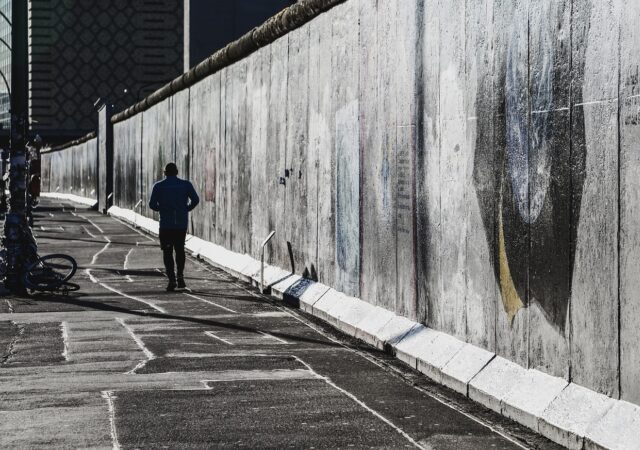
On June 12, 1987, standing before the Brandenburg Gate, President Ronald Reagan did not speak in the flat, bloodless language of diplomatic caution. He issued a moral summons to a tyrannical system and to the men who sustained it: “Mr. Gorbachev, tear down this wall.” With the Berlin Wall looming behind him, Reagan was speaking about more than concrete, checkpoints, and barbed wire. He was speaking about the nature of communism itself—an ideology so hollow, so frightened of liberty, that it had to imprison its own people to keep them from fleeing.
For many of us who had lived beneath the Iron Curtain, those words were not merely memorable. They were clarifying. They gave public voice to what millions already knew in private: communism was not misunderstood, unfinished, or unfairly judged. It was a machinery of fear, lies, and repression, and for the first time its end in Eastern Europe seemed not only imaginable, but near.
That is why June 12 should not be observed as a museum-piece anniversary, admired from a safe distance and stripped of obligation. It should be remembered as a call to seriousness. On June 11, Secretary of State Marco Rubio announced sanctions on Cuba’s state-owned energy company, CUPET, under President Donald Trump’s Executive Order 14404, arguing that the regime has “weaponized energy” as an instrument of social control and kleptocratic profit. The phrase is blunt because the reality is brutal. According to Rubio, the regime has for decades stolen and hoarded available fuel for the Castros’ private jet, for the security forces used to repress the Cuban people, to keep empty tourist hotels illuminated, and to bus crowds into staged protests and political theater, all while ordinary Cubans endure blackouts and wait weeks for a tank of gas. This is not corruption on the margins. It is the essence of the regime laid bare.
The Daily Signal further noted that CUPET serves as a major source of wealth for GAESA, the military conglomerate that sits at the heart of the regime’s coercive and financial machinery; Rep. Carlos Gimenez has said GAESA holds more than $10 billion in reserves. And this pressure campaign is not limited to sanctions on paper. In May, the Department of Justice unsealed charges against Raúl Castro and other regime figures for the 1996 shoot-down of two unarmed Brothers to the Rescue aircraft over international waters, killing four men. Add it together and the message is unmistakable: the United States is finally treating the Cuban dictatorship not as a diplomatic abstraction but as a criminal regime sustained by theft, terror, and lies.

The author visiting the Berlin Wall in 2019
Communism did not die with the Soviet flag. It mutated, borrowed new slogans, adopted new disguises, and found new apologists. Yet its methods remain as recognizable as ever: centralize power, criminalize dissent, politicize every institution, and divide society into oppressors and victims so coercion can parade as justice. Its record is no less familiar: prisons, shortages, censorship, surveillance, corruption, and the slow humiliation of human dignity.
Nor did it vanish into history. Communist dictatorships and socialist-authoritarian regimes still persist in countries such as Cuba, North Korea, China, Venezuela, and Nicaragua, where one-party rule, political imprisonment, censorship, forced deprivation, and state terror continue to crush human freedom and degrade human life. And yet in much of the West, especially among the young and the miseducated, this creed is still marketed as moral seriousness rather than what history has shown it to be: a graveyard ideology with an endless talent for changing costumes. The scandal is not that communism has been studied too closely. It is that too many have been taught to condone its atrocities, as though its victims were a rhetorical inconvenience.
There is reason for hope, but only if the West recovers the moral confidence Reagan displayed in Berlin. Freedom does not prevail because history drifts kindly in its direction. It prevails because men and women are willing to name evil without embarrassment and confront it without euphemism. Reagan understood that the ash heap of history is not a destination reached by sentiment or inevitability. It is where tyrannies are driven when free people stop flattering them, stop excusing them, and stop fearing the clarity required to oppose them.
To this administration’s credit, President Donald J. Trump and Secretary Marco Rubio have shown more willingness than most of their recent predecessors to speak plainly about Cuba’s communist rulers and to strike the regime where it is most vulnerable. That is what worthy successors to Reagan’s legacy do: they do not romanticize tyranny, they do not mistake moral clarity for recklessness, and they do not treat communist oppression as a permanent fact to be cajoled and managed. Thirty-nine years later, Reagan’s lesson is not a relic of the Cold War. It is a living imperative—for every nation that still cherishes liberty, and for every people who still wait in darkness for the wall before them to fall.
Nora D. Clinton is a Research Scholar & Project Manager at the Legal Insurrection Foundation. She was born and raised in Sofia, Bulgaria. She holds a PhD in Classics and has published extensively on ancient documents on stone. In 2020, she authored the popular memoir Quarantine Reflections Across Two Worlds. Nora is a co-founder of two partner charities dedicated to academic cooperation and American values. She lives in Northern Virginia with her husband and son.
Donations tax deductible
to the full extent allowed by law.






Comments
They left eat Berlin and moved to America
“They left (E)a(s)t Berlin and moved to America”
and came to the educational institutions beginning in kindergarten and running all the way through post-graduate school in most of the colleges and universities in the U.S.A. – even in such diverse non-allied fields such as medicine and chemical engineering.
Once heard on Dennis Prager where he interviewed a man with a book ( quite a few years ago) that Communism should have died with collapse of Eastern Block and Bolsheviks. Yet he said it had returned with new agenda.
The Culture Marxists have rewritten it still counting on class warfare but adding Race and sexual orientation as well as opening the borders for a invasion.
It still is their goal to crash society and government taking over.
And yes the Marxists professors left Europe and brought it here to the Marxists Seminaries opening in every university.
This is commonly referred to as “postmodernism.” It did not necessarily introduce new substantive categories; rather, it replaced the victim group. More precisely, it substituted the earlier distinction between “rich” and “poor” with the categories of “oppressor” and “oppressed.” This required a change in narrative and the construction of victim groups, including women. Consequently, the figure of the oppressor became the middle-aged, white, heteronormative, cisgender male.
The Left never stops.
It controls academia, the media, and pop culture.
It is a cancer which consumes our youth, turning them against our founding principles, against the very idea of America.
As the life of workers improved, Communism was fading. Antonio Gramsci campaigned to expand communism to social issues. Oppressor/oppressed expanded to non-worker issues…and jackpot….the gripes of the world became the new fertile fields.
Every freshman in college (and seniors in high school) should be required to watch “The Lives of Others” to see real socialism/communism in action and practical application.