


U.S. Nuclear Acceleration Effort Hits Milestone with Antares Criticality Test
The first time in roughly four decades that a privately developed, non‑light‑water advanced reactor has gone critical in the U.S.
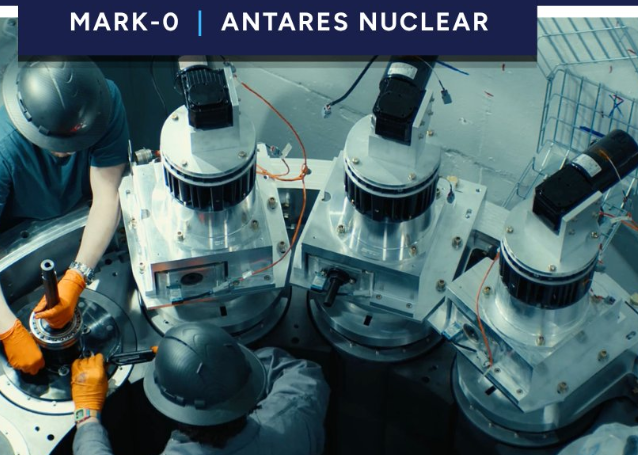
The quiet revolution in American energy just cleared a major technical hurdle.
At Idaho National Laboratory, Antares Nuclear’s Mark-0 microreactor achieved zero-power criticality under the Department of Energy (DOE) Reactor Pilot Program (RPP), becoming the first advanced reactor to meet the ambitious July 4, 2026, deadline set by President Trump’s 2025 executive order to accelerate next-generation nuclear deployment.
The U.S. energy secretary called the development “one of the most significant achievements in nuclear energy in forty years.”
The Department of Energy said the Mark-Zero reactor design by Antares Nuclear, hosted at Idaho National Laboratory, achieved criticality. That means the team started a self-sustaining chain reaction of nuclear fission, the fundamental process for operating a reactor.
The Department of Energy said it is the first time a privately developed, non-light-water reactor has gone critical in four decades, and that it serves as a blueprint for other advanced reactors supported by the Trump administration.
State leaders praised the accomplishment. Sen. Jim Risch posted on social media that Idaho is “leading the charge” to a new era of advanced reactors.
🎉 WE HAVE CRITICALITY! 🎉
On June 4, 2026, at around 12:30 MDT, @AntaresNuclear’s Mark-0 microreactor achieved initial criticality at @INL.
It is the first nuclear test reactor to go critical under @ENERGY’s Reactor Pilot Program. Congratulations to Antares on reaching this… pic.twitter.com/JS9g9Vsm26
— Office of Nuclear Energy | US Department of Energy (@GovNuclear) June 4, 2026
The zero‑power test was designed to confirm that the core’s reactivity, control systems, and instrumentation behave as predicted, before any attempt at higher‑power operation. The next step in the plan is to get the system to generate sustained electricity, and that phase is also scheduled for this year.
“Now that Mark-0 is critical, the real work is just beginning,” said Antares CEO Jordan Bramble in a LinkedIn post on June 4. “I want to reiterate how this fits into our larger roadmap to mature our technology to its commercial potential. This should be obvious, but the goal of a reactor is to sell electricity to customers.”
Following reactor physics experiments, Antares will execute “the next phase of our roadmap—sustained electricity production,” Bramble said. Antares is “able to move fast towards this milestone because we’ve already completed over 6 months of full-power thermal testing in an electrical prototype. We will perform version 2.0 of this in 2026. This is an easier, more iterative way to test, because there is no regulatory process, and you can disassemble to examine material effects.”
He added: “All of our iterative testing sets us up to produce electricity for 6+ months. Hundreds of days, not hundreds of hours. We’re able to test for longer and faster because we’ve designed our reactor around a proven, fully qualified fuel spec developed under Project Pele.”
Some of the great Americans who made Mark-0 possible. Including @Waksman84 @colejust12 @JessGehin @OverReactor1776
Jeff’s work on project Pele began 8 years ago. The program trained operators, improved the regulatory process, and created the fuel line that made our TRISO. pic.twitter.com/cjpJcGqrKN
— Jordan Bramble (@jordanbramble) June 6, 2026
Presidential Executive Order 14301, “Reforming Nuclear Reactor Testing at the Department of Energy,” the RPP also supports the Army’s Janus Program, which focuses on deploying advanced nuclear microreactors for operational and installation energy needs.
The Janus Program is the Army’s answer to Presidential Executive Order 14299, “Deploying Advanced Nuclear Reactor Technologies for National Security.” The Army coordinated with the Energy Department to ensure fuel was fabricated in time to support the criticality timeline and also provided expertise to support the safety review of the Antares criticality test.
“This is a historic moment for advanced nuclear energy in the United States,” Energy Secretary Chris Wright said. “The Antares team has achieved a major milestone in the development of micro-reactor technology, and the Trump administration is proud to have supported their efforts. These technologies will play a critical role in strengthening U.S. energy security for both military and civilian applications.”
Jeff Waksman, principal deputy assistant secretary of the Army for installations, energy and environment, said, “The criticality test of Antares Nuclear’s Mark-0 reactor is an important step toward meeting the president’s goals for nuclear power resiliency for the U.S. Army. A microreactor is now generating neutrons.”
When America sets bold goals, America delivers.
Last year, President Trump challenged our nation to bring multiple advanced reactors to criticality by America’s 250th Anniversary. Today, we reach an important milestone as the first non-light-water reactor goes critical in more… https://t.co/XWuuEF92Dy
— Secretary Chris Wright (@SecretaryWright) June 4, 2026
This milestone, while not yet producing electricity, confirms the reactor’s core physics and safety behavior in the real world, not just in modeling, and sets the stage for operational microreactors expected as early as 2027.
In an energy landscape increasingly defined by grid instability and rising demand, that’s not just progress, but a signal that U.S. nuclear innovation may finally be moving at the speed policymakers have been demanding.
Donations tax deductible
to the full extent allowed by law.







Comments
This wonderful news however, it makes a new target for our domestic terrorists of not securely protected. Bridges, water supply, and nuclear plants would be their prime targets in a terror attack. As a nation we are lazy because we never worried about what we now face. I hope this works out and makes us less dependent on oil.
The intended uses for micro reactors are mostly military. As far as civilian usage goes, you’re looking at applications for arctic expeditions and powering small, remote communities. We’re not really talking about prime terror targets here.
Not so. Microreactors are being considered as the answer to the power demands of large data centers and the AI industry. The reactors will be on-site and will reduce or eliminate the need to draw power from the grid, preventing a rise in electricity’s cost to the grid’s customers.
I don’t know where you get that information but the power output of these reactors is simply way too small to satisfy a fraction of these data centers needs.
These could be scaled up. A semi-micro reactor or a mini-reactor might well be what a data center needs, and that’s fine.
I don’t know where you’re getting your information. Design vary and are scalable, from 15 to 75MW.
@Concise Well when I worked at INL we often described micro reactors as “something that would fit in a shipping container” since that was the most common use case going back to the 60s. However if you’re that interested you can go by DOE’s own definition here: https://www.energy.gov/ne/articles/what-nuclear-microreactor which describes a micro reactor as up to 20 Mw of thermal, meaning probably 12-15 by the time you convert it to electric. Everyone here is confusing microreactors with SMRs. They’re two very different things.
Pretty much any infrastructure is a target. Please see Kurt Schlichter’s novel, The Attack, for an illustration. A micro-reactor (or similar mini-reactor) that powers things that are useful to us can be a target. We should consider protection as part of the package.
There are orders of magnitude of differences here in energy output vs energy demand. We’re talking about an on paper reactor classification that can generate 15 mw against a data center that may need in excess of 500 mw. It’s just not the right tool for the job, period. Yes, companies like Google and Microsoft are lobbying for more nuclear power. What they’re most amenable to is the small modular reactor platform, which is not to be confused with microreactors.
While it MAY make for a new target, the fact is this is an important development in energy production, and the more sources of production we have, the more backup we have in place and operating, the less we are vulnerable to terrorist attacks.
if it stops communistilamofascists then lets do it!!!
🙂
Maybe if policymakers had not embraced the greeniacs’ “No Nukes” propaganda back in the 1970s and 1980s we would not be in the energy fix we are in. Those were the years when licensing the building new nuclear power plants ground to a halt, and research was was cut back (why invest a lot of time and effort into developing something that had been effectively outlawed?).
Something similar happened after we landed men on the moon in the 1960s and 1970s. The technology and ability to do that atrophied for over half a century due to lack of interest, and now NASA, SpaceX and Blue Origin are doing the tedious (and expensive) work of re-discovering it.
Julia DeWahl of Antares on building nuclear reactors for the US military
https://www.youtube.com/watch?v=a_i39TTzGQw
The military this year airlifted a nuclear microreactor from CA to Utah to test the logistics of doing so,
I still prefer the Dodge Demon…
The Dodge Challenger SRT Demon 170 is the pinnacle of American muscle and the most powerful, quickest factory muscle car ever built. Its supercharged 6.2L HEMI V8 pushes out up to 1,025 horsepower on E85 ethanol, launching the car from 0 to 60 mph in a mind-bending 1.66 seconds.Performance & SpecsDesigned by the Dodge “Last Call” division, the Demon 170 is a factory-engineered drag racer.Horsepower: 1,025 hp on E85 / 900 hp on premium pump gasTorque: 945 lb-ft on E85 / 810 lb-ft on premium0-60 MPH: 1.66 secondsQuarter Mile: 8.91 seconds @ 151 mph (making it so fast it is officially banned from NHRA drag strips in stock form without a roll cage)Tires: Staggered Mickey Thompson ET Street drag radialsNotable FeaturesEthanol Recognition: The car’s computer automatically adjusts fueling and spark timing depending on the ethanol percentage in the fuel, unlocking the 1,025 hp capability seamlessly.TransBrake: Allows the driver to lock the transmission and build boost from a standstill for the ultimate launch control.Chiller Mode: Uses the vehicle’s air conditioning system to super-cool the intercooler, ensuring maximum drag performance even on hot days.Production & PricingDodge built only 3,300 units of the Demon 170 (3,000 for the US, 300 for Canada). Originally priced around $100,000, these incredibly rare and highly sought-after collector cars have been trading for well over MSRP on the used market.For a look inside the raw power, feel, and exhaust sound of Dodge’s final V8 masterpiece, check out this POV driving experience:Letting my Mom Drive my Dodge Demon 170 (POV)MilesPerHrYouTube · Jun 4, 202559s10 sites2023 Dodge Challenger SRT Demon 170 – DodgeGarage2023 Dodge Challenger SRT Demon 170. DodgeGarage. 2023 Dodge Challenger SRT® Demon 170. Pause video. 1,025 HP.ZERO BS. Make no mis…DodgeGarageThe 2023 Dodge Demon 170 B5 Blue is a MUST own rare Muscle CarThe 2023 Dodge Challenger Demon 170 is presented as a rare, high-horsepower muscle car. It is considered one of the greatest muscl…17mYouTube·Raiti’s RidesWhich is Best?! My Dodge Demon 170 vs BMW M2 CS (POV Comparison)The 2023 Dodge Challenger SRT Demon 170 replaced a Cadillac CT5V Blackwing about two years ago. This muscle car has a supercharged…15mYouTube·MilesPerHr
🙂