


Artemis II Mission Begins Return Trip to Earth
Distance Records, Mineral Moonscapes, and a San Diego Finale.
During my vacation to Michigan, I had the opportunity to watch the Artemis II launch from a local bar in Royal Oak.
When we arrived, my brother and I asked the waitress to turn the sports TV on to the event. It was a wonderful experience to share the countdown with fellow Americans who realized what was happening and were equally captivated by the coverage.
I have been keeping up with Mary Chastain’s excellent reports. The last one noted that the Artemis II crew broke the distance from Earth record for humans.
Now comes the next phase: The return to Earth and the landing. “Integrity” (the name given to the Orion Multi‑Purpose Crew Vehicle) is now completing the first half of its figure eight “free return” trajectory route.
"We aren't going to the Moon, but rather meeting it at an exact point in space.
And it isn't necessary to spend fuel, either; the calculations are made so that everything works through pure physics and gravity.
It is flawless." pic.twitter.com/HUhCqDRVET— Physics & Astronomy Zone (@zone_astronomy) April 6, 2026
Launched on April 1, Artemis II is now in the seventh day of its mission to demonstrate a successful crewed trip around the moon—the first in more than a half-century. Around 7:02 P.M. EDT on Monday, the Orion capsule and its crew of four astronauts set a distance record for human spaceflight, reaching 252,756 miles from Earth as it arced around the moon before falling back home.
That’s right: falling. Artemis II’s homecoming is already baked into the voyage, courtesy of the moon’s gravity bending the Orion spacecraft’s trajectory to wing the capsule home without much, if any, help from Orion’s rocket engines. That’s the “free” part of the free return trajectory, says Samantha Kenyon, an assistant professor of aerospace engineering at Virginia Tech.
The choice, Kenyon says, was to either fire Orion’s engines as the spacecraft swooped over the far side of the moon and out of radio contact with Earth—or to fire them much earlier in the mission and closer to Earth. Choosing the latter course “means less risk for the astronauts in the capsule” if something were wrong with the rockets, she says. The free return trajectory also set up the spaceflight distance record that the crew set yesterday.
The images captured during the lunar flyby have been outstanding.
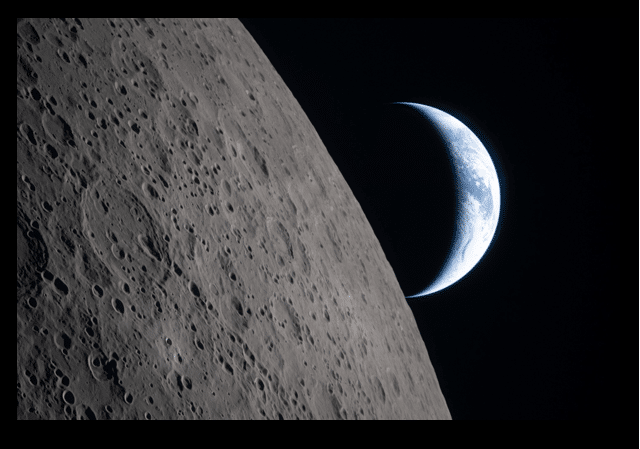
New shades of brown and green in the rings of impact craters. Rugged terrain and long shadows along their rims. Earth rising over the moon’s horizon and the glow of lofted dust.
These are observations the Artemis II astronauts made during their lunar flyby on April 6. While passing by the far side of the moon, they saw parts never observed with human eyes before.
Hello, Moon. It’s great to be back.
Here’s a taste of what the Artemis II astronauts photographed during their flight around the Moon. Check out more photos from the mission: https://t.co/rzM1P0QbOl pic.twitter.com/6jWINHkDLh
— NASA (@NASA) April 7, 2026
My favorite photo is a color-enhanced image indicating specific mineral deposits. Astrophotographer Damian Peach described the colors and what they suggested about the Moon’s formation.
This full-disk view of the Moon has been processed with saturated colour enhancement to expose the rich variety of mineral compositions hidden beneath its familiar gray surface.
Vibrant yellows and oranges trace iron-rich basalts in the ancient lava flows of the maria. Deep blues and purples highlight titanium-bearing ilmenite deposits, while scattered pinks and reds mark unique impact-melt glasses and plagioclase-rich highlands.
Each hue tells a story of billions of years of volcanic eruptions, asteroid bombardments, and cosmic weathering. This isn’t just a pretty picture. It’s science in action. Artemis II’s crewed flyby is gathering data that will guide future landings and help us understand how the Moon formed alongside Earth.
Processed the latest Artemis II lunar view which is significantly better resolution than the previous one. This full-disk view of the Moon has been processed with saturated colour enhancement to expose the rich variety of mineral compositions hidden beneath its familiar gray… pic.twitter.com/kIWdbYKc9H
— Damian Peach🔭🪐 (@peachastro) April 6, 2026
Fortunately, I am now back in San Diego, as this is the final stop of the mission.
After the Artemis II crew makes history traveling around the far side of the moon, the crew will be heading back to Earth, splashing down in the Pacific Ocean off the coast of San Diego Friday night.
The historic 10-day moon mission will come to an end right here in Southern California.
The exact timing and precise location of the crew’s splashdown in the Orion spacecraft could change in the days leading up to reentry as the Artemis II crew hits mission milestones.
At this time, NASA said it expects the crew to splash down off the San Diego coast at 8:07 p.m. (5:07 p.m. PDT) on Friday, April 10.
The San Diego-based USS John P. Murtha will be deployed to recover the Artemis II astronauts after their spacecraft splashes down off the coast of San Diego later this week, the Navy announced Monday. 🚀 https://t.co/e7PMvAIbrh
— NBC 7 San Diego (@nbcsandiego) April 7, 2026
Watching the Artemis II journey come full circle, from that lively bar in Royal Oak to the splashdown just miles from home, will forever be a special memory. In a few days, I’ll probably be standing on the San Diego shore, craft beer in hand, scanning the horizon for “Integrity” as it returns to Earth.
Then it will be time to begin reporting on Artemis III. I just hope the next crewed mission has a working toilet.
This will surely go down at one of the all-time iconic images of human space exploration.
I was listening to the live feed last night and the astronaunts not really having the words to describe the view – and i can well understand why after seeing this incredible image.
Four… pic.twitter.com/W3DBimLVtE
— Damian Peach🔭🪐 (@peachastro) April 7, 2026
Donations tax deductible
to the full extent allowed by law.







Comments
Late April Fools’ joke:
Just before going around the far side of the moon, one of the astronauts should have radioed to NASA, ” hey, look, there’s a city down there.” and then going silent for the next 40 minutes or so.😁 while NASA went ape excement crazy waiting to regain contact.
Even better: “wh… wait! Buckee’s?!?” -click-
Or, how about
“I’ll be darned. It’s Alice Kramden”
Alternately
“It’s full of stars…”
Ty Leslie.. It is hard to fathom how the engineers figured this trip.. I am still spellbound. That and the splashdown close to San Diego.. The logistics involved keeping ten miles of ocean clear of sight seers, even that is mind boggling. And no brakes on the capsule,, just the atmosphere, and eventually parachutes. We needed this, our nation needed something wonderful.
Bread and circuses?
David Gates and circuses… 🙂
For some reason I want to play Kerbal Space Program again.
Can’t figure out why.
There was a meme floating around.
The crew is watching the dark side of the moon out the window and the captain says, ‘can we take a moment to appreciate that we are seeing a sight only a handful of humans in history have seen with their own eyes’.
From the side, ‘Sir, the spaceshitters are broken again’
A long time coming. Great test of the Orion capsule, but…
As a kid who grew up during the race to the moon, I have a soft spot in my heart for Anders’s photo of Earthrise and the reading of Genesis…and
I still clearly remember the day that Apollo 11 landed. I was sitting on the edge of my couch watching every second. “Tranquility Base here. The Eagle has landed!” What a moment!
Got all the way to the moon walk. Heard Armstrong’s first words….then fell asleep from exhaustion!!!
What a time to be alive!
If they land safe and successfully, which I expect, I would give this mission a B+ and I;m a hard grader. Of course I haven’t followed it as closely as I did the Apollo and earlier missions, but still it seems they’ve done quite well. Next time they’ll need to include a plumber in the crew though.
I’m kinda floored a lot of people have no idea this is even happening, or don’t think it’s a big deal. I get that we did it 50+ years ago, less tech, less money. But damn, we are going back to the freaking moon and building a base? The amount of work involved is insane. This is amazing.