


There is a “Popularized Conception of Birthright Citizenship, Which May Not be Accurate”
My quick take on SCOTUS oral argument: “I think one of the big takeaways is this challenge to birthright citizenship has been dismissed as frivolous, as meaningless, as bad faith. But these Justices took it very seriously.”
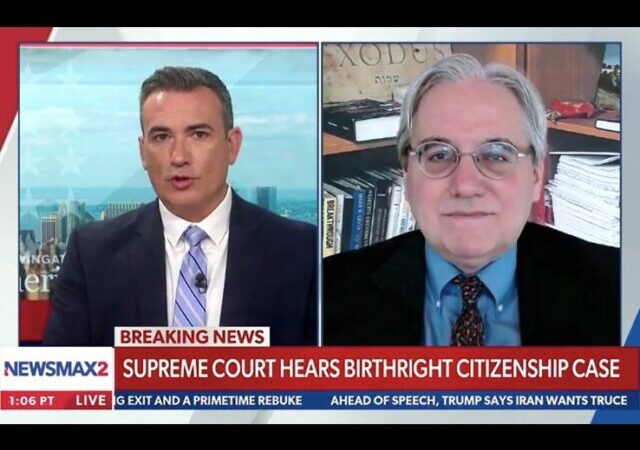
The Birthright Citizenship case is the biggest case of this U.S. Supreme Court case of the term, and the oral argument took place on Wednesday, April 1, 2026.
I offered my immediate take during an interview with Ike Wingate on Newsmax that afternoon:
(Transcript auto-generated, may contain transcription errors, lightly edited for transcript clarity)
Wingate:
Joining us, Mr. Jacobson. Now what happens if the Supreme Court were to rule in the president’s favor?
WAJ:
Well, the executive order at issue here says the federal government will not recognize or issue documents recognizing the citizenship of children whose mother was in the country illegally. And the father was not a permanent resident, or who were here temporarily, and the father was not a permanent resident or citizen.
So it’s going to end what is frequently referred to as ‘anchor babies’. You can’t just fly here and have a child, and all of a sudden that child becomes a US citizen. So it’s going to have a profound impact on how we view our borders, how we view our sovereignty, how we view our citizenship. I don’t know how many people it’s actually going to affect in the short run, but it changes the way we look at who is a citizen,
Wingate:
Right? I mean, there’s only 28 countries in the world out of 195 that allow something like this, and even less that allow what we allow, which is, you know, for anchor babies to happen without even being a citizen. What do you think of the president, though, attending in person? What kind of message do you think he was trying to send maybe to the country and to the Supreme Court?
WAJ:
I don’t think the Supreme Court’s going to be intimidated by him being there. A lot of people have complained about that. It is highly unusual for a president to attend oral argument, but the Justices can read the news, they can watch the TV. They know the politics of this, whether he’s in the courtroom or not. So I don’t think that’s going to have a huge impact. But they do know much like the abortion issue, much like many of the issues they deal with, no matter how they rule, there’s going to be blowback.
Wingate:
Okay. And so, as I mentioned as, we are in the minority, why do you think that is? Why do you think that we have gone this long without finally addressing this issue when there’s so many abuses? I mean, do you think this is intentional and oversight or maybe the resistance to finally get in there and get their hands dirty and handle this? How has this been allowed to go on for so long, do you think?
WAJ:
I think a narrative gets set and it got set almost a century ago, and it becomes a popularized narrative. And if you watch any of the so-called legacy mainstream media, they just assume that if you are born here, you’re a citizen. But that’s not even what the 14th Amendment says. It says if you were born here and ‘subject to the jurisdiction thereof.’ And those words have to have meaning.
So there’s been a popularized conception of birthright citizenship, which may not be accurate. And that’s what the argument was today.
I think one of the big takeaways is this challenge to birthright citizenship has been dismissed as frivolous, as meaningless, as bad faith. But these Justices took it very seriously, and I don’t think anybody can predict how this is going to come out.
It was really a jump ball. The Justices had very probing questions for both sides. This is not a clear issue. It’s not well defined in the Constitution what that wording ‘subject to the jurisdiction thereof’ means. So I think this is a serious case.
I think it shows how a lot of the things that we’re taught as children about the constitution and about our society may not actually be accurate. And I think this is a very serious challenge. I can’t predict how it’s going to come out, but it’s a jump ball.
Wingate:
Yeah. Well, I’ll save my question about asking what your prediction is, but you would think the context of it being part of the reconstruction amendment would be important in the matter, especially for the textualists, because you would think the timing has something to do with this. Am I off in that assumption? Or does it legally have to be treated as its own separate amendment as if the rest of them didn’t exist?
WAJ:
I think that everybody recognizes, I don’t think it’s disputed, that the purpose of this amendment and this citizenship clause was to enable freed slaves and the children of slaves to be recognized as citizens. I don’t think that’s disputed. But the question is, what does the wording mean?
The wording of the constitutional amendment doesn’t say this is limited to freed slaves, even though everybody knew that’s what it was about. And so the question is that wording, that limitation not being in the Constitution, how do we apply it?
And during the oral argument that I listened to the entirety today, there were a lot of examples that came up. It comes up very frequently in the Second Amendment context, the right to bear arms. We didn’t have the sort of rifles and guns back when that was passed, when the Constitution was ratified that we have now, yet we apply the Second Amendment to these newer technologies.
And that was one of the things. The Constitution doesn’t say it’s only limited to slaves. It also doesn’t say that it’s applies to people who were here illegally or who were here, not domiciled. There wasn’t the concept of immigration back then that there is now. But it doesn’t talk about that. It doesn’t talk about a lot of things.
So the question is, you have a principle stated in the Constitution, how do we apply it in this more modern context? And that’s really what the argument is about, because the language is subject to varying interpretations.
Wingate:
Right. Yeah. Understood. I just don’t think the founders could have fathomed where we are today. But it is good to hear your perspective. Some of the leftist headlines out there are, you know, doom and gloom on this for the Trump agenda and the birthright citizenship issue. So William Jacobson, it’s been a pleasure having you on. Thank you for joining us.
Donations tax deductible
to the full extent allowed by law.







Comments
I cannot imagine the Robert’s Court rocking the boat.
Nine unelected, appointed for life, bureaucrats in black robes.
Even if Roberts leads the opinion he will do what he always has done. Issue a very narrow opinion that somehow splits the baby instead of a clear and broad opinion that settles the question once and for all. The problem for him is that he can’t hide behind Federalism and, like abortion, send the issue back to the states because states can’t decide who is a citizen and who isn’t.
Roberts isn’t Solomon and shouldn’t try acting like him,
Not a snowball’s chance in Iran ( I don’t want to be blocked and Iran is a good substitute) will Roberts support the President’s EO. Now if President Trump were Obama and had signed an unconstitutional law, well then we could count on Roberts. But President Trump is not Obama and issued a constitutionally proper order. So we lose.
I listened to the entire hearing, having been personally involved with helping with the delivery of babies by illegal aliens women, back when I was a Border Patrol agent…..
The money line I will remember came from Chief Justice Roberts. “Well, it’s a new world. It’s the same Constitution.”
I hope the 2nd Amendment community jumps on this phrase when arguing a case in front of SCOTUS. No more “Our founding fathers never imagined blah, blah, blah.
It is the same Constitution. That means that it still means what it meant at the time of its adoption, or at the time of the ratification of its amendments.
“Arms” meant personal weapons of all sorts, so that is still the meaning today. The authors of the Bill of Rights 1.) didn’t particularize every individual right, individual rights being too numerous to list; and 2.) they wrote the Ninth Amendment as a catch-all for any unenumerated personal rights, for the very purpose of defusing claims that unenumerated rights do not exist. So arguments against unenumerated rights (such as a right to semi-automatic “arms”) fail.
If the 14th Amendment wasn’t construed at the time of its ratification (that is, if it wasn’t interpreted by those who authored it) as applicable to the children born to persons in the country illegally, then it still doesn’t mean that, no matter how obscure we might consider the language today.
Well, the same problem exists in the German constitution, the Grundgesetz, where marriage is specially protected. Some say that includes same-sex marriage, because the text doesn’t define who exactly is allowed to marry. Others say the framers in the 1950s only meant a man and a woman.
But that can’t really be true as a strict argument—because for the framers to have explicitly meant only man and woman, they would have had to already be aware that, at some point, women might want to marry women (or men marry men), and consciously exclude that. More likely, they just didn’t consider the question at all.
And then you run into the same issue with what your “personal” weapon is in the United States Constitution – or do you want to restrict my right to personally own something like an M1A2 SEPv3 Abrams for personal use?
At that point, interpretation is unavoidable…
If you can afford to feed it, I see no reason why a citizen should not have an MBT. They are a bit of a gas guzzler, and the ammunition is expensive.
The only legitimate criminalization I see is what one does with it – ie, no shelling the neighbor’s house. But that’s a prohibition on assault, murder, and property destruction, which sane people already agree are criminal acts.
Oh, please, not this again. At the time of the writing and ratification of the Constitution, there were privately owned warships, the “ultimate weapon” of the age. So, yes, the Constitution does cover privately owned tanks, fighter/bomber planes, warships… check any military museum. The warfighting systems have been deactivated because of restrictions on the explosives involved, not the weapons themselves. And there are functional systems in private hands – duly licensed and very, very expensive to operate.
The only ‘arms’ I can see as categorically being outside the scope of the 2A are WMD. Otherwise all small arms, crew served weapons, mortars, cannon, privately owned/armed vessels, privately owned/armed forts any types of weapon or arms used by military forces are within the scope of the 2A and totes OK in private hands without any need for pettifogging paperwork or bureaucratic permission.
Our you could take the position that “arms” are “arms” if you don’t want me to own a personal tank or fighter or bomber, then you need to have ratify an Amendment distinguishing between arms. After all, aren’t “arms” short for “firearms” and do not include bows and arrows or the air rifles used on the Lewis & Clark Expedition.
Could you point out what part of 2A refers to “personal” weapons? I can’t seem to find it anywhere. I only see the “keep and bear arms” part. Maybe I’m reading the abridged version.
It is completely legal for US citizens to own a tank. Over a thousand of them are privately owned, most with the weapons disabled but easily made operable.
“do you want to restrict my right to personally own something like an M1A2 SEPv3 Abrams for personal use”
The purpose of the 2nd is to arm the people as insurance against a tyranny. If that tyranny has access to tanks then so should we.
This is absolutely correct.
However this is incorrect. The constitution means what its text says, as an ordinary person fluent in English would have understood it at the time it was ratified. It does not mean what the draftsman who originally wrote the text had in mind, because that person didn’t enact it, so his secret intentions are irrelevant. It was enacted by all the thousands of people who ratified it, and it’s impossible to determine all of their thoughts.
But even if we could, their thoughts don’t determine what it means either. The idea that a law’s meaning can depend on any person’s secret thoughts, let alone on thousands of people’s secret thoughts, which might well have been very different from each other, is absurd. How are we to obey a law if its meaning is secret?
A law means what it says, not what those who voted for it thought it meant, let alone what those who originally drafted it thought. The question isn’t what each of those people had in mind when they voted for it, but how the general public at the time would have understood the actual words that were published.
If the text, in the English of the time, says something then that is what the law means. “Arms” means what it meant in the early 1790s. “Jurisdiction” means what it meant in 1868. And it means that regardless of whether anyone voting for it intended that meaning.
For instance, in 1868 it doesn’t seem to have occurred to anyone that the 14th amendment means the states must respect most of the same rights that the Bill of Rights requires the federal government to respect. No one thought that it incorporated the first and second amendments against the states. People assumed that the states still had the right to censor newspapers, establish official religions and ban unpopular ones, ban guns, take property without compensation, convict criminals without a jury, etc. It was only later that people looked at the text that had passed and realized that if taken seriously the states could no longer do those things. The fact that the ratifiers didn’t consciously have it in mind was irrelevant. The text they ratified said that, so that was accepted as the law.
In this case it’s even stronger than that, because there was no such thing as an illegal alien. If you’d asked anyone in 1868 whether the 14th amendment guaranteed the citizenship of a child born in the USA to illegal aliens they’d wonder what that meant, just as they would if you’d asked them whether the 2nd amendment protected an AR-15, or whether the first protected a blog. But if you explained the concept, then after being amazed that Congress would ever made such laws they would agree that of course the language covered such children too, just as they consciously understood that it covered “the children of Chinese and Gypsies born in this country”.
You were ALMOST thee, Milhouse, until you ludicrous last sentence.
Huh? That is an exact quote from the debate on the 14A. Senator Edgar Cowan pointed out incredulously that it would make citizens of the children of Chinese and Gypsies, and Trumbull confirmed that yes indeed, it would do exactly that, and it was intended to do that, so Cowan voted against it. No one suggested that it wouldn’t do that after all.
1884 SCOTUS made a couple of declarations about the jurisdiction clause in Elk v Wilkins.
First they defined jurisdiction:
“The persons declared to be citizens are “all persons born or naturalized in the United States, and subject to the jurisdiction thereof.” The evident meaning of these last words is not merely subject in some respect or degree to the jurisdiction of the United States, but completely subject to their POLITICAL jurisdiction and owing them direct and immediate allegiance.”
Next, they consequences of jurisdiction or the lack thereof:
“Persons not thus subject to the jurisdiction of the United States at the time of birth CANNOT become so afterwards except by being naturalized…”
Do you know of any reason why either of these declarations should not be heeded?
Combined, they declare that US citizenship by birth is only possible for people who are already at the time of birth “completely subject to [US] political jurisdiction and owing [the US] direct and immediate allegiance.”
Stipulating that Wong Kim Ark was correctly decided, the only people who meet that requirement are people born of US citizens or people born of a legal long-term resident of the US.
Is there any reason why these statements should not be precedent, settled law, stare decisis on the subject of the citizenship of the children born of illegal aliens or transient aliens?
if it’s the same Constitution thrn we won’t hear .”but your rights have limitations” anymore
All rights have limitations. They had them when it was enacted. The freedom of speech has never included a right to libel people, or to incite a riot, or to breach copyright, or to communicate troop movements to the enemy. The right to keep and bear arms never included a right to do so in a manner that unreasonably endangers the public, or to bear arms that are inherently dangerous to the public, e.g. a faulty gun that is likely to go off on its own. The limitations that applied in 1789 still apply.
As I mentioned in a comment in the prior thread, I think “subject to the jurisdiction” is a ‘peculiar institution’ work-around so that the drafters of the amendment didn’t have to explicitly mention slavery. There are too many exceptions to the location=of-birth rule, such as Native Americans, to think they meant to make that radical a change to the understanding of how citizenship was determined. They wanted to make sure the Democrats wouldn’t enact laws that would require freed slaves to go through a naturalization process to become voting citizens.
Arguments about “Native Americans” are red herrings. Native Americans aren’t here illegally. Also, nothing in the 14th Amendment says the government can’t naturalize someone with divided allegiance. Likewise, it doesn’t require the government to naturalize those with divided allegiance (or their children who are born here). The fact that the government does consider as citizens some who have allegiance to more than one sovereign doesn’t mean that it must extend such consideration to all such persons in all circumstances. The 14th Amendment only deals with who must be considered a citizen, not with who can be considered a citizen.
I’m not sure why you are saying the situation of Native Americans is a red herring. It perfectly illustrates your point about “must” versus “can”. If the offspring of people who did not enter the country illegally and whose ancestors had lived for generations on American territory were not recognized as citizens by the 14th Amendment then there is no reason to think it created a right to claim citizenship for anyone born here.
On the contrary, everyone explicitly recognized that children of Indians were not born citizens only if they were immune from US law, and that the children of those Indians who did live under US jurisdiction were citizens.
As were the children born to Chinese and Gypsies. No one on either side of the debate disputed that. Edgar Cowan opposed the amendment for precisely that reason, and no one tried to assure him that he had mistaken its meaning.
After a bit of reflection, the 14th actually does say that a person born in the United States whose parent(s) were either legally allowed or forced by Federal and state law to reside in the United States must be considered a citizen. Everybody else is optional.
No, it doesn’t say that. It says everyone born in the USA whose parents were subject to US jurisdiction, i.e. they had to obey the law, could be arrested for not obeying it, if Congress didn’t like something they were doing it could simply make a law against it, they could be sued and taxed and conscripted. None of those things were true of diplomats, or of tribal Indians. They are all true of illegal aliens.
Subject to the jurisdiction isn’t ’has to obey the law’ and you know it, Milhouse. This is extraordinarily dishonest of you;
No, 4rdm2, that is exactly what it means. There is no other possible meaning. That is clear to anyone who speaks English, and also to anyone who looks at the debates on ratifying the 14A. Anyone who claims to believe it means something else is lying.
“Subject to the jurisdiction of “is more a can to “subject of the nation in question“ not I happen to be in the country and I have to obey the laws because I’m in the country. Just passing through is not a ticket to citizenship.
I thought that was the point of the Native American argument. They were here legally, yet did NOT get citizenship via the 14th – it required a special act of Congress. I would think someone here illegally, hiding from the authorities, would also require a special act of Congress to be made citizens (and you know a Democrat Congress would).
Actually first people dont fall under the 14th amendment due to the fact indian reservation are not part of the US. They are for all intents a separate nation by treaty. No state can impose their laws on them , if you are in NY, you can go to the Mohawk reservation and buy cigarettes with out NY tax on them.
Correct, which means that they were not subject to the jurisdiction thereof.
The fourteenth amendment, therefore, excluded them, just like diplomats, who enjoy what is commonly known as diplomatic immunity and are also excluded by the fourteenth.
Look, I understand why people don’t want birthright citizenship. I don’t want it either. But unless you’re willing to say that the fourteenth amendment should mean something entirely different than what the plain text says, then the only option here is a constitution amendment, like it or not.
And Native Americans are not considered US citizens, but when on US soil, and not the reservation, they are subject to local laws, just as an ordinary Canadian would be subject to US laws in the US. However, the US Constitution doesn’t apply to either, nor does it guarantee them the same “rights” as American citizens.
Some interesting reads are the debates held by the lawmakers when they were discussing the 14th Amendment. There are relevant passages which make it clear that foreigners would not be citizens, since they owed their loyalty to the country they were born in. They had no idea of what today’s world would be. They couldn’t envision foreign tourists who would come solely to have children here. I’m pasting a few paragraphs from the debates below, but I would recommend reading the complete debates to have a real understanding, which may comprise of some 400 pages. A link to that is posted below.
“In the first section of the proposition of the committee, the word “citizen” is used. That is a term about which
there has been a good deal of uncertainty in our Government. The courts have stumbled on the subject, and even here, at this session, that question has been up and it is still regarded by some as doubtful. I regard it as settled by
the civil rights bill, and, indeed, in my judgment, it was settled before. I have always believed that every person,
of whatever race or color, who was born within the United States was a citizen of the United States; but by the
decisions of the courts there has been a doubt thrown over that subject; and if the Government should fall into the
hands of those who are opposed to the views that some of us maintain, those who have been accustomed to take a
different view of it, they may construe the provision in such a way as we do not think it liable to construction at
this time, unless we fortify and make it very strong and clear. If we do not do so
1866
THE CONGRESSIONAL GLOBE
2769
there may be danger that when party spirit runs high, it may receive a very different construction from that which
we would now put upon it. I find that gentlemen doubt upon that subject, and I think it is very easy now to solve
that doubt and put the question beyond all cavil for the present and for the future.
In the first clause of the amendment which I have submitted, I strike out the word ” citizens,” and require the
States to give equal rights and protection of person and property to all persons born in the United States or
naturalized under the laws thereof. That seems to me to put the question beyond all doubt.
The Senator from Maine suggests to me, in an undertone, that persons may be born in the United States and
yet not be citizens of the United States. Most assuredly they would be citizens of the United States unless they
went to another country and expatriated themselves, if they could do so by being adopted in that other country by
some process of naturalization that I know nothing about; for I believe the countries of Europe — certainly it is so
in England — have always held that a person born within the realm cannot expatriate himself and become a
citizen of any other country or owe allegiance to any other country. I think, then, the first section of my
amendment covers the whole ground.
Mr. FESSENDEN. Suppose a person is born here of parents from abroad temporarily in this country.
Mr. WADE. The Senator says a person may be born here and not be a citizen. I know that is so in one
instance, in the case of the children of foreign ministers who reside “near” the United States, in the diplomatic
language. By a fiction of law such persons are not supposed to be residing here, and under that fiction of law their
19
children would not be citizens of the United States, although born in Washington. I agree to that, but my answer
to the suggestion is that that is a simple matter, for it could hardly be applicable to more than two or three or four
persons; and it would be best not to alter the law for that case. I will let it come under that well-known maxim of
the law, de minimis lex non curat. It would make no difference in the result. I think it better to put this question
beyond all doubt and all cavil by a very simple process, such as is the language of the first section of the
amendment I have offered.”
https://ia801508.us.archive.org/26/items/DebatesThatLedToTheCreationOfTheFourteenthAmendment/Debates%20that%20led%20to%20the%20creation%20of%20the%20Fourteenth%20Amendment.pdf
There weren’t any reservations at the time. The Indian nations themselves were outside US jurisdiction. Not their territory, but they themselves. They were considered separate nations within US territory. Wherever a tribal Indian went he was immune from US law.
As one of the 14A’s sponsors said, if we want Indians to do something we don’t imagine that we can just make a law, because they’re not bound by our laws. Rather we negotiate with their governments and try to make a treaty in which they agree to do what we want.
Any Indian could choose to subject himself to US jurisdiction, pay taxes, and obey the law; he would be counted in the census, and his children born thereafter would be citizens. But tribal Indians were immune, just like diplomats.
rwingjr:
They are now.
That was not true in the 1860s. Their immunity from US law was not dependent on territory, because they had none. If they had been subject to US law when outside a “reservation” (had such a thing existed), then their children born outside the reservation would have been citizens under the 14A. The only reason their children were not to be citizens was because they were immune from US law everywhere, just like diplomats.
No, there are no such passages. None at all. Anyone who claims there are is lying to you.
Indeed the lengthy quote you provide explicitly endorses and champions birthright citizenship exactly as it is understood today. Note especially Mr Fessenden’s question, about children born here to tourists (“parents from abroad temporarily in this country”), and the firm answer that yes, they would absolutely be citizens, and that this was right and proper and had to be protected lest some future government or court decide that they were not citizens. This absolutely destroys your argument, and the President’s.
That’s impossible, because in the 1760s they had no compunctions about mentioning slavery. On the contrary, the 13th and 15th amendments explicitly name it. If they meant to limit it to the children of former slaves they would have said so explicitly. But they didn’t mean that. The sponsors explicitly and publicly said so, and no one disputed it.
It was only in the 1780s that they didn’t want to name it, because it was real and was going to continue for the foreseeable future, and the constitution wasn’t going to ban it, but they didn’t want to enshrine it there, so they came up with circumlocutions such as “free persons and other persons”, or “the importation of persons”.
No, there aren’t. At the time of ratification they only thought of two exceptions: Diplomats, and Indians Not Taxed. (Taxed Indians were indeed included and their children absolutely were citizens.) The Supreme Court later came up with a third exception, invading armies, that no one had even thought of at the time.
You would think this would be easily settled by the concept that you don’t allow criminals to profit from their crimes. But I guess that’s too logical
First of all, there is no such concept in the constitution.
But more importantly, the children born here are not criminals. They have done nothing wrong. And the constitution says they are citizens. Neither congress nor the president, nor any honest judge, has any right to change that, regardless of what they might think of it. If they can change that, then they can change the right to keep and bear arms too.
Missing from yesterdays arguments was the strongest arguement. As Yan Kim Ark recognized, there were some classes of people who were not permitted to benefit from birth on the soil. That class included a group of people who were in the realm without the soveriegns consent. Invaders.
The correct analogy to the English common law is that illegal aliens who cross the border without the consent of the government are invaders.
Yet, no one brought this issue up?
I am wondering if that is intentional.
My long term thoughts on this, is that SCOTUS will punt this to Congress for a determination of “subject to the jurisdiction of” with neither side getting what they wanted.
The invader is in the country illegally and subject to the jurisdiction of his native country. Children born to invaders are not granted citizenship for both (illegal entry & allegiance to a foreign sovereign) reasons.
How are those those individuals who illegally enter the country any different from the invaders of a foreign army? Both are here illegally, both have allegiance to a foreign sovereign.
There is no difference. I have yet to hear an argument explaining why the children born here to an invading army should be granted citizen by dint of being born on (invaded) US soil.
I am with you on this line of argument. Jumped out at me when I read the background.
Allegiance, creates an unnecessary dilemma.
Slaves were brought here against their will and by force. They had no allegiance to this country.
Their children were born of parents that neither had allegiance, nor were citizens.
According to your interpretation of the fourteenth amendment, they would not qualify for citizenship, thus defeating the intent of the amendment.
The only way to avoid birthright citizenship, is by a constitutional amendment,!and everybody knows that, but no one is willing to admit it….
They are very obviously different: they are subject to US jurisdiction. They have to obey our laws, and when they don’t we arrest them, try them, and punish them. They have to pay taxes, and when they don’t we arrest them, seize their money, and punish them. They can be sued in our courts, and often are. They have to register for Selective Service, and when we had conscription they were subject to it, just like any alien who is here, but unlike uniformed soldiers of an invading army.
And like any alien who is in the USA, no matter how temporarily, they owe allegiance to the USA for as long as they are here. That is and has always been the law. It was certainly universally understood in the 1860s, and Wong Kim Ark explicitly says so. A person always owes temporary allegiance to whichever country he happens to be in — unless he’s a diplomat or an invading soldier.
Indeed, to change birthright citizenship, we’d have to go through the whole rigamarole of the Constitutional amendment process.
Much as I tend to disagree with Jackson, she was right about jurisdiction. If an illegal alien in the US commits a crime and gets caught, he gets tried by a US court. If that isn’t being under the jurisdiction of the USA, I don’t know what is.
Further, to stray a little from the topic, one reason why British capital was building US railroads in the 19th century was because our legal system worked much like theirs, and a non-citizen would be treated reasonably fairly in a civil case.
That is incorrect. Illegal aliens are not members of a foreign army. If they had the legal status of invaders they would be immune from all US laws. They could not be arrested or punished for any crime they committed here, just as invading soldiers, wearing their country’s uniform, cannot be.
Invading soldiers are subject only to their own country’s laws, and all we can do to them is take them prisoner and put them in POW camps until the war is over and it’s safe to send them home, or until they’re exchanged for our people being held by the enemy. That and only that is why their children born here are not citizens. You don’t want illegal aliens to get that status. You really don’t.
I am confused about what this law means. But if I, being a US citizen, were to be a tourist in Japan and steal a wallet and was arrested I would, at that moment, fully comprehend the meaning intended by this law and it would all become clear to me.
Any non-diplomatic visitor to another country has to obey their laws, but that does not convey citizenship rights. Ask any vet who got a speeding ticket in Germany or Japan.
It doesn’t convey citizenship rights under those countries’ laws, but it does create a temporary duty of allegiance to that country, and both a duty to obey that country’s laws and to expect its protection from criminals. If that country has conscription laws and decides to draft you, it has the right to do so.
And under our constitution, that is enough to give citizenship, not to the tourist but to any child the tourist has while they are here.
We know that people who reside in NY State for less than 183 days in a taxable year, because they moved to Florida, for instance, are not ‘subject to the jurisdiction’ of the New York State department of taxation.
I’m from FL and are you saying Snowbirds are exempt from NY taxes?????
State taxation is largely based on residence or domicile. If you are a New York resident, then New York gets to tax all of your income, even if earned elsewhere. If you are not a New York resident, then New York can only tax the income earned in, or attributed to, New York.
Possibly, but it’s based on number of days of residence and probably other criteria.
That is not true. Taxation departments don’t have “jurisdiction”. States do, not departments. But the NY tax department still has authority over such people when they are in NY. Living in Florida and being out of NY for more than 183 days makes them exempt from NY income tax for whatever income they earn in Florida, but not from any other taxes, nor from income tax for income they earn in NY. And NY could change its law to lower that limit to 30 days, if it liked. Or 1 day.
There are so many rules and so much paperwork, in a remake of Escape from NY, Snake Plissken would have to be an accountant
There is no constitutional or legislative basis for a claim of birthright citizenship any more than if I were to come home to find that a woman had broken in, was living in the back of a closet, and had given birth there, that child would automatically be a part of my family with a right to remain.
Does your family have a constitution? No. And if it had one, it probably wouldn’t have an equivalent of the 14th amendment. But the USA does, and if you claim that “there is no constitutional or legislative basis for a claim of birthright citizenship” then you are outright LYING. There is NO good faith argument for that position. You are simply a liar.
This issue must be decided as it is at the center of whether or not we have a country. Not only did Biden import millions of illegals that fall squarely into this case, birth tourism has now become a big problem. China has over 800 businesses that do this. Have the mother travel here, give birth then go back to China and raise her child there. This country can’t let this continue anymore than we should continue to recognize duel citizens.
You have no choice about it. The constitution requires it, and there is no way an amendment to change it would pass.
IMPEACH JOHN ROBERTS!!!
This is a problem that grew out of laziness, There is no way to determine citizenship in the current system (aka Bureau of Vital Statistics). I was born in 1950 and my BC only confirms I was born in the US, state and city. It lists my parents names and address, but not their citizenship status. How will this ever get untangled? It can be put right going forward, but that WILL take an act of Congress.
The EO is prospective. It looks forward not backwards to remove that very obstacle. Anyone in your situation as described and currently presumed to be a Citizen prior to the effective date of the EO (Jan ’25) is not impacted.
Your parents’ citizenship status is IRRELEVANT. The constitution says that if you were born in the USA you ARE a citizen, unless you were born with immunity to US law. The only way that could happen is if your parents had diplomatic immunity.
And so the “borders” will remain open to birther “tourists,” who can afford to pay the airfare to get here, check in to a hotel, go to a hospital, and voila a new American citizen is born. Chinese women represent apparently the biggest number of birther tourists. China.
That’s what the constitution requires. But we don’t have to give them visas if they’re that far along. For that matter, most airlines won’t sell a woman a ticket if she’s that far along, for fear she’ll go into labor in the air.
Some many American citizens now don’t want to live in the US. They prefer to live in the third world but won’t move. They refuse to believe in the excellence of the US and why we have been excellent. It’s beyond insane.
Artificial womb technology may now be more in the realm of science fiction, but it has the potential to open up an existential can of worms.
It’s popular because the left has told us that was what it was for a long time now. (But not as long as they like to claim.)
One thing that might curb this birth tourism would be to reimpose the draft, and the “citizen” children of immigrants would have to register for the selective service, and should be the first people drafted. Imagine going to war against China, but making the children of their birth tourism, fight their own country.
All male US citizens between the ages of 18 and 26 are already required to register for Selective Service, regardless of where in the world they live. And so are all male residents of the USA in that age range, regardless of their citizenship, and regardless of whether they’re here legally.
As of December, though, no one will have to register any longer, and the government will simply compile its own list of eligible men based on whatever information it has.
So you already have what you want; these citizens are treated the same as all US citizens, and all US residents.
But we do not want to reintroduce conscription. We abolished it because it’s morally wrong, and because it was bad for the military as well as for the country. Subjecting all US citizens and residents to it just to inconvenience a few Chinamen would be beyond stupid.
As the 14A gives no facially clear answer on this issue, then the ambiguity must be resolved by resort to the adopters’ intent underlying the 1868 amd wording. Slaves were brought into the U.S. legally per antebellum laws, so were legally in U.S. jurisdiction. Illegal aliens are not. Just as a litigant can’t bring a state case into federal court unless fed subject matter jurisdiction exists, how is an illegal alien expectant mother “therein” for BR citizenship for her U.S. soil-born child?
Liberals play with the wording and “understanding” of the Constitutional amendments out of bias. That is un American!