


Ohioans Now Hunting for Meteorites after St. Patrick’s Day Fireball
New research indicates that asteroids contain the building blocks of life, “nucleobases” for both DNA and RNA adenine, guanine, cytosine thymine, and uracil.
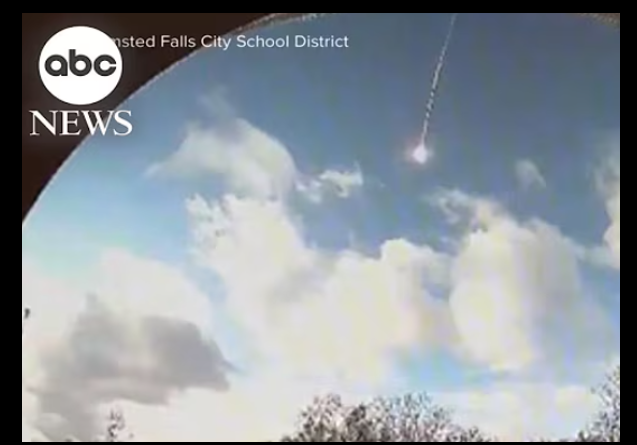
St. Patrick’s Day 2026 will certainly be a memorable one for residents of Cleveland, Ohio.
That’s the day a 7-ton meteor streaked across the sky at 45,000 mph, unleashing 250 tons of TNT energy in a boom heard across multiple states.
People several states away reported seeing the bright fireball even though it was 9 a.m. The American Meteor Society said it received reports from Wisconsin to Maryland. NASA later confirmed that it was a meteor nearly 6 feet in diameter.
“This one really does look like it’s a fireball, which means it’s a meteorite — a small asteroid,” said astronomer Carl Hergenrother, the group’s executive director.
“So much stuff is being launched that a lot of times what you see burning up is just reentering satellites. But usually those don’t get especially bright,” he said.
The meteor was first seen about 50 miles above Lake Erie, near Lorain. It traveled more than 34 miles through the upper atmosphere before fragmenting over Valley City, north of Medina, NASA said in a statement from Bill Cooke, who leads the agency’s Meteoroid Environments Office in Huntsville, Ala.
WTF was that!' Dash cam catches rare meteor over Ohio https://t.co/zw0CwgACDs pic.twitter.com/Bx8iYz6NcY
— New York Post (@nypost) March 17, 2026
Most meteors are incinerated while traveling through Earth’s atmosphere. However, this one left bits and pieces scattered across Ohio, and meteorite hunters are now on a quest for a souvenir.
Medina resident December Harris didn’t have to go looking — her cousin and roommate, Ambra Sinclair, found a small black rock they suspect is a meteorite when she was leaving for work. They had heard the sonic boom Tuesday morning but figured it might have been noise from a nearby airport.
Harris said her roommate found the rock in a 4-foot (1.2-meter) area between the garage and the house late Wednesday morning. She described it as somewhat triangular shaped, less than 2 inches (5 centimeters) in diameter — and “very, very black,” with pits on the surface, grooves and a melted texture on its exterior.
The discoveries will have to be confirmed by the American Meteor Society, but see why these meteorite hunters are so passionate about this pursuit. https://t.co/FSrkw5DaKE pic.twitter.com/V3UMeXEkun
— The Weather Channel (@weatherchannel) March 20, 2026
Would finding a meteorite be as worthwhile as finding a “pot of gold”? That depends on the meteorite. Some can be worth as much as $1000 per gram.
Meteorite pricing models can vary widely based on several factors, including the type of meteorite, its rarity, and whether it has been classified. Common meteorites may sell for anywhere between $0.50 to $5 per gram. However, prices can escalate dramatically for rare specimens. Martian meteorites can reach prices of $1,000 per gram or more, reflecting their scarcity, scientific importance and especially their known place of origin from the planet Mars.
Additionally, the pricing model is often influenced by current market trends and collector demand. As interest in meteorites fluctuates, prices can also fluctuate. Therefore, understanding these pricing models is valuable for both buyers and sellers. It enables them to make informed decisions based on the current market landscape and helps them gauge the true worth of their meteorites.
When examining the prices of various types of meteorites, significant disparities become evident. Iron meteorites, for example, tend to have a different pricing structure compared to stony meteorites. While a common iron meteorite might cost around $1 to $10 per gram, unique or rare specimens might demand prices upwards of $50 per gram due to their historical significance or aesthetic appeal.
In some respects, meteorites may be priceless. New research indicates that asteroids contain the building blocks of life, “nucleobases” for both DNA and RNA: adenine, guanine, cytosine, thymine, and uracil.
All the essential ingredients to make the DNA and RNA underpinning life on Earth have been discovered in samples collected from the asteroid Ryugu, scientists said Monday.
The discovery comes after these building blocks of life were detected on another asteroid called Bennu, suggesting they are abundant throughout the solar system.
One longstanding theory is that life first began on Earth when asteroids carrying fundamental elements crashed into our planet long ago.
The asteroids that hurtle through our solar system give scientists a rare chance to study this possibility.
St. Patrick’s Day 2026 will certainly be a memorable one for many in Ohio.
Donations tax deductible
to the full extent allowed by law.







Comments
I blame
global warming climate change ICE Putin voter IDthe war in Iran.I blame Trump
What if it hadn’t broken up
Inquiring minds want to know
And, did the meteor fall behind the grassy knoll?
Don’t dig by East Palestine… 🙂
The horribleness and the awfulness of it will never actually be forgotten.
Luther Heggs
Aaargh, they’re always after me lucky chondrites!