


Artemis II Moon Launch Pushed to March After Fuel Test Hydrogen Leak
Other problems were uncovered during the testing process. Additionally, the Sun has released several powerful solar flares this week that resulted in radio blackouts.
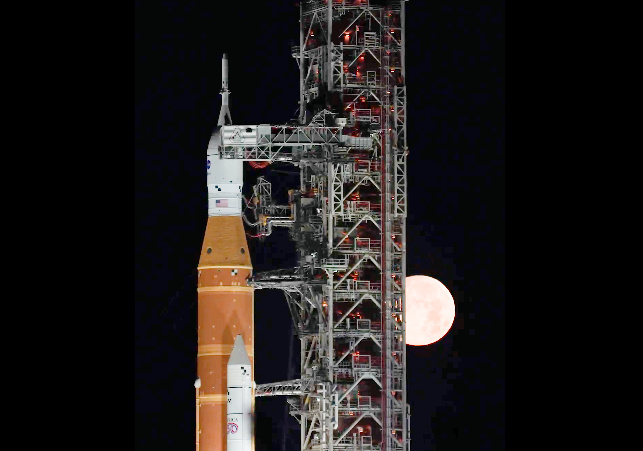
As I noted earlier this week, the Artemis II mission vehicle, which will be used for a 10-day crewed mission around the Moon, underwent a “Wet Dress Rehearsal.”
Unfortunately, NASA’s test was cut short 7when engineers detected a liquid hydrogen leak at the tail service mast umbilical interface on the Space Launch System (SLS) rocket, leading to a delay of the Artemis II launch from February into March.
The launch of NASA’s Artemis II mission, the first flight of astronauts to the Moon in more than 53 years, will have to wait another month after a fueling test Monday uncovered hydrogen leaks in the connection between the rocket and its launch platform at Kennedy Space Center in Florida.
“Engineers pushed through several challenges during the two-day test and met many of the planned objectives,” NASA said in a statement following the conclusion of the mock countdown, or wet dress rehearsal (WDR), early Tuesday morning. “To allow teams to review data and conduct a second Wet Dress Rehearsal, NASA now will target March as the earliest possible launch opportunity for the flight test.”
The practice countdown was designed to identify problems and provide NASA an opportunity to fix them before launch. Most importantly, the test revealed NASA still has not fully resolved recurring hydrogen leaks that delayed the launch of the unpiloted Artemis I test flight by several months in 2022. Artemis I finally launched successfully after engineers revised their hydrogen loading procedures to overcome the leak.
NASA Delays Artemis II Moon Launch Due To Issues During Fuel Test | 99.3 The Fox https://t.co/hlpQ7DXGmT pic.twitter.com/0vBY6mFaJf
— 99.3 the Fox (@rockwiththefox) February 4, 2026
Apparently, the vehicle used in Artemis I also suffered from the same issues.
If that sounds familiar, it’s because the Artemis 1 SLS experienced hydrogen leaks in the same location during its wet dress rehearsal three years ago. Those leaks resulted in three separate rollbacks to NASA’s cavernous Vehicle Assembly Building (VAB) over the course of six months before Artemis 1 would finally launch.
NASA completed a wet dress rehearsal for the Artemis II mission in the early morning hours on Feb. 3. To allow teams to review data and conduct a second wet dress rehearsal, NASA will now target March as the the earliest possible launch opportunity for the Artemis II mission.… pic.twitter.com/jSnCUPLQb6
— NASA (@NASA) February 3, 2026
Other problems were discovered during testing.
The wet dress rehearsal uncovered other issues — including a problem with the Orion capsule, which will carry the crew to the moon. While no one was on board Monday, teams practiced preparing the spacecraft for its passengers. A valve that pressurizes the vehicle required additional attention and took more time to close the hatch than anticipated.
Teams also uncovered issues with cameras due to cold weather and audio dropouts across communication channels. “As always, safety remains our top priority, for our astronauts, our workforce, our systems and the public,” said NASA administrator Jared Isaacman in a post on X, and that NASA will only launch when the agency is ready.
Hopefully, the issues will be fixed and the second mission will go off as successfully as the first.
Yet there may be another good reason for a delay. Space weather has heated up over the last few days.
The sun has erupted in a relentless barrage of powerful solar flares over the past 24 hours, firing off at least 18 M-class flares and three X-class flares, including an X8.3 eruption — the strongest solar flare of 2026 so far. Solar flares are ranked by strength from A, B and C up to M and X, with each letter representing a tenfold increase in energy — meaning X-class flares are the most powerful explosions the sun can produce.
The culprit is sunspot region 4366, a volatile active region that has grown rapidly in just a few days. The flurry of activity began late Feb. 1 and has continued into Feb. 2, with multiple M-class and X-class flares erupting in quick succession. The prolific region appears to be far from finished. Spaceweather.com described the region as a “solar flare factory”, warning that its rapid growth and magnetic complexity make further eruptions highly likely.
The X8.3 solar flare peaked at 6:57 p.m. EST (2357 GMT) on Feb. 1, unleashing a blast of extreme ultraviolet and X-ray radiation that ionized Earth’s upper atmosphere. The flare triggered strong R3 radio blackouts across parts of the South Pacific, with shortwave radio disruptions reported across eastern Australia and New Zealand, according to NOAA’s Space Weather Prediction Center.
An X8.1 Solar Flare Occurred from Region 4366. pic.twitter.com/q8PuvOsUL5
— NOAA Space Weather Prediction Center (@NWSSWPC) February 2, 2026
In risk management terms, a slipped launch window due to gas leaks is vastly preferable to a problem that arises while orbiting the Moon. The entire purpose of a wet dress rehearsal is to force hardware and procedures to fail gracefully on the ground rather than in space, where failure is “not an option”.
Hydrogen is a small, light molecule, which makes it hard to contain… so exposing every weakness in seals, valves, and interfaces now is exactly what a mature program should do.
Add in a hyperactive Sun throwing X‑class flares, and the delay starts to look less like bad luck and more like a systems check by the universe itself.
When Artemis II finally departs, hopefully it will do so with calmer space weather, with all issues resolved and under the safest possible conditions for the first crewed trip around the Moon in over half a century.
Then, onto the future…with perhaps a new vision of what space vehicles should be.
The Artemis vision began with President Trump, but the SLS architecture and its components long predate his administration, with much of the heritage clearly traced back to the Shuttle era. As I stated during my hearings, and will say again, this is the fastest path to return… https://t.co/bu0SvThwS9
— NASA Administrator Jared Isaacman (@NASAAdmin) February 3, 2026
Donations tax deductible
to the full extent allowed by law.







Comments
Good decision
I will stick with my original prediction: there is a 50-50 chance Artemis II is successful (meaning it accomplishes at least some of the mission objectives AND returns the crew home safely).
But the chances Artemis III lands on the Moon at near zero, and the whole thing may get cancelled because of its huge price tag.
If Artemis II is successful, then IMO it would rank up there with Apollo 8 as one of the gutsiest space missions ever flown. Like Apollo 8, Artemis II involved a first crewed flight of a somewhat cranky rocket that flew to the Moon. In spaceflight there is no such thing as routine.
Artemis I to the moon and back went off with no major problems. I understand the complexity and the risks involved, but I think Artemis II is going to be a success.
I was too young to remember Apollo 8. To see a 2026 version of that flight would be absolutely amazing.
As far as Artemis III, we’ll cross that bridge when we get to it.
I was 7 years old when Apollo 8 flew. What made it especially ballsy was the fact that it was the first manned mission using the Saturn V – and it was going to the Moon! Apollos 4 and 6 were the two previous unmanned test missions that used the Saturn V – and the second test flight did not go well. Apollo 6 developed a rather nasty “pogo effect” that might have injured or killed the crew if one had been onboard, and the third stage failed to restart. All in all Apollo 8 was a nail-biter that fortunately went off without a major hitch.
I have very low confidence in Artemis II. They embraced DEI and I just have a hard time trusting anything they produce.
And by “they”, I mean Lockheed Martin,
Other DEI embracers have their fingerprints on this too. Though it looks like an ass kicking like no other that will come from the government if they kill more people due to DEI quality is forcing them to get their act together on the manufacturing side- even if their execs are still corrupt as hell.
IYKYK
no bonus for you whitey!
referencing Lockheed’s no bonus for white guys scandal
American engineers must be very proud 😂: while it’s not NASA who literally built this thing, the parts that failed are super old Shuttle-era hardware — RS-25 engines from the Space Shuttle, solid rocket boosters basically lifted from Shuttle designs, and the core tank plumbing dating back decades. LMAO, these are literally parts designed in the 1970s–80s being pushed into 2026!!! Looks like only nauralized Nazis like Wernher von Braun or Elon Musk can really build spacecraft that don’t leak hydrogen everywhere 😬🚀.
Is calling Musk a “naturalized Nazi” an attempt at parodying the left, or do you really think it’s OK to call him that?
It has the largest liquid hydrogen tank ever built for a rocket. Surprise! It leaks. SpaceX switched to liquid Methane because it is much easier to use – larger molecule and doesn’t need to be as cold.
Drummers must be accompanied by an adult at all times
https://www.facebook.com/ArtimusPyleBand/posts/artimus-pyle-would-like-to-wish-his-beautiful-and-talented-daughter-misty-libert/1419087352930095/
I voted for Trump. However, this whole Artemis thing looks like a vanity project that two billionaires want to see happen. The Apollo program had its problems, but it had an enviable success rate and safety record. I doubt that the current bureaucracy is up to the task.