


Trump Admin Planning Test of Golden Dome Missile Defense System in 2028
Meanwhile, Space Force is considering novel development tools to speed development of space-based interceptors needed for the ambitious project.
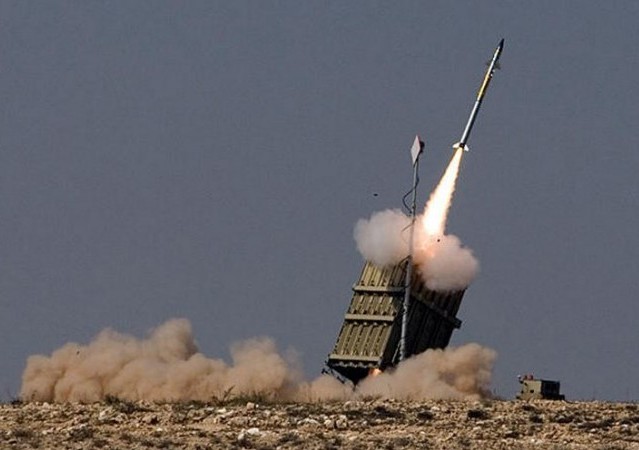
Back in May, I noted that the Chinese were unhappy with U.S. plans for a massive missile defense system inspired by Israel’s Iron Dome.
The Golden Dome will be designed to shield this country, and potentially some of our allies, from advanced missile threats, including ballistic, hypersonic, and cruise missiles. Pentagon officials are now reporting that the first test of the system may be as early as 2028.
That timeframe lines up with Trump’s ambitious goal to “have it done in three years” and comes amid pitches from defense contractors to score coveted contracts to develop the cutting-edge system.
“They want a win to point to in November [2028],” a defense official told CNN. “And DoD [Department of Defense] wants to avoid anything they perceive will slow them down.”
The test, which will be conducted by the Missile Defense Agency, is expected to be called FTI-X, which stands for “Flight Test Integrated,” in a nod to how it will assess the Golden Dome’s vast array of sensors and weapons systems, according to the report.
Development of the state-of-the-art missile defense system is expected to cost about $175 billion, according to Trump, who tapped Gen. Michael Guetlein, vice chair of operations at the Space Force, to oversee the ambitious project in May.
The challenge for the defense team appears centered on the development and refinement of space interceptor technologies. The goal of the 2028 test is to demonstrate that both the scale and the economics are achievable and realistic.
The three-year timeline is particularly ambitious given that the US has been exploring the possibility of space-based missile intercept for decades, the defense official said. But it’s still a “hard problem, and technically very risky,” the official said. “The possible number of satellites needed to achieve a probability of engagement success is going to be very high, given the time and area needed to cover the continental United States.”
Space Force Gen. Michael Guetlein, who was tapped by Trump in May to lead the development of Golden Dome, alluded to that challenge in remarks at a space industry summit last week.
“I think the real technical challenge will be building of the space-based interceptor,” Guetlein said. “That technology exists, I believe. I believe we have proven every element of the physics, that we can make it work. What we have not proven is, first, can I do it economically, and then second, can I do it at scale? Can I build enough satellites to get after the threat? Can I expand the industrial base fast enough to build those satellites?”
Ultimately, the tests conducted in 2028 may just constitute “phase one” of the program, the second source said. This person noted that right now, the project is all about moving quickly and relying on existing systems to show that the broader concept of a massive missile shield is worth more funding.
To help move the process along, a U.S. Space Force official says the Defense Department is considering novel methods (e.g., prize contests and industry cooperation) to help speed the development of space-based interceptors (SBIs).
Maj. Gen. Stephen Purdy, acting head of space acquisition for the Department of the Air Force, told the House Armed Services Committee today that “from initial discussions” with the Pentagon’s new Golden Dome czar, Gen. Michael Guetlein, and his team, it is clear that the primary goal for SBIs is speed.
“They plan to intend to be as fast as possible,” he said. “[T]hey’re looking at really additional novel ideas, like prize activities, [and] cooperative work with industry where they’re leveraging industry development.”
…As the Space Force moves forward with development of SBIs, Purdy said the service will apply “lessons learned” from recent efforts to shorten acquisition timelines for other space systems by using non-traditional contracting vehicles, such as Other Transaction Authority, Middle Tier Acquisition constructs and Commercial Solutions Openings.
Further, he stressed that in order to take advantage of commercial innovation, it is key that SBI development not be bogged down by “gold standard” requirements developed up front — instead defining necessary capabilities and asking industry how it can provide solutions.
Trump admin plans first ‘Golden Dome’ test of space-based missile defense system: report https://t.co/smAxB9elNn pic.twitter.com/P1LEyXqGVK
— New York Post (@nypost) August 3, 2025
And while SpaceX at one time appeared to have an inside track to help support the project, the Defense Department will be considering all the private sector options.
It comes amid a deteriorating relationship between Trump and Musk, which culminated in a public falling-out on June 5. Even before the spat, officials at the Pentagon and White House had begun exploring alternatives to SpaceX, wary of over-reliance on a single partner for huge portions of the ambitious, $175 billion space-based defense shield, two of the sources said.
SpaceX did not respond to requests for comment. Responding to a post about the Reuters story on X, opens new tab, Musk wrote, “Federal acquisition regulations require using the best provider at the best price. Anything else would be breaking the law.”Due to its size, track record of launching more than 9,000 of its own Starlink satellites, and experience in government procurement, SpaceX still has the inside track to assist with major portions of the Golden Dome, especially launch contracts, sources say.
Project Kuiper, which has launched just 78 of a planned constellation of 3,000 low-earth orbit satellites, has been approached by the Pentagon to join the effort, signaling the administration’s openness to integrating commercial tech firms into national defense infrastructure and going beyond traditional defense players.
🚀 The Pentagon just opened its $175B Golden Dome satellite shield contract to SpaceX competitors like Kuiper, ULA, and Rocket Lab.
Elon Musk fired back: “Best provider at best price – anything else breaks the law."https://t.co/0YE7ZIiN7Z
— James Hydzik (@JamesHydzik) July 29, 2025
Donations tax deductible
to the full extent allowed by law.






Comments
Testing is continuous, unless he’s going to get the Chinese in on it to supply the unexpected.
lefty says
hold my fentanyl
you think omar and crew are going to allow this!!??
“Back in May, I noted that the Chinese were unhappy with U.S. plans for a massive missile defense system inspired by Israel’s Iron Dome.”
Back in the 1980s when Reagan announced his desire to build SDI, the Soviets were unhappy too. Must be something having to do with being communists.
Yup. All the reason we need to move forward with it.
The Chinese are one of the only two groups threatened by this.
We have plenty of other enemies, and some of the love to lob toys at each other all over the Middle East, but they won’t be reaching out and touching us that way any time soon. They’re much more likely to ship some dirty tricks in over our land borders, and then execute some exploits in place. Golden Dome is useless against them. And those moral midgets are much more likely to try mischief than the two big powers that might be deterred by it
In general if the chinese are unhappy it is a good idea. I’d tell them that too.
Tucker Qatarlson and Candyass Owens are very upset too!