


Appeals Court Affirms Nationwide Injunction on Trump’s Birthright Citizenship Order
The decision came shortly after the U.S. Supreme Court held that some nationwide “injunctions likely exceed the equitable authority” of federal courts.
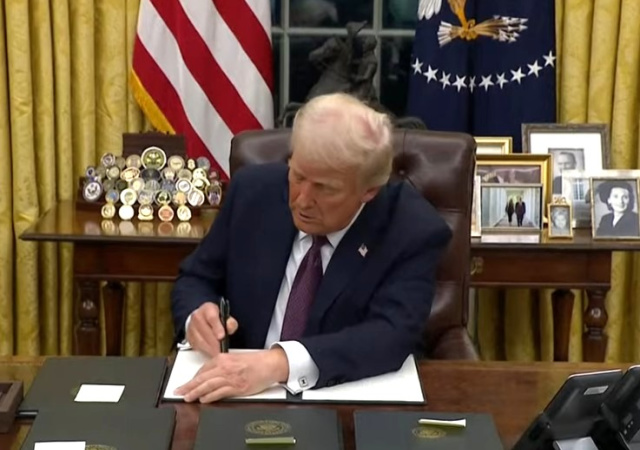
A federal appeals court on Wednesday affirmed a nationwide (or universal) preliminary injunction blocking President Donald Trump’s executive order restricting birthright citizenship.
A three-judge panel of the U.S. Court of Appeals for the Ninth Circuit held 2–1 that the challengers, four states, were likely to succeed on the merits of their claim that the executive order is unconstitutional.
The Ninth Circuit’s decision comes less than a month after the U.S. Supreme Court held that some “[u]niversal injunctions likely exceed the equitable authority that Congress has given federal courts,” as Legal Insurrection reported.
That decision, Trump v. CASA, Inc. (2025), dealt with universal injunctions that extended beyond the individual plaintiffs who sought them. The Court did not address the issue of universal injunctions granted to state plaintiffs:
As the States see it, their harms—financial injuries and the administrative burdens flowing from citizen-dependent benefits programs—cannot be remedied without a blanket ban on the enforcement of the Executive Order. Children often move across state lines or are born outside their parents’ State of residence. . . . The lower courts should determine whether a narrower injunction is appropriate, so we leave it to them to consider these and any related arguments.
The Ninth Circuit dismissed the claims of individual plaintiffs because another court’s certified class action covered them. Answering the Supreme Court’s call in CASA, the Ninth Circuit agreed with the lower court “that a universal preliminary injunction is necessary to give the States complete relief.”
The Ninth Circuit held that issuing a nationwide preliminary injunction for the state plaintiffs was within the lower court’s power because of the likelihood of interstate travel:
We conclude that the district court did not abuse its discretion in issuing a universal injunction in order to give the States complete relief. States’ residents may give birth in a non-party state, and individuals subject to the Executive Order from non-party states will inevitably move to the States.
The Ninth Circuit parties’ dispute over the scope of the Fourteenth Amendment’s Citizenship Clause and its grant of birthright citizenship came down to one phrase:
All persons born or naturalized in the United States, and subject to the jurisdiction thereof, are citizens of the United States and of the State wherein they reside. (emphasis added)
The Trump administration argued that “subject to the jurisdiction thereof” referred not to “regulatory jurisdiction,” where an individual is subject to the laws of the United States. Instead, the administration argued, the phrase referred to “political jurisdiction,” which the administration “define[d] as ‘a concept rooted in allegiance and protection.'”
Under the administration’s theory, an individual is only “subject to the jurisdiction” of the United States if that individual “owe[s] primary allegiance to the United States,” exempting children born in the United States to illegal immigrants or temporary visa holders.
The states contended that “subject to the jurisdiction thereof” only “exempts a small and well-defined group of people who are born in United States territory yet not subject to United States authority,” such as the children of foreign ambassadors and the children of foreign soldiers during an invasion.
The Ninth Circuit flatly rejected the administration’s view:
We conclude that the text of the Fourteenth Amendment supports the Plaintiffs’ interpretation. In interpreting the text of the Constitution, courts are guided by the principle that the Constitution was written to be understood by the voters; its words and phrases were used in their normal and ordinary as distinguished from technical meaning. (cleaned up)
When the Fourteenth Amendment was drafted, the Ninth Circuit noted, “jurisdiction” was understood as a “reference to the power of the courts” to adjudicate disputes or to “regulatory jurisdiction,” such as the power to legislate or govern.
The Ninth Circuit found support for this position in a landmark Supreme Court decision interpreting the Citizenship Clause, United States v. Wong Kim Ark (1898). In Wong Kim Ark, the Court had to determine whether Wong Kim Ark, a man born in the United States to Chinese alien parents, obtained United States citizenship at birth.
The Court in Wong Kim Ark held 6–2 that Wong Kim Ark obtained citizenship “by virtue of the [Citizenship Clause] of the Fourteenth Amendment of the Constitution.”
The Ninth Circuit, surveying Wong Kim Ark, found no requirement that birthright citizenship is conditioned on “primary allegiance,” as the administration argued. “Instead, [the Supreme Court] considered allegiance to be part and parcel of . . . ‘regulatory’ jurisdiction,” the Ninth Circuit noted.
One judge on the panel dissented on narrow grounds, arguing the states lacked standing to sue because their asserted harms were too speculative or self-inflicted.
The opinion:
Donations tax deductible
to the full extent allowed by law.







Comments
come on congress do your job GOP we know the dems hate america
quit giving in to them
The panel is correct on the underlying case; there is no possible way that the administration can win this case. As to the injunction, the Supreme Court mapped out exactly when and how a nationwide injunction can be justified, and the panel followed those instructions. The administration can try taking it back to the Supreme Court and see whether they will issue new instructions, but the panel followed the instructions as they currently stand.
“No possible way.” Too certain by half.
The fact is that you do not know, but are prone to pretend you do, with sweeping statements to boot. Watch you do not get caught with your pants down.
He has pants?
No, they are not. U.S. v. Wong Kim Ark (1898) 169 U.S. 649, 649 (which you proably have not even read) certainly does not support their nonclusion. Wong Kim Ark parent’s were legally present in the U.S. at the time of his birth (“His father and mother were persons of Chinese descent, and subjects of the emperor of China. They were at the time of his birth domiciled residents of the United States, having previously established and are still enjoying a permanent domicile and residence therein at San Francisco. They continued to reside and remain in the United States until 1890, when they departed for China; and, during all the time of their residence in the United States, they were engaged in business, and were never employed in any diplomatic or official capacity under the emperor of China.”)
The case goes on to say “Wong Kim Ark, ever since his birth, has had but one residence, to wit, in California, within the United States and has there resided, claiming to be a citizen of the United States, and has never lost or changed that residence, or gained or acquired another residence; and neither he, nor his parents acting for him, ever renounced his allegiance to the United States, or did or committed any act or thing to exclude him therefrom.”
None of these very important facts are true in the 9th Ciruit case. None of the parents were lawfully present. Thus, Wong Kim Ark (1898) 169 U.S. 649, 649 does not support their position or the erroneous opinion of the Circuit Court of Appeal.
Exactly. People rush to trot out Wong then gloss over the facts of Wong. His Parents at the time of his birth in the USA were lawfully present as what we would today characterize as lawful permanent residents (aka green card holders).
Wong was indisputably a US Citizen from birth. As would be the Children of today’s green card holders b/c those Parents are also lawful permanent residents.
That doesn’t automatically extend to the children of non permanent aliens, even those lawfully present. No Court has ruled on this. In fact the closest analogue are the Insular Cases which held that US Citizenship didn’t automatically confer to children born in US Territories acquired in the Spanish American War; Puerto Rico. Guam and the Philippines.
As late as 2022 SCOTUS in US v Vaello Madero ruled that residents of Puerto Rico, (US Citizens mind you) could be denied from Supplemental Security Income Program (SSI) in an 8-1 decision relying on the same doctrine as the Insular Cases. Essentially that just b/c the US Govt has suzerainty over Puerto Rico doesn’t mean all the Constitution applies to its residents.
IMO, that demonstrates pretty clearly ‘subject to the jurisdiction’ means far more than the possibility of potential criminal or civil prosecution by the Gov’t for non compliance with statutes/regulations. Instead it means, just as the Trump Admin is arguing, the reciprocal duties from the individual to the Gov’t, the Community and their fellow Citizens; the ability to meet Civic burdens of Citizenship such as service on a jury, service as a member of the Sheriff’s Posse, service in the unorganized Militia …all of which are barred to non Citizens and non permanent lawful residents.
Bottom line is if the Parents ain’t here as Citizens or lawful permanent resident aliens then the children shouldn’t be US Citizens. Probably have to be a prospective application of this due to reliance interests but at least it would stop the insanity.
Chief, you are making a fundamental error — again, after I pointed it out the first time you made it. Neither US v Vaello Madero nor the Insular cases are relevant, because none of them deny that Puerto Rico, American Samoa, and all the other islands are under full US jurisdiction, and so is everyone who happens to be there, whether as a permanent resident, a tourist, or anything else. All of them must obey US law, pay such taxes as Congress requires of them, can be sued in US courts, and compelled to testify. That means they are under full and absolute US jurisdiction and the constitution fully applies.
What those cases say is not that they were not born under US jurisdiction, but that they were not born in the USA. Those territories are not incorporated into the USA; they are not part of it. They are under US sovereignty and full jurisdiction, but they are separate territories from the USA. Therefore people born there don’t fulfill the requirements of the 14th amendment, which says “all persons born or naturalized in the United States, and subject to the jurisdiction thereof”. You’re ignoring that very important “and”.
Milhouse,
You are certainly entitled to your own opinion. I’d even stipulate that your view about ‘birthright citizenship’ is currently in vogue. That doesn’t mean you are correct on the broad point. You are definitely incorrect about the case I cited.
The 8-1 SCOTUS decision in US v Vaello Maduro denying SSI informs us that mere physical presence in places under the suzerainty of the US Gov’t didn’t extend full constitutional protection/application. The gentleman raised property right interest and due process interest claims under 5A and 14A and SCOTUS directly held against it ruling that Congress could deny benefits.
That’s the exact claim the proponents of unlimited ‘birthright citizenship’ claim; that the phrase ‘subject to the jurisdiction’ ONLY means physical presence in the places the USA has suzerainty over. Y’all refuse any other possible connotation and reject any notion that it means reciprocal responsibility and allegiance. IMO y’all are wrong.
The other problem for y’all is the ‘presumption’ you claim for support of ‘birthright citizenship’ rests on jack squat. It is no different than an argument ‘we’ve done it this way for decades’. The context of birthright citizenship rests on permanent v temporary residency/domicile. To reject this view is to argue that they were approving ‘birth tourism’ when writing the 14A. That’s absurd. Mere presence in a location under the suzerainty of the US Gov’t at birth doesn’t automatically confer US Citizenship by itself IMO precisely b/c it is a ludicrous policy interpretation among other things.
We’re gonna have a trial on the merits and appeals and almost certainly SCOTUS review that will answer the question.
Why are you pretending that the case rests on Wong! Wong is only tangentially important. The constitution speaks for itself, with or without Wong. Wong was merely a prominent occasion on which the court said that this language means what it says. In that instance the parents were legal residents, but the language doesn’t say anything about that, so the same is true for anyone else. If someone is born within the USA (not in an unincorporated territory) and must obey US law, then he is a citizen.
‘Subject to the jurisdiction of’
DOES NOT apply to people who are illegally in the country who are actively avoiding the jurisdiction of the US because to obey the law means they have to leave.
It’s like you don’t seem to understand that an illegal alien is, right out of the gate, before anything else is said, violating UIS law.
The interpretation of the 14A to suggest that anyone from anywhere who, while passing through the US, spits out a child has some claim to citizenship for that child is preposterous
Because they are not ‘Subject to the jurisdiction of’.
They are subject to the terms of the visa worked out between THEIR government and that of the US. Thus they are obeying THEIR government, not the US government.
What’s interesting is that we’ve seen this in play in recent history –when that idiot got caned in Singapore. He tried to use the consulate, to trade on his citizenship, but the visa put him in the hands of the law he’d agreed to comply with through the US consulate
That’s simply not true. The judge panel interpreted the vague phrase, “All persons born or naturalized in the United States, and subject to the jurisdiction thereof, are citizens of the United States and of the State wherein they reside”.
If the parents are here illegally then they are not subject to the jurisdiction of the US. They are hiding from the law which is the jurisdiction of the US.
Exactly the issue isn’t ‘reside’ as in mere temporary physical presence but rather reside as in establishing domicile or permanent residence.
They are hiding from the law to which they are subject, that of their own country, by illegally being somewhere else. Think of a pregnant female prisoner who escapes jail and illegally enters the USA.
Wong Kim Ark turned on the fact that the parents were in the country legally.
It appears the States conceded that children born in-country to two classes of persons do not receive citizenship under the 14th Amendment – children of foreign ambassadors and the children of foreign soldiers during an invasion.
The former require an exemption, in part for their own benefit so as not to confuse the citizenship of their children born here, as the parents would be legally in the country, but not permanently, and while here are in the employ of a foreign nation, working at that nation’s behest and direction, and in its interests (i.e., their allegiance is to a foreign country).
The latter are somewhat similar and somewhat different. Invading soldiers are also in the employ of a foreign nations, working at that nation’s behest and direction, and in its interests (again, having allegiance to a foreign country). But they are also here illegally. This is very much unlike the situation in Wong Kim Ark, making Ark not particularly illuminating when it comes to children born in the U.S. to those here illegally.
The States’ admission undermines their position, as it makes it clear that the children of persons (soldiers) who both owe allegiance to a foreign country and who are here illegally are not granted citizenship by dint of being born here – a situation perfectly analogous to that of illegal aliens whose children are born here.
Ninth Circus?
Now taking bets that SCOTUS overturns 6-3.
5-4. We lose ACB on this one
The idea that “jurisdiction” in this clause means something completely different from what it means in every other legal context is ridiculous and is not honestly argued. The administration’s lawyers don’t believe their own claims.
Speaking for the lawyers, determining who is honest. Can you hear yourself.
The fact is that this matter is not settled, and lawyers probably more informed than you come down on both sides, for example:
“Birthright Citizenship: Two Perspectives”
https://fedsoc.org/fedsoc-review/birthright-citizenship-two-perspectives
He’s not a lawyer.
Mr. Walpin’s argument was far more thorough and interesting.
The Rivkin / Yoo essay is hollow, positivism; without basis in the Constitution – history, tradition and text. … Far below par for Yoo.
Well,Milhouse, if the intent of the amendment was to accord birthright citizenship to the offspring of anyone who happens to be physically within the US, then why add that jurisdictional qualification at all? Simply saying “everyone born In the US is a citizen” would suffice, no need to be redundant. Unless the framers of the amendment intended birthright citizenship to be more limited. Which they did. And no S.Ct. case has interpreted the citizenship clause as broadly according birthright citizenship to the offspring of anyone who happens to set a foot over the border. The holding of Wong Kim Ark was specific and limited to the offspring of permanent legal residents.
No, it would not suffice, because there are people who are in the USA but not subject to its jurisdiction. They are not bound by US law, are exempt from all taxes, cannot be arrested, cannot be sued in a US court, cannot be summoned to testify. Children born in the USA with that status are not citizens.
The senate sponsor of the amendment made this very clear, in a sentence that ironically the opponents of birthright citizenship dishonestly misquote> in order to try to make him out as having said the exact opposite of what he did say. He said clearly that “under the jurisdiction” was meant to exclude those foreigners who have diplomatic immunity but that everyone else was included. (He didn’t mention “Indians not taxed” in that sentence, but they were clearly also excluded. It was up to each Indian whether to be taxed or not, and taxed Indians were included but untaxed ones were not.)
Milhouse, that’s your own limiting conception of jurisdiction and who is subject to and subjects himself to the law is certainly open to debate. Now apparently, not so much in your original comment though. And in this debate I can also point to legislative intent and, I also have. a SCt decision that, contrary to the popular belief that is held by those who have never actually read the case, supports my views above. Views expressed in the entire comment, not excerpts you chose to paste in a reply. If you want to respond, just respond honestly., this cut and paste segmented response style of yours gets old after a while.
I agree with you Milhouse, this is regularly, and wrongly, cited. (I’ve noticed that myself and have pointed it out elsewhere.) But it is also not the only historic reference that’s cited by those who believe otherwise.
Although the intent of sponsors (and of the Congress in general) can be revelatory, the opinion of any single Congress person (even the sponsor, who, in this case, was not the author of the citizenship portion of the amendment) isn’t definitive. When the types of persons whose children, when born here, aren’t automatically conferred with citizenship are considered (as I commented above), there is consistency in including children born here of those illegally in the country in the same class.
To recap my earlier comment:
Invading soldiers (whose children are acknowledged to not be the persons included in the 14th Amendment’s birthright citizenship):
Owe allegiance to a foreign country
Are in the U.S. illegally
Illegal aliens:
Owe allegiance to a foreign country
Are in the U.S. illegally
There is nothing in the amendment that expressly excludes (from birthright citizenship) the children of invading soldiers. The exclusion must be found in the language of the amendment. If so, then that language should equally exclude the children of any parents whose allegiance and form of entry (illegal) are identical to that of those of invading soldiers, who are admittedly excluded from the citizenship conferred by the amendment.
Subject to the jurisdiction means exactly what the authors intended back in the day. Today’s usage is irrelevant
Should be dismissed for standing, unless they are saying unborn babies have standing (they are the ones that will be “harmed”). If unborn babies can have standing under the law, we may need to revisit some of these abortion decisions…..
The babies are not parties to this suit (they’re in the class action, so they join the class as soon as they’re born, exactly as the Supreme Court said. This suit is brought by the States, and they certainly have standing.
However, the dissent mentioned that the problems here would be caused by the States, and he was correct. If Trump’s EO is allowed to stand while the case makes its way through the courts, children born in one State will not meet difficulties when they travel to other States because they will all be in the same boat. Only when the States are granted the injunction do the problems involved manifest. The court here is using this as an excuse to issue nationwide injunction, when the potential problems can be similarly avoided by not issuing an injunction at all.
There’s a song in this. Meet the new nationwide injunction, same as the old nationwide injunction. Well, a bad song at any rate.
I’ll bet Milhouse can dance to that.
I suppose you could dance to worse songs. Like something from Eminem.
Kraftwerk would try it.
Expected. On to SCOTUS and Congress.
Birth on the soil of the United States is a necessary but not sufficient condition for citizenship. American Indians who were born in the US were not automatically citizens. That took the Snyder Act signed into law by Herbert Hoover in 1924. Andrew Branca covered this subject throughly in a recent podcast. He read from the original Senate discussions on the citizenship clause of 14A. The whole purpose of the clause was to give citizenship to the newly freed slaves, who would otherwise have been stateless. It was never meant to provide citizenship to anyone who drops a baby on US soil. He also covers the Wong Kim Ark case.
Are we supposed to just ignore the original intent of the Senate? Eventually SCOTUS will have to deal with the meaning of the citizenship clause. So far it never has.
Not all Indians. Only those who were not under US jurisdiction. Their status was the same as that of foreign diplomats; they didn’t have to pay taxes, they didn’t have to obey the law, they couldn’t be sued or called to testify. That’s why they were excluded. The children of those Indians who had chosen to be subject to US jurisdiction were citizens.
The criterion is born in the USA (not in an unincorporated territory) and subject to US jurisdiction, i.e. is not immune from the law. If the parents can be arrested, then their children born within the USA are automatically citizens. Nothing more is required.
Wow you really AREN’T a lawyer.
Your understanding of the law seems to be cartoonish –at best.
You actually wrote this–
If the parents can be arrested, then their children born within the USA are automatically citizens. Nothing more is required.
This is one of the stupidest things that has ever marred this site.
If you are an illegal alien and you get arrested pursuant to getting you out of the country any children you spawned in this country are instantly granted full citizenship? Because you were finally caught?
Go back to Vox, Milhouse. They’ll think you’re a genius.
That’s not what he said. He didn’t say WHEN the parents are arrested, he said parents that the government has the authority to arrest (unlike diplomats).
Abolishing slavery apparently led to this birthright citizenship fiasco. Time to reconsider?
Temporary visa holders is unlikely to win given past precedent – I’m fuzzy on the details but there was an 1800s case where an Englishwoman’s parents travelled to America to join family, she was born, they decided they didn’t like it so returned home, her uncle in America died years later, and under (NY?) law she was initially deemed ineligible as only Americans could inherit the property. She sued in court and was declared an American born citizen and thus eligible for the inheritance. I don’t think the case went to SCOTUS, but the precedent is long standing.
Whether illegals are subject to the jurisdiction and thus able to birth American citizens remains open to debate. And of course even if they are American citizens, their parents are not so can still be deported. It’s up to the parents whether they take their American children with them or not though.
Any case before the 14th amendment is irrelevant.
“Newborn” persons are “minors” aka “dependents”, unable to make “adult decisions”. They have no “rights”, not even the right to life in some states. Such minors are dependent on their parents for “protection”; and they by nature know no other “allegiance”.
[According to PPACA young progeny can be dependents until 26 years of age, i.e., their parents are financially responsible for their care (excepting if they choose genital self-mutilation or, if female, to kill another “human” developing within). Same according to civil orders imposing burdens on the male in divorce proceedings.]
At the time the Constitution was created and approved (1791), and for centuries prior, English and European laws universally held that a “newborn” was a “subject” of the monarch to whom the father was a subject and owed primary allegiance to; and that monarch had the duty to protect the newborn given the father’s allegiance; this regardless of place of birth, even if the father was an “alien friend” in a foreign land.
[1700s, the good ole times, when women were still chattel. … As an aside, I expect we will return to that reality in the not too distant future.]
On a related point, Article. III. courts (neither supreme nor inferior) did not receive from the People in the Constitution the Power to interpret the Constitution. Certainly, there is no provision in the Constitution re: interpretation let alone an anointing of “judicial supremacy” in such matters.
Each of the three “co-equal” branches have a duty pursuant to respective “oaths of office” to interpret and justify their actions pursuant to delegated limited Powers specifically enumerated in the Constitution.
As noted, “history, tradition and text” are all in align with the fact that there is no such concept of “birthright ‘subject’ allegiance” or “Right” to a foreign monarch’s protection (based on where birth occurred). … As well, there was no such concept of “citizenship” distinct from “subject” created by the Constitution or the 14th Amendment other than in the US the “citizen” has allegiance to the Constitution as opposed to a “throne” and “person”.
Last the 14th Amendment was clearly created to be imposed on those states and their “citizens” re-entering the Union, in order to address the former “slaves” who were then without country.
The feral courts are wrong, as are the NGOs and attorney’s who seek to usurp the collective wealth of actual natural and naturalized US Citizens, and destroy the USA as a sovereign nation.
It is all just a OWG / communist initiative to incite violence.
“On a related point, Article. III. courts (neither supreme nor inferior) did not receive from the People in the Constitution the Power to interpret the Constitution. Certainly, there is no provision in the Constitution re: interpretation let alone an anointing of “judicial supremacy” in such matters.”
The Constitution, at Article VI defines itself as the supreme law of the land. The article also states that all judges are bound by the Constitution. (Being “bound” means that the Constitution puts “boundaries” on what the court may enforce.) The authors of the Constitution knew exactly what that language would authorize and anticipated that the courts would settle controversies over government acts and legislation. Such authority was mentioned in both the Federalist Papers and in debate at the federal convention (as recorded in Madison’s Notes On The Debates In The Federal Convention). At the convention it was remarked by three different convention attendees, and no opposition was raised to their presumption that judicial review was within the scope of the courts’ authority.
Federalist Papers
#44
Madison noted that the “success” of acts of Congress would “depend on the executive and the judiciary departments, which are to expound and give effect to the legislative acts.”
Notes of the Debates in the Federal Convention of 1787
July 21
Mr. L. Martin:
“And as to the Constitutionality of laws, that point will come before the Judges in their proper official character. In this character, they will have a negative on the laws.” (Can’t get plainer than that.)
Mr. Rutledge:
“The Judges ought never to give their opinion on a law till it comes before them.”
July 23
Mr. Madison:
“A law violating a constitution established by the people themselves, would be considered by the Judges as null & void.” (Here Madison himself, whose administration ended up on the short end of the stick in Marbury v Madison acknowledges the authority of judges to strike unconstitutional legislation.)
*****
Courts hear controversies of law. Courts, by their nature, are the places where controversies over legislation are adjudicated. The court is one of the primary government offices to which a citizen has a right to petition for relief, and that includes relief from government acts that exceed the authority of the Constitution.
“… the courts would settle controversies over government acts and legislation. …”
I appreciate the approach you used to argue for the false claim of “judicial supremacy” without mentioning it.
First, Article. VI. sets forth the supremacy of the Constitution (not Article. III. courts), and that “the Judges in every state shall be bound thereby,” and identifies all who “… shall be bound by Oath or Affirmation to support this Constitution; …”
Next, I agree that “Notes from Debates” and the “Federalist Papers” can offer insight as to intent at the founding; but neither source is complete nor superior to the words chosen to be contained in the Constitution.
That said:
“Mr. L. Martin: … (Can’t get plainer than that.)” … “Article. I., Section. 1. All legislative Powers herein granted shall be vested in a Congress…” … No Power to sub-delegate to the Executive; and though the supreme Court’s “Chevron deference” is dying, yet but it lives.
Mr. Rutledge shared – “judges give their opinions”. … Did you not find a more certain quote suggesting “judges opinions are ‘The Final Word’” on matters of Constitutional interpretation ? … Even supreme Court judges have been known to be wrong (see para. above), often only a majority of the court (supreme, en banc, appeals, etc.) carry the decision (recording written dissents for future reference).
Similarly, “co-equal branches” is not found in the Constitution, but all taking an “oath to support” is therein. To “support” the Constitution one must read and understand it, interpret and apply the document made “of, by and for the People”; a “co-equal” duty to support.
[Clearly, it appears few elected officials and government bureaucrats consider compliance with the Constitution a daily basis. … “The Meese Revolution” is a new book which boldly acknowledges upfront that prior to Meese it was rare for Article. III. courts to consider the Constitution. Meese receiving credit for setting in motion the movement now known as “originalism”. … Related, at the time of the founding “Law” was principle based, far less prescriptive, and historians believe people were much more knowledgeable of the “Law” and its rationales than today. … It used to be said: “Ignorance of the Law is no excuse.”]
As well, the Constitution contains provisions for the removal of judges (even if these are wrongly rarely used: by Impeachment; for “bad Behaviour”; through dissolution, defrocking and defunding; etc.); as well the President, Vice President and officers of the executive branch can be removed; the Executive can thwart the Congress by not signing or vetoing bills; Congress can override a Presidential veto and remove their own; and the courts can hear disputes among two or more identified parties (but no universal injunctions; and nation-wide injunctions are now of dubious validity).
Prior to the 17th Amendment States also had significant Powers to control a feral government, including replacement of their senators and Article. V. Powers; but, we yet have the “establishment clause” which may in the future be applied against “self-anointed” Article. III. judges.
So there are yet some “checks and balances”, i.e., numerous ways for each of the branches to thwart the others; but nowhere in explicit (or implicit) word or delegated Power are the Article. III. courts “supreme” when interpreting the Constitution.
The Judicial branch has exclusive jurisdiction over matters of law, as the Congress has over making legislation and as the POTUS has over executive acts. Because the judiciary hears controversies at law, and because sometimes the government is a party to those cases, the government becomes as bound by the court’s decision as does any other litigant. Nothing in the Constitution explicitly states this, but then again neither does it explicitly state what the POTUS’ executive powers are, it merely assigns all of same to the POTUS – just like it assigns judicial authority to the Judiciary.
Explicit lists of both the POTUS’ and the courts’ authority are simply not practical, and were not made for fear that any partial list would be seized upon as a limit, as the 2nd Amendment’s militia clause is frequently misinterpreted. Congress was given explicit authority over the Executive in certain situations because without that explicit authority, any attempt by Congress to interfere with the Executive would be a violation of the separation of powers. Making determinations of law is within the authority of the Judiciary, so when the other branches are parties before the court, the Judiciary, ipso facto acquires jurisdiction to judge their actions. A court’s decisions are always binding upon the parties, and nowhere does the Constitution excuse either the Congress or the POTUS from this historic, regular, and completely usual practice of a court’s business within its sphere – hearing controversies at law and making decisions in favor of one party or the other.
I’m not a lawyer (although my son is and we discuss these things), but I know that I have common sense.
There is no way the founders and writers of the Constitution ever intended for foreign citizens to come to this country and give birth to declare that their infants are citizens when the parents never were.
No other country allows it and no individual gets to decide for himself if they are a citizen.
Claiming citizenship for an infant by foreign parents is fraudulent behavior. similar to squatting in a vacant house.
Coupla things:
1) The 14th Amendment happened in 1868, the better part of a century after the Constitution and Bill of Rights were written—in 1787. The Founders had nothing to do with it. What they likely would have said about the matter will therefore never be anything but speculation—most likely interesting speculation, but still. The Amendment says what it says.
2) But it’s a law that can be changed, if such a change is what the people want. The Constitution has been amended many times, and it will continue to be amended as time passes. While ex post facto prohibitions would prevent applying a new or changed law to those ~currently~ targeted, a new law could be in force going forward and affect ~future~ offspring of illegal immigrants.
I’m not much of a Roberts fan, but his plain-spoken description of SCOTUS’ function is to call balls and strikes, i.e., say what is and isn’t consistent with what’s in the Constitution, not make things up. If what’s there changes, they are required to adapt.
Which, note, does not mean that they always get things right. SCOTUS has made some terrible mistakes, like Dred Scott, Kelo, and Roe, to name but a few. But it also has the power to reverse (correct) itself later. That’s not particularly satisfying to the initial losing party—you can’t uncook an egg—but it’s arguably better than nothing.
But the 14th amendment was written in response to the end of slavery to ensure that slaves would have full citizenship. It was never intended to start a new industry of “birth tourism” (which IMO is bad faith and fraud).
You can say that the Amendment is poorly written in that context, and it probably is. Following that, we will need the Supremes to clarify and/or Congress to pass legislation.
There’s no way the supporters of passage for 14A believed they were authorizing the offspring of non-permanent unlawful aliens to be granted automatic Citizenship at birth due to mere physical presence in a geographic location where the Govt of the USA asserts suzerainty. No flipping way and IMO anyone arguing the contrary is operating in bad faith.
I might be willing to grant good faith to those who have always clung to a strict textualist interpretation and analysis for every other case/controversy and who refrain from injection of bad precedents not resulting from strict textualist formulation.
100%
“There’s no way the supporters of passage for 14A believed they were authorizing the offspring of non-permanent unlawful aliens to be granted automatic Citizenship at birth due to mere physical presence in a geographic location where the Govt of the USA asserts suzerainty.”
This in a nutshell. If the SCOTUS does its job it will look to Congress’ original intent, not what every sh*tlib looking to wreck the country wished it was.
The provision against ex post facto law applies only to criminal law. Look it up in Madison’s Note On The Debates In The Federal Convention. Also see any one of a number of federal civil laws (such as tax law) that were written or revised to have an ex post facto effect.
Laws concerning citizenship are civil in nature, not criminal, so the prohibition would not apply to such laws.
Google example of a tax law that was made retroactive
Ironically for you and your post; Dred Scott was decided in accordance with federal law and the Constitution, no matter how repugnant it may have been. The Supreme Court owes fealty to the law, particularly the US Constitution, not feelings. The 14th Amendment applied only to former slaves according to the writers of the bill.
Our system, being run by people and not angels, isn’t perfect and can’t be expected to be so. But for the maintenance of order, courts should be given great deference, at least, if not having their decisions considered absolutely binding. This is not to say that an occasional reversal should be discouraged, they are sometimes necessary.
Too damn bad more “justices” aren’t real Americans.
The 9th Circuit allowing a Nationwide injuction b/c of potential for ‘interstate travel’ is amusing. Will the 9th Circuit be so sanguine when this logic is applied to other things? Say the 2A rights of a Citizen departing a ‘constitutional carry’ no permit needed State to travel into a State with heavy infringement of 2A?
Now don’t go applying logic to the 9th
No but they are happy to do it in the other direction. A federal law outlawing guns from school zones is “valid” because lots of guns often move in interstate commerce.
You’ve got to know how to pick the right principle for the agenda,
I simply don’t understand how and why a person’s rights can change, in a country that’s a republic of States all beholden to the same principles of liberty and individual rights, merely by displacing himself geographically from one State to another. This has never made a lick of sense to me, especially with regard to Art. IV, sec 2’s “Privileges and Immunities” clause that I believe should make a person who is immune from prosecution for an act in one State (such as owning a certain firearm) also immune from prosecution for the same offense in “the several States.”
It’s fascinating that we are the only country on Earth that allows people to perform an illegal act, then get to enjoy the benefits of their illegal acts and the idiots of the nation (such as Millhouse) fight tooth and nail to let these people who have committed the illegal acts keep their benefit.
If someone sneaks into your home and gives birth, does the baby automatically become a part of your family?
A comprehensive solution is need. According to Congressman Chip Roy (R-Texas), chairman of the House Constitution subcommittee, birth tourism occurs between 124,000 and 300,000 times a year. Say 200,000 citizens every year. Do these citizens pay taxes?, register for the draft ? (still a law)
Nope, they are citizens to get benefits. As John Kennedy said”…”Ask Not What Your Country Can Do For You”…
Amend the Constitution or interpret its words to deny birthright citizenship.
Political Commissar Judges at it again