


Judge Rules Trump Firing of FTC Commissioner was Illegal
In 1935, the Supreme Court ruled that the FTC Act is constitutional and does not infringe upon the executive power of the President.
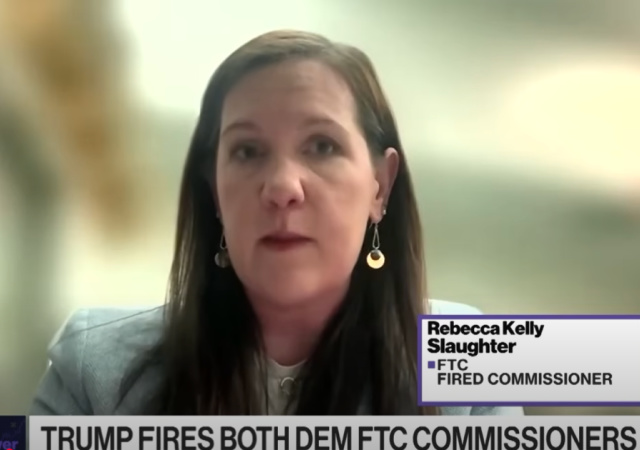
A federal judge for the U.S. District Court of D.C. ruled that President Donald Trump’s firing of Rebecca Slaughter was illegal.
“Because the law on the removal of FTC Commissioners is clear, and for the reasons explained below, the court will grant Ms. Slaughter’s motion for summary judgment and deny Defendants’ cross-motion for summary judgment,” wrote Judge Loren Alikhan.
Slaughter and Bedoya filed the lawsuit after Trump alerted them of their removal on March 18.
Bedoya formally resigned his post in June. However, he joined the lawsuit as he “continue[s] to seek any and all relief appropriate in light of [his] new circumstances, including a declaratory ruling from this [c]ourt recognizing that the President’s ‘purported termination’ without cause . . . was ‘unlawful.’”
Alikhan dismissed Bedoya’s claims because he did not “maintain [his] personal interest in the dispute at all stages of litigation.”
Alikhan used Humphrey’s Executor v. United States as her basis for her ruling.
The Supreme Court ruled that the FTC Act is constitutional and does not infringe upon the executive power of the President.
Section 1 of the FTC Act states that a president can only remove a commissioner for “inefficiency, neglect of duty, or malfeasance in office.”
Trump told Bedoya and Slaughter, “Your continued service on the FTC is inconsistent with my Administration’s priorities. Accordingly, I am removing you from office pursuant to my authority under Article II of the Constitution.”
The Supreme Court has not strayed from the precedent given in the Humphrey case even though SCOTUS has raised questions about the decision.
However, I doubt SCOTUS (because you know this will end up there) will side with Trump on this issue due to the long precedent.
“It is not the role of this court to decide the correctness, prudence, or wisdom of the Supreme Court’s decisions—even one from ninety years ago,” wrote Alikhan. “Whatever the Humphrey’s Executor Court may have thought at the time of that decision, this court will not second-guess it now.”
White House spokesperson Kush Desai said the Trump administration will appeal Alikhan’s decision.
Donations tax deductible
to the full extent allowed by law.







Comments
So it lists Dereliction of Duty. Just send over some directives to do things you know they disagree with and when they do not do them, bam, dereliction of duty.
Biden Judge. That’s all you need to know.
Any honest judge would have made the same ruling; there really isn’t another one available. Humphrey’s Executor is binding precedent until the Supreme Court changes it, and all lower court judges are bound by it. If Trump wants it overturned he’ll have to take it to the top.
“Whatever the Humphrey’s Executor Court may have thought at the time of that decision, this court will not second-guess it now.”
But within a year of Heller, McDonald, Bruen, they’re all second-guessing those decisions into a black hole.
“All” might be a little broad, there.
But this precedent happened to be one they liked, so it works for them.
The key is that we actually look at the law and apply it properly, regardless of who it affects. We work to throw the law out if it’s a bad one. But we need to stick to Rule Of Law even while applying reciprocal lawfare to the other side.
It will be binding precedent until a lower court judge rules differently and the case gets back before SCOTUS
This is the correct answer, unfortunately. Humphry’s Executor was wrongly decided by the Court. But, it’s not up to this District Judge or any District Judge to tell SCOTUS that it was wrong. Unfortunately, as henrybowman also correctly points out, this never stops progressive jurists who routinely ignoring binding precedent to advance their own political agenda. We saw this just a couple weeks ago when the New England District Court judge ignored a binding SCOTUS precedent that had just been established TWO DAY prior.
I would say it IS up to a district court to tell SCOTUS any particular precedent was wrongly decided. Tell them it was wrong and why, in the expectation that will go back up to SCOTUS and inform a new decision.
To me, that’s the right way to handle bad precedent. Not to simply rule otherwise in defiance.
That is not what he did.
See Milhouse’s comment. It could have been any judge ruling on law, not feelings, or legislating from the bench.
As long as the Supreme Court follows the law, I have no complaints if Trump loses one. However, I don’t know enough law to know what the correct answer is in this case.
The problem is the law is unconstitutional, as is the ruling in Humphrey’s Executor at least IMO. Let’s keep things simple with a few easy questions.
1. Is the FTC part of the Legislative Branch (art I)? Nope.
2. Is it part of the Judicial Branch (Art III)? Nope.
Since we only have three Branches of the Federal Gov’t that means the FTC must be part of the Executive Branch (Art II). Since Art II plainly states ‘The executive power shall be vested in a President’ the discussion about authority over any Executive Branch entity is pretty well ended. The POTUS is the HMFIC of anything in the Federal Gov’t that’s not part of the Judiciary or the Congress, period.
That is a matter for the Supreme Court only. The district court judge had no choice but to follow Humphrey’s Executor, which says the law is constitutional. And the law says the president can’t fire FTC commissioners. Only the Supreme Court can change that.
Well, to be fair, in today’s federal judiciary, observance of the S.Ct. is kind of optional, but of course that rule only applies when ruling against President Trump.
True, the District Court is supposed to follow the precedent and I’m not stating otherwise. Though Congress could change the statute.
I am not at all convinced the S.Ct. will uphold Humphrey’s. It is an absurd decision where the Court discovered the “quasi-legislative” and “quasi-judicial” powers. It is an affront to constitutional separation of powers, has been called into question by recent Court decisions, and runs counter to an even older precedent. Myers v United States. Of course, we have Roberts and Barrett so I may be wrong
At minimum this will provide a more straightforward opportunity for SCOTUS to hear a case that challenges Humphrey’s Executor and perhaps overturn it. They’ve been inching towards it but whether the preference for an incremental approach by Roberts and maybe Barrett has been satisfied is an open question. I have my doubts but at least the opportunity is arising.
So any Democrat hired by a previous administration it’s a lifetime position.
Good to know
No, it’s a fixed term position. The law explicitly says so, and the binding precedent is that the law is valid. Trump’s only argument is that the Supreme Court got it wrong and the law is really invalid; he may be right, but no lower court judge has the power to say so. This judge had no choice but to rule as she did, and neither will the appeals courts have any choice but to uphold it; the only court that can give Trump the answer he wants is the Supreme Court.
Funny how district courts are able to rule against Trump when doing so ignores the opinions of SCOTUS and precedent. (E.g., issuing nationwide injunctions in situation that don’t allow for them. Has anyone been keeping count how many times SCOTUS has had to remind lower courts of its decisions when it comes to ruling on Trump-related cases?)
Lower courts can’t ignore binding precedent. They’re not allowed to. Doing so is dishonest and unprincipled and all the things we complain about — so why do you want this judge to have done exactly that? Only because of whose ox is gored?! That would be a disgusting reason.
Please send that comment to Judge Laplante who warped class action rules to issue a nationwide injunction after the S.Ct. admonished lower federal courts against issuing nationwide injunctions.
Judge Laplante didn’t warp anything. The Supreme Court told the lower courts they could do this, so he followed their instructions exactly.
Not allowed to murder people either.
The S.Ct. ordered no such thing Milhouse. They warned against the possibility of this very abuse. And creating a provisional class of aliens who haven’t even been born yet is what we call warping the rules.
Doing so is dishonest and unprincipled and all the things we complain about
This is the part with which I disagree. IF the judge explains with good constitutional and legal reasoning why the precedent is wrong, then I don’t think it’s dishonest or unprincipled. That sets it up for an appeal, and another decision by SCOTUS. Blind adherence to precedent is part of the problem in our legal system, as it gives them kinglike powers – even when they did horribly wrong. (Like Roe v Wade – if that were anything but a SCOTUS decision under our precedent system, it would have been laughed out of a serious court it was so awful; and I’m not even looking to the morals of it.)
but wait
isnt that ftc act/ law going so far back and is an obscure ancient law
cause thats what they tagged djt with when he used on the book laws that were “so old”
Why the long face?
The 1939 decision was one of many questionable rulings by a terrified Supreme Court cowed by FDR’s threat to pack the Court. After the 1937 “switch in time that saved nine” the Supreme Court largely tended to rubber-stamp whatever FDR and Congressional Communists wanted.
The result – as CommoChief noted – is that the FTC commissioner is now outside the three branches of government and (thanks to the 1939 ruling) not accountable to anyone once they are in power. It is the sort of “government by Tsars” that Communists have long lusted for, but which is poisonous to a constitutional republic.
The “switch in time that saved nine” is a myth. There was no such thing. Roberts expressed his skepticism of Adkins in early 1936, explicitly said he wanted to overturn it on December 17, and voted that way on December 19. FDR didn’t announce his court-packing plan until February 5, 1937, and his fireside chat about it was on March 9. It is physically impossible for news of the court-packing plan to have gone back in time and frightened Roberts into changing his vote two months earlier.
Why didn’t DJT just fire them for “inefficiency, neglect of duty, or malfeasance in office”? There has to be something he could have found that fits. Surely he must have been told his firing would not stick unless SCOTUS reversed precedent.
Do you believe that would have made any difference to this judge? We have been watching #Resistance Federal judges inventing things out of thin air so that Latin American gangbangers can go free in the US and continue to rape, rob and murder American citizens.
Either he couldn’t find such an excuse, or he deliberately did it this way because he didn’t really care about firing them but wanted to get the precedent overturned, and this is the only way that can happen.
It’s pretty clear to me that the DC district judiciary’s job is to wall off bureaucrats in DC; that is, democrat activists and loyal party sycophants; from any consequence or responsibility for incompetence, negligence, or accountability for any lackluster performance or dereliction of duty…DC exists to protect itself and guarantee that the bureaucracy exists into perpetuity.
“Section 1 of the FTC Act states that a president can only remove a commissioner for “inefficiency, neglect of duty, or malfeasance in office.””
Okay, put her back in office. If she is not on board with the President’s agenda, I’m sure that she will quickly become, at a minimum, inefficient and probably neglectful of her duty.