


Trump Easter Message Puts Faith Back at Center of Public Life
“In churches across the nation, on Sunday, the pews will be fuller, younger and more faithful than they have at any time in many, many years.”
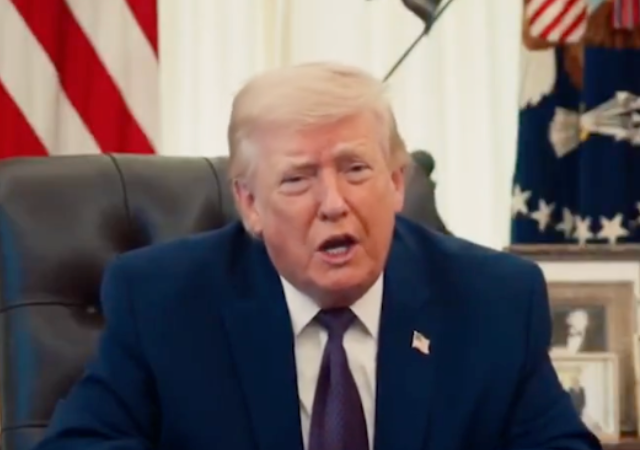
President Donald Trump used his Easter message to do something modern presidential statements often avoid: speak in direct, unmistakably Christian terms while tying those beliefs to the country’s identity and direction.
In a video released on Good Friday, Trump did not dilute the religious meaning of Easter into general language about renewal or unity. He centered the message squarely on the resurrection of Jesus Christ and the core claims of Christianity.
PRESIDENT TRUMP: "I'm proud to join with Christians across the country and around the world to celebrate the most glorious miracle in all of time: The resurrection of our Lord and Savior, Jesus Christ."
"To be a great nation, you must have religion — and you must have God. In… pic.twitter.com/1iIc1SKp4G
— Fox News (@FoxNews) April 4, 2026
“This Holy Week, I’m proud to join with Christians across the country and around the world to celebrate the most glorious miracle in all of time, the resurrection of our Lord and Savior, Jesus Christ.”
Trump moved through foundational elements of the faith, including a direct reference to scripture.
“For God so loved the world that He gave His only Son, for whoever believes in Him should not perish but have eternal life.”
Presidential holiday messages in recent years have tended to broaden religious observances into more general civic language. This message takes a different approach by presenting Easter as a distinctly Christian event.
Trump then extended that framing beyond the holiday itself, connecting religion to the condition of the country in explicit terms.
“As I have often said, to be a great nation, you must have religion, and you must have God.”
That line places religion inside a larger argument about national strength and continuity, suggesting that faith is not peripheral to public life but central to it.
He paired that claim with a broader observation about religious participation, pointing to what he described as a visible shift in church attendance.
“In churches across the nation, on Sunday, the pews will be fuller, younger and more faithful than they have at any time in many, many years.”
Taken together, the message operates less like a ceremonial greeting and more like a statement about the role of religion in American life. It does not frame faith as private or incidental. It treats it as a defining feature of the nation’s past and a necessary part of its future.
Trump closed with a familiar blessing.
“Happy Easter to all. May God bless you. May God bless the United States of America.”
The emphasis is clear. The message places religion back at the center of national life, without qualification.
Donations tax deductible
to the full extent allowed by law.






Comments
The Easter story didn’t make any sense in Sunday School and doesn’t now.
I am sorry that it is beyond your understanding.
What word are you struggling with?
It seems most likely that it’s a mistranslation. Narratively it makes no sense. As Genet said, as a literary critic, it’s written with the assiduous gestures of a philologist, an archeologist or a mythologist bent on dispersing, destroying and crossing out whatever he finds or reconstitutes. A strange assiduousness, distracted from itself.
Points out a fact, abandons the fact and goes on to the next fact, crosses that out, and so forth. No narrative line.
What’s left is the style of the gestures themselves. Which is what making no sense meant.
Did your mystified source mention the New Testament was translated from ancient Greek and then on to English? He could correct any mistranslation he discovered.
He’s commenting on:
So Mary Magdalene ran back until she came to Simon Peter and the other disciple, whom Jesus loved, and said to them: They have taken our Lord from the tomb, and we do not know where they have put him. So Peter and the other disciple came out, and went to the tomb. The two ran together, but the other disciple ran faster than Peter and reached the tomb first, and bent down and looked in and saw the bands lying there, but he did not go inside. Then Simon Peter came, following him, and he went into the tomb; and he saw the bands lying there, and the napkin, which had been on his head lying not with the bands but away from them and folded. You see how he writes his Funeral Rites and the remains: with the assiduous gestures of a philologist, an archeologist, a mythologist bent on dispersing, destroying, crossing out whatever he finds or reconstitutes. The most critical operation. But his assiduousness is strange, as if distracted from itself. He always seems in fact to be assiduous about something else, detached from what he does. He tells you another history, you follow the narrative attentively…
Well of course he’s going to say that because he’s cutting off the section before the most important verses.
Gospel of John, Chapter 20, verse 8 and 9 (NIV) “Finally the other disciple, who had reached the tomb first, also went inside. He saw and believed. (They still did not understand from Scripture that Jesus had to rise from the dead.) ”
John is simply relating the events as they appeared to him at the time since in both his case and in the case of Mary’s initial discovery they did not yet understand that Jesus had risen.
He is risen!
He is Risen Indeed!
I’m going to echo Whitewall: He is risen indeed!!!!
Bravo President Trump! Long over due.
What happened to the Trans Day of Visibility?
John Adams. “Our Constitution was made only for a moral and religious People. It is wholly inadequate to the government of any other.”
James Madison: our Constitution requires “sufficient virtue among men for self-government,” otherwise, “nothing less than the chains of despotism can restrain them from destroying and devouring one another.”