The Advanced Research Projects Agency for Health (ARPA-H), an agency within the U.S. Department of Health and Human Services (HHS), launched a new program called Systematic Targeting Of MicroPlastics (STOMP) to investigate how microplastics affect human bodies.
I don’t know much about microplastics. This is Leslie’s area of expertise, but I’ll do the best I can!
The $144 million program will “create the definitive toolbox for measuring, researching, and affordably removing microplastics and nanoplastics (MNPs) in the human body.”
Microplastics are little plastic particles from broken-down plastic debris.
The tiny particles, less than five millimeters long, can end up in the air and water filtration systems.
Humans mainly consume microplastics by drinking bottled water, but can also ingest these particles through food and air.
HHS wants to understand how these plastics affect the human body since “each plastic works differently.”
“We can’t clear what we can’t measure, and we can’t develop interventions that are precise, safe, and effective for impacts we don’t understand,” HHS wrote in the press release.
HHS Secretary Robert F. Kennedy Jr. said:
We are launching STOMP, which stands for the Systematic Targeting of Microplastics. It’s a $144 million national program to measure, understand, and remove microplastics from the human body. We are focusing on three questions: What is in our bodies, what causes harm, and how do we remove it? And we’re answering them in that order. We will first build and standardize gold-grade tools capable of detecting and quantifying microplastics across tissue and fluids with precision.Next, we will map how microplastics move through the body. How they cross biological barriers like the gut lining or the blood-brain barrier, where they accumulate, and how long they persist.Third, clinically safe strategies to reduce microplastic burden in the body. We will also prioritize those at greatest risk.
According to the press release, studies have found microplastics in lungs, arterial plaques (clogged arteries), and the brain.
“Microplastics are in every organ we look at—in ourselves and in our children. But we don’t know which ones are harmful or how to remove them,” said Alicia Jackson, Ph.D., ARPA-H Director. “Nobody wants unknown particles accumulating in their body. The field is working in the dark. STOMP is turning on the lights.”
The EPA joined forces with HHS to keep our water clean:
At the heart of today’s announcement is EPA’s draft Sixth Contaminant Candidate List (CCL 6), which the agency is releasing for public comment, and is a critical tool under the Safe Drinking Water Act (SDWA) that drives research, funding, and future decisions on regulating emerging threats in public water systems.The draft CCL 6 includes four contaminant groups—microplastics, pharmaceuticals, per- and polyfluoroalkyl substances (PFAS), and disinfection byproducts—as well as 75 chemicals and nine microbes that may be found in drinking water. For the first time in the program’s history, EPA is designating both microplastics and pharmaceuticals as priority contaminant groups—a direct response to the concerns of millions of Americans who have long demanded answers about what they and their families are drinking every day. The CCL helps prioritize funding, research, and information collection to better understand the potential health risks of these substances in drinking water while advancing the agency’s commitment to gold standard science.
“For too long, Americans have vocalized concerns about plastics and pharmaceuticals in their drinking water. That ends today,” said EPA Administrator Lee Zeldin. “By placing microplastics and pharmaceuticals on the Contaminant Candidate List for the first time ever, EPA is sending a clear message: we will follow the science, we will pursue answers, and we will hold ourselves to the highest standards to protect the health of every American family.”
But, once again, how bad are microplastics in America?
China produces the most plastic in the world.
However, the United States produces the most plastic waste, according to a study in 2023:
According to the World Population Review, the US ranks first in the top 10 countries that generate the most plastic waste – producing 34 billion kilograms annually. India comes at second place with 26.3 billion kilograms of plastic waste, followed by China (21.6 billion kilograms), Brazil (10.6 billion kilograms), Indonesia (9.1 billion kilograms), Russia (8.4 billion kilograms), Germany (6.6 billion kilograms), the UK (6.4 billion kilograms), Mexico (5.9 billion kilograms) and Japan (4.8 billion kilograms).
Honestly, I’m not shocked that high-income nations produce the most plastic waste.
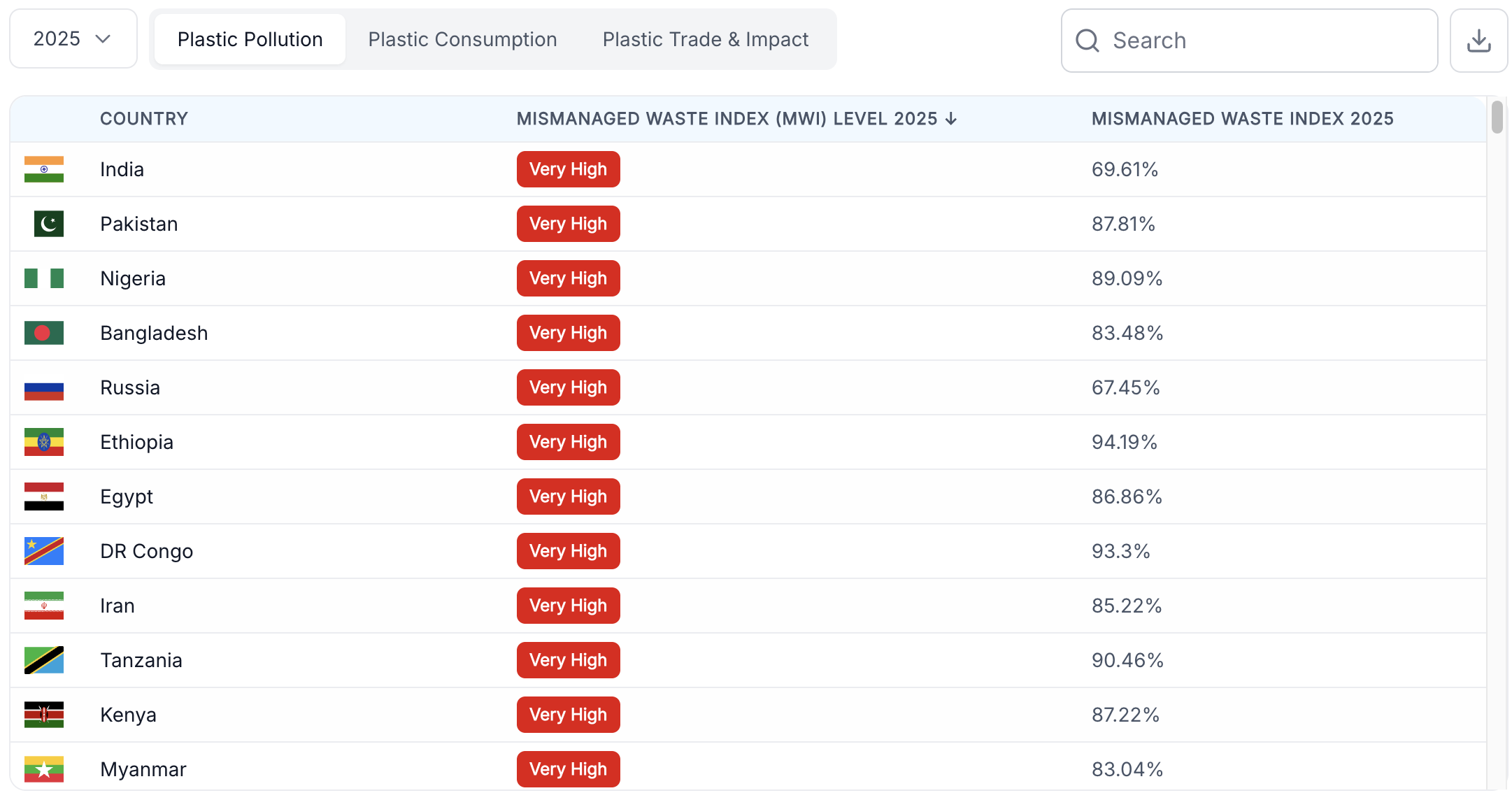
Despite generating the most plastic waste, these countries do not really contribute to plastic pollution. What comes from plastic pollution? Microplastics.
These higher-income nations have better waste management. I found this chart with data from 2025:
CLICK HERE FOR FULL VERSION OF THIS STORY